After My Daughter’s Funeral, My Son-in-Law Said He Wanted to Get Rid of His Own Daughters — But He Had No Idea What My Grandchildren Were About to Reveal
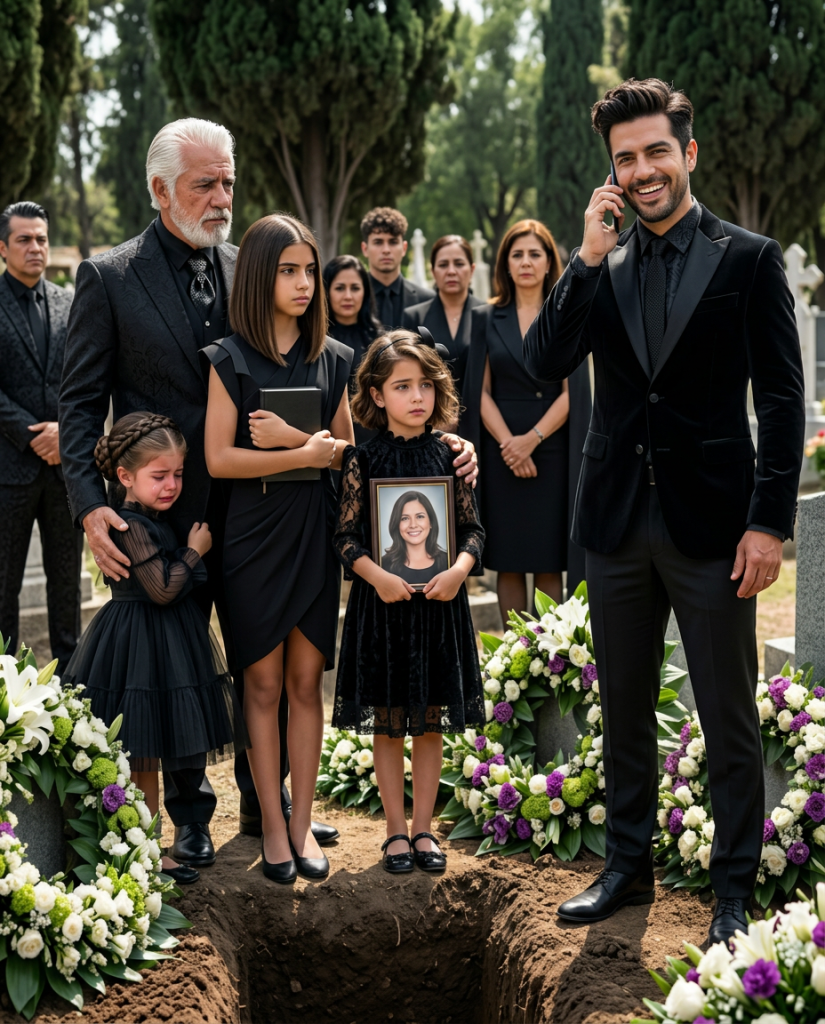
PART 1
“If nobody wants to take responsibility for those girls, I’ll leave them with social services on Monday. I’m not wasting my life raising children from a dead woman.”
That was what my son-in-law said beside my daughter’s grave.
Not privately. Not quietly. Not even with the dignity of a grieving husband.
He said it out loud in the middle of the cemetery in Puebla, while the dirt covering Rosa’s coffin was still fresh and the cheap lilies around her grave still carried their bitter scent. My daughter had just been buried at thirty-five years old, and Arturo was already talking about abandoning his daughters as if they were old belongings he no longer wanted.
I felt something crack inside my chest.
My three granddaughters stood beside me.
Twelve-year-old Lucía held her mother’s photograph tightly against her chest.
Nine-year-old Renata stared into the distance without blinking.
Six-year-old Abril hid behind my black coat, trembling silently.
Arturo looked perfectly composed. Gray suit. Expensive watch. Polished shoes. Not a wrinkle on his face. Not a trace of sorrow in his eyes.
He checked a message on his phone and smirked slightly, like somebody somewhere was waiting to celebrate with him.
“What did you just say?” I asked.
He sighed impatiently, like I was the inconvenience.
“Don Julián, don’t make this harder than it already is. Rosa is gone. I deserve to move on.”
“And your daughters?”
He pointed toward the girls carelessly.
“My new partner isn’t going to raise three girls who barely listen to me anyway. You’re their grandfather. If you care about them so much, take them.”
Several relatives lowered their eyes in shame. My godmother covered her mouth. Even the priest suddenly became very interested in adjusting his robe so he wouldn’t have to witness the scene.
For one second, I wanted to hit Arturo right there in front of everyone.
But Abril squeezed my hand tightly, and I stopped myself.
Lucía didn’t cry.
That frightened me more than anything else.
She looked calmly at her father, then at her sisters. The three girls exchanged a silent understanding that felt far too mature for children their age.
That was when I realized they already knew something.
Something I didn’t.
“From now on, you’re coming home with me,” I told them.
Arturo laughed under his breath.
“Perfect. That’s one less burden for me.”
He didn’t hug his daughters goodbye.
He didn’t kiss their foreheads.
He didn’t ask if they needed clothes, medicine, or anything at all.
He simply turned around and walked toward a white van parked outside the cemetery. Inside, a young woman wearing dark sunglasses waited for him.
That night, I brought my granddaughters home.
I made soup. Heated tortillas. Prepared the room where Rosa used to sleep when she was little.
Renata fell asleep wearing one of her mother’s blouses.
Abril refused to let go of my hand.
Lucía sat silently beside the window for hours.
At three in the morning, she walked quietly into the kitchen.
“Grandpa,” she whispered, “Mom didn’t die just because she was sick.”
My entire body went cold.
“What are you saying?”
Lucía placed a small purple cloth bag on the table.
Inside was an old cellphone, a notebook, and a USB drive.
“Mom told us that if something ever happened to her, we had to give these to someone who still loved her.”
And in that moment, I realized my daughter had left behind much more than memories.
She had left behind the truth.
PART 2
My hands shook as I opened Rosa’s notebook.
Her handwriting appeared neat and delicate at first, exactly the way I remembered it. Grocery lists. Medical appointments. School reminders. Notes about bills and medications.
Then the writing changed.
The letters became tighter. Messier. Nervous.
Like someone writing while afraid of being discovered.
“Arturo says the girls ruined his life.”
“Today he hid my car keys so I couldn’t go to the doctor.”
“They changed my work schedule again. Human Resources said it came from management.”
“Arturo works in Human Resources.”
A chill crawled down my spine.
Rosa and Arturo worked at the same company. She handled administration. He worked in Human Resources, meaning he had control over schedules, leave requests, and internal reports.
I always believed he took care of her.
She often told me she felt exhausted. That her chest hurt. That she couldn’t sleep anymore.
I begged her to stay with me for a while, but she always answered:
“I don’t want my daughters growing up without their father.”
I kept reading.
“They denied my medical leave again.”
“Arturo said if I died, he’d finally feel free.”
“Mariela doesn’t want girls around. Arturo said he would solve that problem.”
I slowly looked up.
“Who’s Mariela?”
Renata answered quietly.
“The woman from the white van.”
Abril started crying.
“Dad called her ‘my love’ even when Mom was nearby.”
Lucía connected the USB drive to my computer.
The folder contained screenshots, emails, audio recordings, and photos of documents.
In one recording, Arturo’s voice cut through the speakers coldly:
“Stop acting dramatic, Rosa. If you’re so miserable, then maybe stop making everyone else miserable too.”
Another recording captured a woman laughing.
“But without the girls, Arturo. I’m not becoming somebody’s stepmother.”
Arturo answered calmly:
“Relax. First I’ll get rid of Rosa. Then I’ll figure out where to dump the little brats.”
Renata covered her ears.
I had to walk outside before I lost control completely.
The dawn smelled of wet dirt and fresh tortillas from a nearby house already preparing breakfast.
I imagined my daughter carrying all that pain alone.
Her tired eyes.
Her trembling hands.
Her final phone call to me.
“Dad… I’m so tired. But I don’t want you to worry.”
The next morning, I brought everything to a lawyer recommended by an old friend.
Her name was Beatriz Salgado.
She reviewed every document carefully without interrupting. When she finally closed the notebook, her expression had changed completely.
“Don Julián,” she said softly, “this changes everything. Custody. Criminal charges. Workplace misconduct. But first, we protect the girls.”
“And Arturo?”
“He must not realize how much evidence we have.”
For weeks, we stayed quiet.
Social services intervened — but not the way Arturo expected.
My granddaughters remained under my care.
The company launched an internal investigation.
The prosecutor’s office accepted the complaint.
And little by little, the truth began moving forward.
Meanwhile, Arturo kept pretending his life was perfect.
He posted romantic dinners online with Mariela. Shared fake grieving messages for sympathy. Two months later, he announced their wedding at an elegant hacienda in Cholula.
“After every storm, God gives us another chance,” he wrote online.
Lucía stared at the post silently.
Then she walked to the wooden cabinet, picked up her mother’s purple notebook, and said:
“Then let’s show God the real story.”
And that was the moment I realized Arturo’s wedding would never happen peacefully.
Because none of us imagined what my granddaughter was about to reveal in front of the altar.