Part 1: A Wealthy Woman Took Every Discounted Turkey—Then Her Father’s Voice Came Over the Store Speakers
A wealthy woman grabbed all thirteen discounted turkeys at our local supermarket while an elderly grandmother begged for just one to feed her sick grandson. “If ten dollars is such a problem, maybe you shouldn’t be buying turkey,” the woman sneered. When I confronted her, she smiled and said, “Remember who my family is.” Two minutes later, an elderly man’s voice came over the store speakers, called her by name, and ordered her to stop. The color drained from her face.
My name is Kara Lindell, and I work as a respiratory therapist at Millbrook General Hospital in Pennsylvania. That Tuesday evening, I’d just finished a twelve-hour shift on the pediatric floor and stopped at ShopRite for milk before heading home.
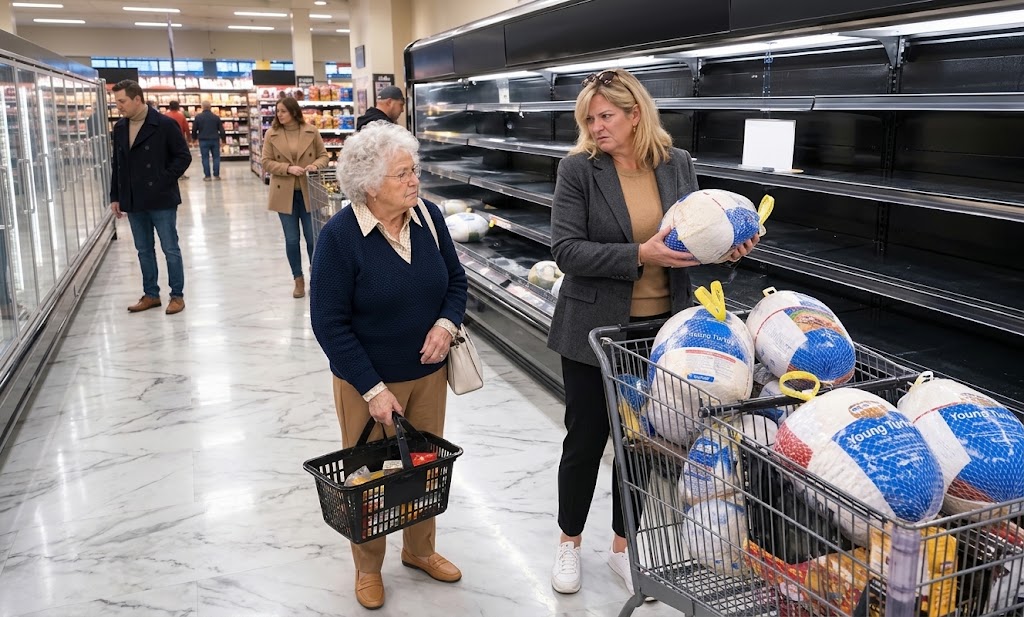
Thanksgiving was only two days away, and the store was crowded with families buying their holiday groceries. Near the refrigerated meat section, a woman in an expensive camel-colored coat was filling her shopping cart with frozen turkeys marked down to $9.99.
I recognized her immediately.
Beatrice Pemberton was the wealthy daughter of Elias Pemberton, whose family owned several car dealerships, commercial buildings, and rental properties throughout Millbrook. Their name was also displayed prominently on a hospital wing where I worked.
Beside Beatrice stood a frail elderly woman wearing a faded blue coat and holding a nearly empty shopping basket.
“Please, ma’am,” the older woman said. “Could you leave just one?”
Beatrice didn’t look at her.
“I got here first.”
The grandmother explained that she was raising her nine-year-old grandson alone. He’d been sick with the flu for several days and barely wanted to eat anything.
“My mother’s turkey soup is the only thing he’ll ask for,” she said. “But I can’t afford the regular turkeys. They’re almost forty dollars.”
Beatrice lifted another discounted turkey into her overflowing cart.
“Then buy chicken.”
“The chicken isn’t on sale either.”
The grandmother reached toward the last turkey remaining in the freezer, but Beatrice quickly grabbed it first.
Thirteen turkeys now filled her cart.
“Please,” the grandmother whispered. “You already have twelve.”
“Thirteen,” Beatrice corrected.
I couldn’t stay silent.
“Are you seriously taking every single one?”
Beatrice looked at my hospital scrubs and gave me a dismissive smile.
“Absolutely. Is there a problem?”
“She’s asking for one turkey to make soup for her sick grandson.”
“Then perhaps she should manage her money better.”
The grandmother opened her worn purse and pulled out a carefully folded ten-dollar bill.
“I can pay you right now,” she offered. “Please. My grandson hasn’t eaten properly in two days.”
Beatrice laughed.
“If ten dollars is this difficult for you, turkey soup shouldn’t be your priority.”
Several shoppers stopped and stared.
The grandmother slowly lowered her hand, visibly embarrassed.
Beatrice pushed her heavy cart toward the checkout lanes.
“That’s not my problem,” she announced.
Then she glanced back at the people watching.
“And before anyone decides to make a scene, remember who my family is.”
Her expensive heels clicked against the floor as she struggled to push the overloaded cart around the corner.
Suddenly, the supermarket speakers crackled.
“Attention, shoppers.”
It was an elderly man’s voice, deep and unmistakably stern.
“Beatrice.”
She stopped so abruptly that her cart struck a display of stuffing boxes.
The man’s voice continued.
“You just told everyone in aisle six to remember who your family is.”
Beatrice’s fingers tightened around the cart handle.
“Oh, no,” she whispered.
The speaker crackled again.
“That’s actually a very good idea.”
Her face turned completely pale.
Then came an instruction that made every shopper nearby turn toward the front of the store.
“Stay exactly where you are, Beatrice.”
“Why?” she demanded, her voice trembling.
The man answered calmly.
“Because I’d hate for you to miss what happens next.”
A moment later, an elderly man carrying a carved wooden cane appeared beside the store manager. He walked straight toward Beatrice, glanced at her cart full of turkeys, and then looked at the grandmother still holding her ten-dollar bill.
His expression changed.
He removed his cap and stared at the older woman.
“Hattie?”
The grandmother looked up, her eyes widening.
“Eli?”
And suddenly, I realized the man standing before us was Elias Pemberton himself—Beatrice’s father, and one of the wealthiest men in town.
But the way he was looking at that grandmother told me there was a history between them that nobody in the store could have imagined.
Part 2: The Millionaire Recognized the Poor Grandmother—Then Revealed the Secret Behind His Fortune
Elias Pemberton stood in the supermarket aisle, staring at the elderly grandmother his daughter had just humiliated. His hand trembled around his wooden cane as he removed his cap.
“Hattie Gaines?”
The grandmother pressed one hand against her mouth.
“Eli Pemberton. Good heavens, is that really you?”
Everyone nearby fell silent.
Beatrice looked between them, confused.
“Daddy, you know this woman?”
Elias didn’t answer immediately. Instead, he approached Hattie and looked at the faded blue coat she wore and the ten-dollar bill still folded in her hand.
“How long has it been?” he asked.
“Fifty-four years,” Hattie whispered. “Since Lula’s Diner closed.”
Elias closed his eyes briefly.
“Fifty-four years, and you still remember.”
He turned toward his daughter.
“Beatrice, come here.”
“Daddy, please. People are watching.”
“Then perhaps they’ll learn something worth remembering.”
Beatrice reluctantly walked toward him, her expensive heels clicking against the supermarket floor.
Elias pointed toward Hattie.
“Do you know who this woman is?”
“No.”
“She’s the reason our family has everything it owns today.”
Beatrice frowned.
“What are you talking about?”
Elias turned toward the shoppers gathered around them.
“In 1970, I returned from Vietnam with four hundred dollars, no family, and nowhere to live. I rented a gravel lot outside Millbrook and bought three broken-down cars, hoping I could repair them and start a business.”
He paused, looking toward Hattie.
“That winter, I lived in a freezing trailer behind the lot. I couldn’t afford an apartment, and some days I barely had enough money to eat.”
Every evening, Elias explained, he visited Lula’s Diner and ordered the cheapest soup on the menu. A young waitress named Hattie always brought him homemade turkey soup instead.
“I told her I couldn’t afford it,” Elias continued. “She insisted it cost the same thirty-five cents.”
Hattie’s eyes filled with tears.
“Your hands were always shaking from the cold, Eli.”
Elias nodded.
“What I didn’t know was that she cooked that soup herself and carried it to work in a mason jar.”
Then his voice became unsteady.
“One night, I became terribly ill. I had pneumonia, although I didn’t know it. I was lying alone in that trailer, too weak to get up.”
When Elias failed to appear at the diner, Hattie became worried. After finishing her shift, she walked two miles through the snow to check on him.
“She found me barely conscious,” Elias said. “She fed me soup, found someone to take me to the hospital, and visited every day until I recovered.”
He looked directly at Beatrice.
“The doctors told me another night alone in that trailer could have killed me.”
Beatrice’s expression changed.
“Daddy, I never knew.”
“You did,” Elias replied quietly. “I’ve told you that story since you were a little girl. You simply never listened.”
He gestured toward the supermarket aisle.
“After I recovered, I sold my first car. Then another. Eventually, I opened the dealerships that paid for our house, our properties, and the hospital wing.”
His eyes returned to Hattie.
“Everything began because a young waitress cared enough to help a stranger who had nothing.”
Hattie wiped her cheeks.
“I only did what my mother taught me.”
Elias reached for her hand.
“I searched for you after the diner closed. Nobody knew where you’d gone.”
“I married and moved away,” Hattie explained. “When I returned to Millbrook, I saw your name everywhere. I didn’t want you thinking I’d come looking for money.”
Elias shook his head.
“You gave me something money couldn’t buy.”
Then he faced his daughter.
“Now tell me why you have thirteen turkeys in your cart.”
Beatrice hesitated.
“They’re for the foundation’s Thanksgiving charity drive.”
Elias stared at her.
“You took every discounted turkey away from families who needed them so you could give them away at a charity event?”
“The newspaper is covering the event,” Beatrice admitted. “And our budget was tight after the gala.”