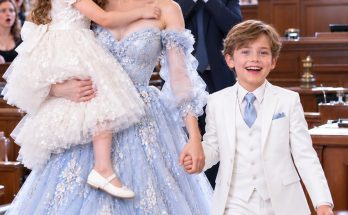
Julian Vance smiled when his attorney told the judge I was an unfit mother. He sat across the courtroom wearing the gray suit from our wedding, with his hands neatly folded and his expression calm enough to suggest he was discussing a business arrangement rather than asking to take our daughter away.
I recognized a small repair near his left cuff. My mother had sewn it after the jacket caught on a wooden chair during our reception. Ten years had passed, and somehow that little stitch was still there.
I wondered whether he remembered who had made it.
Then his lawyer mentioned our six-year-old daughter, Maya, and I stopped thinking about the past.
"Mr. Vance is requesting primary and sole physical custody," attorney Delaney Price told Judge Elena Mercer. "He believes the child faces an unacceptable risk if she remains in her mother's care."
My attorney, Naomi Reed, touched my arm beneath the table.
"Let her finish," she whispered.
I pressed my lips together.
Julian was asking for much more than a divorce. His petition sought exclusive possession of our home, control of our joint savings, and the authority to make every important decision about Maya's future.
He wanted the judge to believe I could not manage money, maintain a stable household, or care for our daughter without supervision.
Five weeks earlier, I would have laughed at such accusations.
Now I was sitting in a courtroom wondering whether my little girl would be sleeping in her own bed that night.
Maya's room was at the end of our upstairs hallway. She had picked the pale green paint herself, after changing her mind four times in the hardware store.
Her dresser had mismatched purple handles. Her drawings covered the closet door. Every night she arranged three stuffed animals beneath her blanket, then complained that Button, her rabbit, needed more room.
I knew the precise way her hair curled behind her right ear when she slept.
Julian knew those things too.
That was what made everything so difficult to understand.
Our marriage had not always been unhappy.
We met when I was twenty-six, working at the circulation desk of a public library. Julian was helping renovate the building's community room. He came in every afternoon with sawdust on his boots and borrowed books he rarely finished.
The first time he asked me to dinner, he admitted he had been renewing the same mystery novel for six weeks because he wanted an excuse to see me.
I thought it was charming.
Perhaps it was.
For years, Julian could be genuinely kind. When my father died, he drove me to the hospital without asking questions. When I was sick, he brought tea to bed. Before Maya was born, he spent an entire Saturday assembling a crib, then took it apart because one rail was slightly crooked.
Those memories were real.
So were the things that came afterward.
Julian eventually started his own home-renovation business. The first few years were difficult, but he worked hard, and I helped wherever I could.
I managed invoices on weekends and organized receipts while he visited job sites. When his first employee quit unexpectedly, I answered customer calls from the library's parking lot during my lunch breaks.
We bought our house after three years of marriage.
The kitchen needed new cabinets. One upstairs bathroom leaked. The backyard was mostly weeds.
We loved it anyway.
Julian promised that one day he would build a porch large enough for summer dinners.
Instead, he built a business that eventually seemed to require every hour of his attention.
At first, the changes were ordinary.
He came home later. He answered emails during meals. He stopped joining us for Sunday walks.
Then he began speaking about our money as though it belonged to him alone.
If I bought Maya new shoes, he wanted to see the receipt.
If I replaced a broken appliance, he questioned why I had not waited for a sale.
He once spent forty minutes criticizing a grocery bill because I had bought two different kinds of breakfast cereal.
Yet he continued purchasing expensive equipment for his business without discussing it with me.
Whenever I asked about those expenses, he said I did not understand what it took to earn money.
I had worked steadily throughout our marriage, although I reduced my hours after Maya was born. I knew our household budget better than anyone.
What I did not know was how much of our savings Julian had begun moving into accounts I could no longer see online.
By the time I discovered the problem, he had already decided to leave.
It happened on a Thursday evening.
I was drying dishes when he walked into the kitchen carrying a manila envelope.
"I think we should stop pretending this is working," he said.
I thought he meant our latest argument about money.
"We can talk after Maya goes to bed."
"There isn't anything left to discuss."
He placed the envelope beside the fruit bowl.
Inside were divorce papers.
I remember noticing that a corner of the envelope had become wet from the dishcloth in my hand.
It was an absurd detail, but I stared at it because everything else seemed impossible.
"You're filing for divorce?"
"I've already filed."
I looked toward the hallway to make sure Maya could not hear.
Julian had always been careful about appearing reasonable. Even when he was angry, he rarely raised his voice. He preferred a slow, disappointed tone that made it sound as though I had forced him into whatever decision he was making.
That night was no different.
He said our marriage had become unhealthy.
He said I was emotional.
He said Maya needed consistency.
Then he told me he intended to ask for custody.
I almost dropped the papers.
"She's six, Julian."
"I'm aware of how old our daughter is."
"You're away from home most evenings. I take her to school, pick her up, help with homework, arrange her appointments—"
"That's what you'll tell yourself."
I stared at him.
"What is that supposed to mean?"
"It means I've been documenting things."
He walked away before I could ask what things.
That night I sat on the edge of Maya's bed long after she fell asleep.
She had a book open on her chest. Her little finger rested beside an illustration of a fox in a yellow coat.
I removed the book, tucked her blanket around her shoulders, and stayed there until my legs went numb.
The next morning I called Naomi Reed.
A friend from the library had recommended her. Naomi was a family-law attorney in her early fifties, with closely cropped silver hair and a habit of listening without interrupting.
I brought the divorce petition to her office in a paper grocery bag because I could not find a proper folder.
She read every page.
Then she asked, "Has your husband ever claimed you were dangerous to your daughter before this?"
"No."
"Has anyone at school raised concerns?"
"No."
"Any involvement with child protective services?"
"Never."
She wrote something in her notebook.
"What about the financial allegations?"
I explained that Julian had handled most of the business accounts but that we both contributed to the household.
I also told her about the savings.
Three days after receiving the petition, I had tried to transfer money from our joint account to pay the mortgage. The balance displayed on my phone was far lower than I expected.
When I attempted to check the transaction history, my online access no longer worked.
At the bank, a teller confirmed that I remained a joint account holder. She helped me obtain statements, which showed several large transfers to an account associated with Julian's business.
The total was more than eighty thousand dollars.
I brought the statements to Naomi.
She studied them for a long time.
"Did you authorize these transfers?"
"No."
"Did he tell you about them?"
"No."
"Then we'll need complete records. Don't assume the money is gone forever, but we need to establish exactly where it went."
I wanted her to sound more certain.
Instead, she gave me a list of things to gather: pay statements, mortgage records, school correspondence, medical appointments, text messages, and anything relevant to Maya's daily care.
I spent the next four nights searching through drawers and downloading records.
I found birthday invitations, dental bills, insurance forms, and school photographs.
I found the receipt for Maya's first bicycle.
I found an old note Julian had left on our refrigerator when Maya was a baby.
You two are my whole world, it said.
I sat at the kitchen table holding that note until the clock struck midnight.
Then I placed it back in the drawer.
The divorce was painful enough.
The custody allegations were worse.
Julian claimed I had become unpredictable after financial disagreements. He described my tears during arguments as emotional instability.
He wrote that I frequently forgot household responsibilities, even though the examples included a missed recycling collection and one late electricity payment during a billing-system change.
He accused me of excessive personal spending while omitting the transfers from our joint savings.
Most disturbing was a statement claiming that I had left Maya alone at home while I went shopping.
When Naomi asked about it, I knew exactly which afternoon Julian meant.
Maya had been sick.
She came home from school pale and unusually quiet. By late afternoon her temperature had risen, and I had spoken with the pediatric clinic.
A prescription was sent to the pharmacy.
Julian arrived home early while I was looking for my car keys.
"I'll go," I told him. "You can stay with Maya."
He stood by the kitchen sink drying his hands.
"Fine."
"Are you sure? I can call the pharmacy and ask them to hold it."
"Clara, she's my daughter too. I can sit with her for half an hour."
I remembered the irritation in his voice.
I remembered Maya sitting at the table in a yellow sweater, arranging plastic horses beside her coloring book.
Before leaving, I kissed her forehead.
"Be right back, sweetheart."
Julian was standing less than six feet away.
During the drive, he sent me two messages.
One asked whether the medicine came in strawberry flavor.
The other reminded me to buy tissues.
I replied to both.
At the pharmacy, I stood in line behind a man buying bandages and an older woman arguing politely about an insurance card.
The prescription took longer than expected.
When I returned home, Julian was putting away dishes.
Maya was on the sofa watching a cartoon.
I asked how she had been.
"Fine," Julian said.
"Did her temperature go up?"
"No. Everything's fine."
He took the pharmacy bag from my hand and placed it on the counter.
I never imagined that afternoon would become the foundation of his custody case.
At the temporary hearing, I learned how thoroughly he had prepared his version.
Delaney Price introduced a series of photographs showing unfolded laundry, dishes in the sink, and toys on the living room floor.
The pictures had been taken on ordinary evenings after dinner.
In one, Maya's craft supplies covered the table.
Julian's lawyer described it as evidence of an unsafe home environment.
I wanted to stand up and explain that Maya had been making paper flowers for her teacher.
Naomi's hand settled briefly on my wrist.
She had already prepared our response.
The judge listened to both sides.
Judge Mercer was a woman in her sixties with dark-framed glasses and an expression that gave little away.
She asked precise questions.
When Julian's lawyer mentioned financial irresponsibility, the judge wanted the underlying records.
When she mentioned instability, the judge asked whether any medical or professional assessment supported the allegation.
There was none.
Delaney Price said her client had firsthand knowledge.
Judge Mercer made a note.
Then the attorney introduced the kitchen footage.
"My client installed a security system to protect his family," she explained. "One recording captured a particularly troubling incident."
A monitor turned toward the bench.
I recognized our driveway.
The first segment showed me leaving the house with my handbag and getting into my car.
The image then shifted to our kitchen.
Maya sat at the table.
She was wearing her yellow sweater.
An amber medicine bottle rested nearby.
Her face was wet, and she seemed to be crying.
Another section showed the kitchen later, apparently with no adult present.
According to the timestamp presented with the footage, Maya had remained alone for nearly an hour.
I felt cold.
I knew I had never left her unattended.
I knew Julian had been home.
But the pictures were our kitchen, our daughter, and our furniture.
They looked convincing because so much of what appeared on screen was real.
Only the meaning was false.
"That isn't what happened," I whispered.
Naomi leaned toward me.
"Tell me exactly what you recognize."
"The day she had a fever. I went to the pharmacy because he told me to. He stayed with her."
"Was that bottle on the table when you left?"
I tried to remember.
"No. I don't think so."
"Take your time."
"The prescription wasn't even in the house yet. That's why I went out."
Naomi looked toward the monitor.
"Is that the bottle you collected?"
"I can't read the label from here."
She made a note.
I watched the video again in my mind.
Maya's yellow sweater. Her plastic horses. The strange position of the medicine bottle. The little girl's frightened expression.
Something had happened in that kitchen after I left.
I had no idea what.
Naomi rose.
"Your Honor, we dispute both the characterization and completeness of this recording."
Judge Mercer turned to Delaney Price.
"Do you have the original file?"
"We have the relevant excerpts provided by my client."
"That was not my question."
Delaney straightened her papers.
"We can arrange production of the source material."
"Please do. I also want clarification regarding these timestamps. The footage appears to contain separate segments."
Julian shifted in his chair.
Until that moment he had barely moved.
Now he looked toward the courtroom clock.
I recognized his expression.
It was the one he wore when a customer asked for paperwork he had not expected to produce.
Before Naomi could continue, I felt a gentle tug at my sleeve.
Maya was beside me.
The court had arranged for a child specialist to accompany her because the judge intended to meet her privately after the preliminary proceedings.
I had objected to having her anywhere near our dispute.
Naomi explained that the judge could assess whether any child interview was appropriate without making Maya choose between us.
Maya had been sitting quietly with her stuffed rabbit.
I thought she wanted water.
Instead, she rose from her chair.
"Your Honor?"
Her voice was so small that I barely heard it.
Judge Mercer looked over her glasses.
"Yes, Maya?"
"Can I show you something Mom doesn't know about?"
Every part of me wanted to protect her from what was happening.
I reached toward her.
"Sweetheart, you don't need to talk about anything."
Maya looked at me.
"I know, Mommy."
Then she turned back toward the judge.
"I made a movie."
Judge Mercer did not immediately ask to see it.
She looked at the child specialist, then at Naomi and Delaney Price.
"Maya, nobody is going to be upset with you for having a question," she said. "But you should know that deciding these matters is the adults' job. Do you understand?"
Maya nodded.
"Is there something you want us to know without feeling that you have to choose a parent?"
"Yes."
"What is it?"
"My tablet has a movie from the day Mommy went to get my medicine."
Julian's chair scraped sharply against the floor.
"That's not relevant," he said.
His attorney touched his sleeve.
"Julian. Sit down."
He remained standing for another second.
Then he lowered himself slowly into the chair.
Maya reached into her backpack.
She removed an old blue tablet with a cracked corner and a silver star sticker on the case.
I knew the tablet.
Julian had bought it for her birthday the year before. She loved making videos with her plastic animals and recording herself singing songs she learned at school.
The cracked screen had made Julian declare it useless.
Maya disagreed.
She called it her movie machine.
I had watched dozens of her recordings.
Most showed the ceiling, her shoes, or Button falling dramatically from a pillow.
I had never seen the one she was holding.
Judge Mercer ordered a recess.
The child specialist took Maya to a quiet room while both lawyers arranged a supervised review of the file.
The recording was copied for the court without altering the original tablet. The attorneys discussed whether it could be viewed provisionally, subject to later verification of its origin and completeness.
I sat beside Naomi, feeling as though the air had been removed from the room.
"What could she have recorded?" I asked.
"I don't know yet."
"Julian looked frightened."
"I noticed."
"Does that mean—"
"It means we should examine the recording carefully before deciding what it proves."
I watched Julian speaking urgently to his lawyer across the room.
Delaney Price listened without expression.
Then she said something that made him turn away.
I had spent years trying to understand the meanings behind Julian's silences.
This time I could not.
When the hearing resumed, the judge restricted access to the child-related recording and stated that the court would not treat the video as authenticated merely because it appeared on the screen.
Both attorneys had an opportunity to review it.
Maya returned briefly with the child specialist, holding Button against her chest.
Judge Mercer reassured her that she would not be expected to explain the video in front of the adults.
Then the monitor came on.
The first image was sideways.
I saw the leg of our kitchen table and a pile of plastic horses.
The camera tilted as something bumped against it.
Maya's voice said, "The white horse goes first."
I recognized her favorite game.
She had been making a story about animals crossing a river.
The picture showed a strip of kitchen floor, the bottom of a chair, and the edge of the cupboard.
Then a man's shadow crossed the tiles.
Julian entered the frame.
He was wearing the green sweater I had given him for his birthday.
His square watch flashed beneath the kitchen light.
I had repaired its scratched clasp myself after it caught on a cabinet.
There was no possibility that I had mistaken him for someone else.
He picked up Maya's yellow sweater from the back of a chair and placed it nearby.
Then he reached toward the counter.
"Put it there," he said.
Maya answered, "Where?"
"No, closer to the table."
A small amber prescription bottle appeared in his hand.
I recognized it suddenly.
The cap had a faded red mark.
Months earlier, I had placed that empty bottle inside a kitchen drawer because Maya liked using clean, empty containers in her pretend doctor's office.
It was an old prescription bottle.
Not the medicine I had collected that afternoon.
Julian set it beside Maya's coloring book.
I leaned forward.
The video continued.
"Daddy, that's my doctor's bottle," Maya said.
"I know."
"Can I play with my horses?"
"In a minute."
Julian moved the bottle closer to the edge of the table.
He turned toward the security camera mounted near the kitchen doorway.
Then he adjusted its angle.
I could see his arm reaching upward.
The image shook slightly as Maya retrieved a fallen horse.
"Can I stop now?" she asked.
"Not yet."
Julian stepped back.
"Listen carefully, sweetheart. I need you to sit here until I tell you to move."
"Why?"
"Because we're making something important."
"What kind of something?"
He hesitated.
"Something that will help Daddy."
Maya's small voice sounded puzzled.
"Like a present?"
"Something like that."
He crouched beside her.
"Do you remember when Mommy went away?"
"She went to get my medicine."
"Yes. And you were alone."
"No, I wasn't."
He looked toward the doorway.
"Maya, listen."
There was a pause.
"You were sitting right here without Mommy."
"But you were here."
Julian sighed.
"That's not what I'm asking."
I heard somebody move a chair behind me.
Nobody spoke.
On the screen, Julian pointed toward the medicine bottle.
"When somebody asks you what happened, you need to say Mommy left you beside the medicine, and you were frightened."
Maya looked at him.
"But I wasn't frightened."
"Then pretend for the picture."
"Why?"
"Because grown-ups sometimes need to see things a certain way."
I stared at the screen.
Julian was not merely asking Maya to remember an event differently.
He was telling her to perform it.
He wanted a frightened child on camera.
Our child.
Maya's recorded voice grew quieter.
"Will Mommy be mad?"
"No."
"Will she come back?"
Julian did not answer immediately.
Then he said, "That depends on whether you help me."
I heard Naomi draw a sharp breath.
Julian glanced toward his lawyer.
Delaney Price was looking directly at the monitor.
The recording continued.
Maya had picked up Button from the chair beside her.
Julian reached toward the rabbit.
"Put that down. It isn't part of the picture."
"I want him."
"You can have him afterward."
Maya began to cry.
It was not loud.
It was the helpless, uneven crying of a tired six-year-old who did not understand why her father was upset with her.
Julian stood.
"Good. Just stay like that."
I covered my mouth.
In the earlier footage, I had seen Maya crying at the table and believed she must have been frightened by something I could not explain.
Now I understood why she had tears on her face.
Julian had made her cry.
Then he recorded it.
The judge did not move.
Delaney Price leaned toward her microphone.
"Your Honor, I ask that this be paused while we confirm the full context and technical provenance."
Naomi stood.
"We agree on the need for verification. We also request that every device and original recording associated with this incident be preserved."
Judge Mercer nodded.
"Both requests are appropriate."
She turned toward Julian.
"Mr. Vance, you will not delete, alter, or dispose of any recording, device, or account data relevant to this incident. Do you understand?"
"Yes, Your Honor."
His voice was barely audible.
The judge looked toward the child specialist.
"Maya should not be required to remain here for the remainder of this discussion."
The specialist guided Maya toward the door.
Before leaving, Maya turned toward me.
"Mommy?"
"Yes, sweetheart?"
"Did I do something bad?"
My heart seemed to stop.
"No."
I answered too quickly, my voice breaking.
I tried again.
"No, honey. You haven't done anything wrong."
She looked at the judge.
"Am I in trouble?"
Judge Mercer leaned forward.
"Absolutely not. You were very brave to tell us there was something you wanted us to know. Now the adults will take care of the rest."
Maya nodded.
She walked out holding Button by one ear.
I watched until the door closed.
Only then did I realize that I was crying.
Naomi passed me a tissue.
I could hardly hold it.
For weeks, Julian had told people that my emotions made me unreliable.
He had turned ordinary sadness into evidence of instability.
I had practiced staying calm because I feared that any tears would be used against me.
But there are moments when a mother cannot watch her child's pain without showing her own.
I wiped my face and straightened in my chair.
Naomi stood again.
"Your Honor, we have additional records directly contradicting the allegation that Mrs. Vance abandoned her daughter."
She handed the clerk a printed copy of my messages.
The first showed Julian telling me to collect Maya's prescription while he remained home.
The next showed his question about strawberry flavor.
Another reminded me to buy tissues.
All were sent during the period his video suggested Maya was unattended.
Delaney Price studied them.
She turned toward Julian.
"Did you send these messages?"
He nodded reluctantly.
"Yes."
"While your wife was at the pharmacy?"
"Yes."
Naomi continued.
"Mrs. Vance also has the pharmacy receipt. We have requested the transaction record from the pharmacy, and the security camera's original recordings are subject to preservation."
Judge Mercer reviewed the messages.
She said nothing for several moments.
Then she addressed Julian.
"Your petition alleges that your wife left your daughter without adult supervision during this interval."
"That's what I believed happened."
"But you were in the house."
"I stepped outside briefly."
Naomi glanced at me.
The judge continued.
"Your daughter has now produced a recording apparently showing you directing her behavior while your wife was away. Do you dispute that you were the adult speaking in it?"
Julian looked toward his attorney.
Delaney said, "My client acknowledges that his voice appears to be on the recording. He reserves his position regarding its context and completeness."
"Very well," Judge Mercer replied. "The court will not make final determinations about this evidence today."
I understood why she said it.
A single recording, however compelling, still had to be examined properly.
But I also understood something else.
The judge was no longer looking at my husband's allegations as established facts.
She was looking at them as claims requiring proof.
That difference mattered more than I could have imagined.
The judge directed both parties to preserve their electronic records. She scheduled an expedited continuation of the hearing and ordered production of the source security footage and related financial information.
For the time being, she maintained Maya's residence with me and restricted any unilateral changes to the child's school or living arrangements.
A child specialist would assess what contact arrangements were appropriate while the video was examined.
Julian's attorney asked for clarification.
"Your Honor, my client has not been found to have engaged in misconduct."
"Correct," the judge said. "These are temporary safeguards while contested evidence is reviewed."
Her voice remained measured.
"The child's stability is the immediate priority."
I held onto those words.
Maya's stability.
Not Julian's reputation.
Not the story he had prepared.
Not even my desire to prove him wrong.
Our daughter's well-being.
When the court recessed, Julian approached our table.
Naomi stepped slightly in front of me.
Julian looked past her.
"Clara, we need to talk."
"Through counsel," Naomi said.
"This is a family matter."
"It is also pending litigation."
His jaw tightened.
I remembered how often he had used the words family matter when he wanted me to keep something private.
A disputed bank charge.
An argument that ended with me apologizing.
A decision about money he had already made.
This time I remained seated.
Julian lowered his voice.
"You don't understand what that recording is going to do."
I looked at him.
"What did you think your recording would do?"
He did not answer.
Naomi asked him to return to his attorney.
For a moment, I thought he might refuse.
Then he walked away.
I watched the gray suit disappear through the courtroom door.
Ten years earlier, he had worn it while promising to protect our family.
Now he had worn it while trying to convince a judge that our daughter's tears were evidence against me.
I felt a grief so heavy that I had to put both hands on the table.
Naomi gave me a few minutes.
Then she opened her briefcase.
"There's another issue we need to discuss."
I looked up.
"The video?"
"The financial records."
She placed the bank statements between us.
Several transfers were highlighted.
Julian had moved money from our joint savings into an account associated with his renovation business.
The transfers began months before he filed for divorce.
I had noticed the missing money only after the petition.
But Naomi had noticed something I had overlooked.
"Look at the timing," she said.
The earliest transfers occurred during the same period Julian began documenting my supposed failures as a wife and mother.
The photographs of laundry.
The complaints about grocery bills.
The accusations that I was too emotional to manage our finances.
All of it had started while he was withdrawing money from the accounts we had built together.
"Do you think he planned this?" I asked.
Naomi did not rush to answer.
"I think we need to establish where the money went and why he omitted these transfers from the financial picture he presented."
She slid a document toward me.
It was a copy of the financial summary Julian had submitted with his custody request.
Beside a list of household expenses was a note attributing financial hardship to my alleged irresponsible spending.
I recognized the amounts.
Several matched the money that had disappeared from our savings.
I looked at Naomi.
"He blamed me for money he moved himself."
"That's what the records suggest. We need the receiving-account documents before we can establish the full picture."
I thought about all the nights I had sat at the kitchen table, wondering whether I had somehow failed our family.
Julian had encouraged that belief.
He had watched me search for explanations while withholding the information that might have answered my questions.
Outside the courtroom, I heard Maya laughing with the child specialist.
The sound was brief and bright.
I turned toward the door.
For a moment, I wanted nothing except to take her home, make her dinner, and let the world leave us alone.
But the case was not over.
The court had seen part of what happened in our kitchen.
We still had to prove the recording was genuine, trace our savings, and answer the accusations Julian had built into his petition.
Naomi gathered her papers.
"Clara, your husband came here expecting you to defend yourself against his version of events."
I looked at the highlighted transfers.
"And now?"
"Now we're going to follow the evidence."
I placed the statements into my folder.
For the first time since Julian handed me the divorce papers, I understood that defending myself would not be enough.
I needed to find out what he had done before he ever walked into that courtroom.
That evening, Maya asked whether the judge was going to send me away.
I had just finished washing her hair. She sat on a folded towel at the foot of her bed while I worked a comb through the damp tangles.
"Why would you think that, sweetheart?"
She looked down at Button.
"Daddy said judges decide where people belong."
I stopped combing.
"Sometimes judges help families make decisions when grown-ups can't agree."
"Like when you and Daddy disagree?"
"Yes."
She picked at a loose thread on her pajama sleeve.
"Does that mean one of you has to go away forever?"
I set the comb on her dresser.
Then I sat beside her.
"No. You have two parents who love you. And whatever happens between us, you don't have to earn our love or choose which one you deserve."
She considered that.
"Even if somebody makes a mistake?"
"Even then."
She leaned against my shoulder.
For several minutes, neither of us spoke.
I wanted to ask her a hundred questions about the recording. How long had she kept it? Had Julian told her not to show anyone? Was there something else he had asked her to do?
But Naomi had warned me against questioning Maya about the evidence.
Our daughter needed to know that she was safe, not that her memories had suddenly become another responsibility.
If she wanted to talk, I could listen. If she seemed frightened, I could comfort her.
The investigation belonged to the adults.
So I pulled the blanket over her legs and asked whether she wanted the fox book or the one about the bear who hated bedtime.
"The bear," she said.
I read it twice.
Halfway through the second reading, she fell asleep with her fingers around Button's ear.
I stayed until the little lamp beside her bed began to feel warm against my arm.
Then I went downstairs.
Our kitchen looked exactly as it had that morning.
The same wooden table stood beneath the window. The same refrigerator hummed. A dish towel hung over the oven handle.
Yet I could no longer look at the room without seeing Julian placing that old medicine bottle beside our daughter.
He had chosen this familiar place because he knew how convincing it would look.
A messy table.
A tired child.
An apparently absent mother.
Everything ordinary, until he removed the truth around it.
I opened the drawer where I kept Maya's craft supplies.
The old prescription bottle was gone.
I remembered washing it, removing the medication, and giving it to Maya months earlier for her pretend doctor's office.
There had been a little red mark on the cap from a marker she used to decorate her toy medical kit.
I checked the drawer again, even though I knew it would not be there.
Julian had taken it.
The thought made my stomach tighten.
I had spent weeks doubting the accuracy of my own memories.
He had created a false account of that afternoon using objects from our everyday life, and I had almost believed the confusion meant something was wrong with me.
I closed the drawer.
Then I opened the folder Naomi had given me.
At the top was a list of documents we needed to obtain.
The first concerned the video.
The second concerned the money.
The third was a single sentence Naomi had underlined.