Inside lay a bundle of envelopes tied with a ribbon, every one addressed to him in Delia’s neat teacher’s handwriting. Beneath them was a padded courier envelope, still sealed.
Marguerite appeared in the doorway. For the first time in his life, she looked her age.
“Don’t,” she said quietly.
Weston tore it open.
Inside was a small hospital bracelet, the kind they put on newborns, labeled Baby A Rowe. Beneath it lay a single folded sheet.
Weston,
I know you told me to disappear, and I will. But I won’t let you hear about this from a stranger. The doctors say I’m carrying twins. Girls. I’m scared, and I’m doing it alone, and I would give anything for you to be the man I thought you were when we met.
If you want to be their father, call me. If you don’t, I’ll understand, and I’ll never ask again.
I named the first one Josephine, after my grandmother. The second I haven’t decided. Maybe you’d like to help.
Delia
The paper shook in his hands. He read it twice. Then he read the last line a third time.
She had left the second name open for him.
“She was going to let me name our daughter,” he whispered.
Marguerite said nothing.
“And you put it in a drawer.”
PART 6
There was one more envelope at the bottom of the drawer, older than the others, yellowed at the edges.
It wasn’t from Delia.
It was addressed to Weston in his father’s handwriting. Richard Hale had died when Weston was twenty-six. Weston turned it over. The seal had never been broken.
“Your father left it with his lawyer,” Marguerite said, her voice thin. “It was to be given to you on your thirtieth birthday. I told the lawyer you’d already received it.”
“You lied about my father’s letter?”
“I read it,” she said. “I knew what it would do.”
He opened it with fingers that no longer felt like his own.
Weston,
If you’re reading this, I’m gone, and your mother has probably done her best to keep you from the one thing I wanted you to know. I made my fortune by being hard. I lost my brother, my friends, and nearly my wife that way. Don’t repeat it.
When you find someone who loves you for who you are rather than what you own, don’t let anyone, including me, including your mother, talk you out of her. Money is only worth what it lets you protect.
There is a trust in your name that has nothing to do with the company. It was meant for your family. Use it for them.
Dad
Weston lowered the letter slowly.
His whole life he had believed his father was a ruthless man whose approval he could never earn. And here was the one sentence his father had wanted him to hear, kept from him for sixteen years by the woman now standing in the doorway.
“Why?” Weston asked.
Marguerite’s composure finally cracked.
“Because I was afraid,” she said, and her voice broke. “Your father nearly left me for a woman who loved him the way that girl loved you. I spent thirty years making sure it never happened again. I couldn’t stand to watch you become him.”
“You became worse,” Weston said, not unkindly. “You just did it quietly.”
PART 7
Delia agreed to meet him in the park across from the bakery.
He arrived forty minutes early and sat on a bench with the letters in his lap, rehearsing sentences that all sounded wrong.
She came with the girls, one hand in each of theirs, wearing the same worn coat. Her face was guarded. Josie spotted the bag of croissants he’d brought and tugged her mother’s hand. Willa, the quieter one, clutched her planet notebook and watched him with Delia’s careful eyes.
“Hello, Delia.”
“Weston.”
He stood. Neither of them moved.
“I have something that belongs to you,” he said, and held out the bundle of envelopes.
She recognized her own handwriting and went pale. “Where did you…”
“My mother kept them. All of them. I never saw one until yesterday.”
Delia sank onto the bench beside him. She untied the ribbon with shaking hands. When she reached the hospital bracelet, she covered her mouth.
“I thought you knew,” she whispered. “I thought you read them and decided. For five years I told myself you chose not to call.”
“I didn’t know. I’m not asking you to forgive me for what I said when you left. I said it. It was mine.” His voice shook. “But I’d like to try to be what you hoped I’d be. Slowly. However you want.”
She looked at the girls, who were already negotiating over the croissants, Willa carefully breaking hers in half so Josie could have the bigger piece.
“They don’t know who you are,” Delia said.
“Then tell them when you’re ready. Or never, if that’s what you decide. I’ll help either way. Money, time, anything. But I’m not walking away again.”
Delia wiped her eyes and nodded once.
“Saturdays,” she said. “Here. One hour. We’ll see.”
“Saturdays,” he said.
EPILOGUE
It took a year before Willa climbed into his lap without being asked.
It took two before the girls called him Dad. Josie said it first, absently, over a bowl of cereal, and then looked up to see him frozen with the spoon halfway to his mouth.
“Are you crying?” she asked.
“No,” Weston said, which was a lie.
He used his father’s trust to endow a science scholarship at Delia’s school and to buy the little bakery on the South Side outright, then quietly deeded it to Walt. He sold Harbor Point’s competitor at a loss and slept better than he had in a decade.
Marguerite wrote him a letter. He read it, kept it, and didn’t answer it for a long time. Eventually he invited her to Josie’s sixth birthday, with Delia’s permission, with ground rules. She came, sat very straight, and brought the girls a telescope.
Willa pointed it at the moon that night and went silent for ten minutes.
“Dad,” she said finally. “It’s real.”
“It’s real,” he said.
Delia stood beside him on the porch, her shoulder against his, not quite touching, not quite apart. They were not rebuilt. They were something newer, slower, and honest.
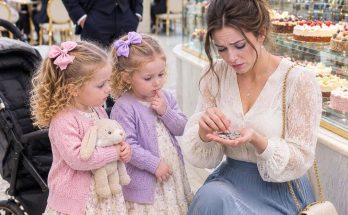
He had walked out of a $600 million deal because he saw a woman counting coins. It was the best bad deal he ever made.
THE END
END PART 2
Disclaimer: This fictional story was created with AI assistance for entertainment. Names, characters, dialogue, and events are fictional. Any resemblance to actual people or events is coincidental.