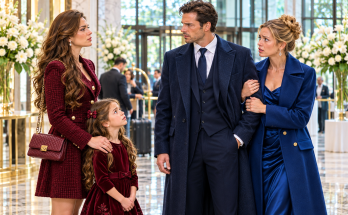
Chapter 1: The Porcelain Cup
“You can start over somewhere else,” my mother-in-law declared, thrusting a thick, binder-clipped stack of papers against my chest while my husband’s pregnant mistress calmly measured the curtains of my two-point-eight-million-dollar mansion.
I didn’t take the papers. I let them slide down the front of my cashmere trench coat and hit the polished Italian travertine floor with a heavy, flat slap. The sound echoed up into the twenty-foot vaulted ceiling of the foyer, bouncing off the Venetian plaster walls I had personally selected with an architect from Milan three years ago.
Just twenty minutes earlier, I had been sitting in the back of a quiet airport town car, rubbing the bridge of my nose to ease the dull throb of a ten-day business trip across Tokyo and Zurich. My bones ached with that deep, pressurized fatigue that only comes from crossing too many time zones in too few days. All I had wanted was a hot bath in my soaking tub, a glass of something dry and red, and forty-eight hours of silence in the sanctuary I had built with my own hands.
Instead, the town car had rolled up the sweeping circular driveway of my Oakridge Heights estate, and my driver had braked so abruptly that my leather carry-on slid off the seat.
Lined up along the pristine white marble steps like curbside trash were my six custom Louis Vuitton suitcases. Beside them, two burly men in gray coveralls were wrestling my late grandmother’s antique mahogany vanity out through the double oak front doors. The afternoon sun glinted off the brass hardware, and for a split second, my tired brain refused to process what my eyes were seeing. I thought we were being robbed.
Then I saw the moving truck parked carelessly across my manicured hydrangeas, its tires crushing the pale blue blossoms I had spent last spring tending on my hands and knees.
I paid the driver, stepped out onto the warm gravel, and walked toward the steps. My heels clicked with a steady, measured rhythm. That was something my father had drilled into me before I was even tall enough to see over the dashboard of his jeep: Never let the enemy see you rush, Victoria. Speed is for people who are panicking. Precision is for people who are winning.
Halfway up the steps, my gaze snagged on an open cardboard box sitting near the stone planter. Stuffed inside, wedged between a pile of old financial journals and a tangled knot of charging cords, was a heavy silver frame. The glass was smudged with a greasy thumbprint. Inside the frame was a vintage photograph of General Robert Vance in his full dress blues, three silver stars gleaming on his shoulders, standing ramrod straight on the tarmac of an airbase in Germany with a ten-year-old version of me grinning beside him.
Whoever had packed that box hadn’t even bothered to wrap it in newspaper. They had tossed my father’s face into the garbage like a chipped coffee mug.
A strange sensation washed over me then. It wasn’t the hot, blinding rage that makes people scream and throw things. It was colder than that. It felt like liquid nitrogen pooling at the base of my spine, freezing every exhausted nerve ending into absolute, crystal-clear stillness. I reached down, lifted the silver frame out of the cardboard box, and brushed a flake of dry mud off the glass with my thumb.
The heavy oak front door stood ajar. They hadn’t even bothered to lock it, because Elena Harrison had clearly decided I was already broken.
Laughter drifted out from the grand living room—high, tinkling, and terribly pleased with itself. I stepped inside, the silver frame resting against my forearm, and walked toward the sound.
The living room looked like a crime scene of bad taste. My hand-knotted Persian rugs had been rolled up and shoved against the limestone fireplace. Standing near the floor-to-ceiling windows that overlooked my saltwater infinity pool was a girl who couldn’t have been more than twenty-four. She wore a tight cream-colored knit dress that stretched deliberately over a five-month baby bump, and she was holding a brass retractable measuring tape against my custom Belgian velvet drapes.
“I think we should go with a soft blush silk, Elena,” the girl said, tilting her head so her bleached blonde extensions caught the light. “This charcoal velvet is just so gloomy. It feels like a funeral home in here. No wonder poor Daniel was always so depressed.”
“Oh, completely, Chloe darling,” Elena purred from the center of my white linen sectional.
Elena was sixty-two, meticulously preserved by dermatologists whose bills I had quietly paid for the last four years, and dressed in a pastel tweed suit that looked like it had been stolen from a country club mannequin. She had her legs crossed at the ankles, and cradled between her manicured fingers was a delicate, hand-painted Limoges porcelain teacup.
My mother’s teacup. The last surviving piece of a tea set my mother had brought back from Paris six months before cancer took her. Elena knew I kept it locked in the glass vitrine in the dining room. She had clearly forced the tiny brass lock just to make a point.
I didn’t clear my throat. I just stood in the archway, holding my father’s photograph, and waited.
Chloe noticed me first. The measuring tape snapped back into its brass casing with a sharp metallic zip. She didn’t look ashamed. She didn’t even flinch. Instead, her wide hazel eyes swept over my travel-wrinkled trench coat, my sensible flats, and the tired shadows under my eyes, and a slow, triumphant smirk curved her glossy lips. She placed one hand protectively over her stomach, as if she were shielding a royal heir from a commoner.
Elena turned her head slowly. She didn’t set the teacup down. She took a long, deliberate sip of chamomile, swallowed, and looked at me with the cold, predatory disdain of a landlord evicting a deadbeat tenant who was three months behind on the rent.
“Well,” Elena said, her voice dripping with theatrical boredom. “You’re back early. The flight from Zurich must have caught a tailwind. How inconvenient for you.”
“Put the cup down, Elena,” I said. My voice was remarkably level, carrying no tremor, no heat—just the flat, quiet cadence I used in boardrooms when a junior analyst tried to fudge a quarterly projection.
Elena’s eyebrows shot up. She looked down at the Limoges porcelain, then back at me, and laughed softly. “Oh, Victoria. Still so dramatic over trinkets. Honestly, it’s pathetic. You really haven’t grasped the situation yet, have you?”
She rose from the sofa with a rustle of tweed, setting the cup down on my unprotected walnut coffee table without a coaster. A faint ring of condensation bloomed on the dark wood. She walked over to the console table, picked up a thick stack of legal documents bound by a heavy black clip, and strode toward me.
That was when she shoved them against my chest and told me I could start over somewhere else.
As the papers hit the floor, Elena’s thin lips tightened into a sneer. “Don’t make a mess on the travertine, dear. The cleaners are coming at five to sanitize the master suite before Chloe moves her things in. Honestly, I don’t know why you’re standing there looking like a stunned deer. You knew this marriage was dead two years ago. You’re thirty-four, you’re cold as a slab of granite, and you’ve spent the last five years married to your laptop instead of my son.”
“My laptop,” I murmured, my eyes flicking briefly to Chloe, who was now casually inspecting my crystal decanter on the bar cart, “paid for the roof currently keeping the rain off your freshly dyed hair, Elena.”
Elena let out a sharp, barking laugh. “Please. Stop embarrassing yourself. Daniel told me everything about your little ‘consulting’ gigs. A few freelance contracts here and there to keep you busy while my son built an executive career at Apex Logistics. Do you have any idea how hard he’s worked? How lonely he’s been coming home to an empty bed while you gallivanted around Europe pretending to be a businesswoman?”
I stared at her. For a brief, surreal second, I actually marveled at the sheer architectural brilliance of Daniel’s lies. When I had married Daniel Harrison five years ago, I had made a deliberate, romantic, and colossally foolish choice. Growing up as the daughter of a three-star general and the younger sister of Marcus Vance, the ruthless tech and real estate tycoon whose name made Wall Street analysts sweat, I had spent my twenties watching men fall in love with my last name instead of me.
When I met Daniel—a charming, seemingly humble operations manager with an easy smile and a modest apartment—I had kept my family’s true weight in the shadows. I told him my father was retired military, which was true. I told him my brother worked in commercial real estate, which was also true. I used my mother’s maiden name on my consulting LLC, and when I bought this two-point-eight-million-dollar mansion through a private family trust, I had told Daniel it was a long-term corporate lease-to-own arrangement subsidized by a generous inheritance from my aunt. I hadn’t wanted to emasculate him. I had wanted him to feel like the king of his own castle.
Apparently, if you hand a beggar a paper crown and let him sit on your throne long enough, he eventually convinces himself he built the palace.
“Daniel is downstairs in the study signing the final transfer authorizations with our attorney on the phone,” Elena said, crossing her arms over her chest. “The locks were changed at nine this morning. Your name has been removed from the gate security list. Your clothes—the ones Chloe didn’t want to donate—are on the front steps. Frankly, Victoria, you should be down on your knees thanking us for letting you keep your wardrobe and offering you a generous exit package.”
Chloe drifted closer, tucking a strand of blonde hair behind her ear. “I left you the black wool coats,” she offered magnanimously, as if she were tossing bread crumbs to a pigeon. “They’re a little boxy for my figure anyway. And Daniel said you can keep your old sedan. He’s getting me the white Range Rover next week so the baby has plenty of room.”
My old sedan, I thought, almost amused, is an armored Audi A8 that my brother insisted on buying me.
I looked from Chloe’s smug, youthful arrogance to Elena’s pinched, greedy face. I looked down at the silver frame in my hands, at my father’s stern, proud eyes staring back at me from beneath the brim of his uniform cap. Five years. I had spent five years shrinking myself to fit inside Daniel Harrison’s fragile ego. I had bitten my tongue through Elena’s passive-aggressive jabs at Thanksgiving, paid off Daniel’s secret gambling debts through anonymous shell transfers so he wouldn’t feel humiliated, and even nudged my brother into quietly acquiring Daniel’s struggling firm so my husband wouldn’t lose his job during the last recession.
And this was the return on my investment.
Elena took a step forward, gesturing impatiently toward the open front door. “Well? Don’t just stand there breathing up the air. Pick up your little divorce papers, grab your suitcases, and call yourself an Uber. Daniel doesn’t want a hysterical scene. It’s bad for the baby’s blood pressure.”
I didn’t scream. I didn’t cry. I didn’t even raise my voice.
Instead, a chilling, microscopic smile touched the corners of my lips. It was the exact smile my brother Marcus wore right before he executed a hostile takeover of a competitor who had dared to short his stock.
I set my father’s photograph gently down on the marble console table, turning it so it faced the room like a silent witness. Then, slowly, I slipped my hand into the pocket of my cashmere trench coat and pulled out my matte-black encrypted phone.
Elena rolled her eyes. “Oh, who are you calling? Your little therapist? Or are you going to call the police and make a fool of yourself? Because Daniel has the lease paperwork right downstairs, sweetheart. You’re trespassing.”
I didn’t answer her. I pressed and held speed dial number one. The line didn’t even finish its first ring before it clicked open.
“Victoria,” a deep, gravelly voice rumbled through the receiver—a voice that had once commanded forty thousand troops across three theaters of operation. “You’re supposed to be asleep. Did the Zurich deal close?”
“It closed, Dad,” I said, my eyes never leaving Elena’s sneering face. My voice was as soft as silk and twice as sharp as a razor. “I’m standing outside my own front door. Send the heavy detail.”