CHAPTER 1
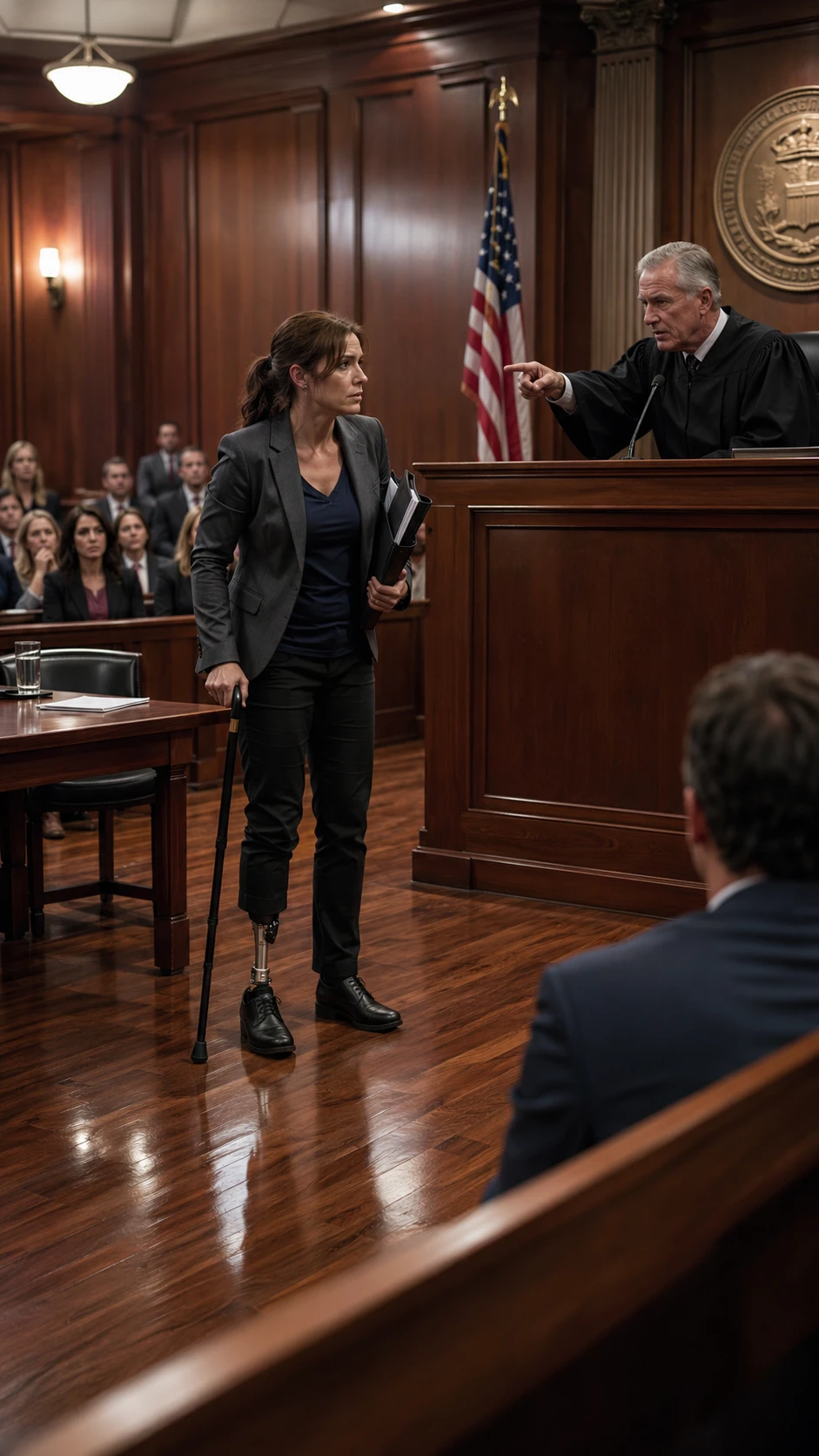
The sound of Talia Monroe’s cane striking the polished courtroom floor was quiet, but to her, it felt louder than thunder.
Every step reminded her that the world loved courage only when it looked graceful.
At thirty-seven, she had learned how to smile through pain, how to stand when her body begged her to sit, and how to let strangers misunderstand her because explaining everything took more strength than she had left.
That morning, she entered Jefferson County Court wearing a charcoal blazer, black slacks, and the same calm face she had worn through explosions, surgeries, funerals, and nights when sleep never came.
Under her pants was a prosthetic leg that rubbed against old scars.
In her hand was a cane she hated needing.
Against her chest was a folder filled with medical records, overdue notices, and three parking tickets that had somehow become the final insult in a life already stretched thin.
“Name?” the clerk asked without looking up.
“Talia Monroe,” she said.
The clerk pointed toward a bench.
“Wait there.”
Talia sat slowly, lowering herself with careful precision.
A young man beside her glanced at the cane, then at her face, then quickly away as if disability were something embarrassing to witness.
She was used to that.
People either stared too long or pretended not to see anything at all.
The courtroom smelled of old wood, coffee, and nervous breath.
At the front, Judge Harold Whitcomb sat above everyone like a carved statue in black robes, his silver hair perfectly combed, his mouth bent into permanent disapproval.
Talia had seen men like him before.
Men who confused authority with dignity.
Men who believed suffering should present itself politely.
When her name was finally called, her stomach tightened.
She pushed herself up, fingers gripping the cane, jaw locking against the pain in her hip.
Every movement had to be planned.
Every step had to be earned.
She reached the front and stood before the bench while her folder trembled slightly in her hand.
Judge Whitcomb glanced at the papers in front of him.
“Ms. Monroe, you are here regarding three unpaid parking citations near Jefferson Medical Center.”
“Yes, Your Honor,” Talia said.
“My appointments ran long because of complications with my prosthetic fitting.”
He did not look interested.
“You have submitted medical documentation.”
“Yes, sir.”
“And yet the citations remain unpaid.”
Talia swallowed.
“I was hoping the court might consider reducing the fines or allowing a payment plan.”
A few people in the gallery shifted in their seats.
Judge Whitcomb leaned back, studying her for the first time.
His eyes moved from her face to the cane.
Then his expression hardened.
“Before I deliver my decision,” he said, “stand up straight.”
CHAPTER 2
For one second, Talia thought she had misheard him.
The courtroom became painfully still.
“Your Honor,” she said carefully, “I am standing.”
A murmur moved through the room like wind through dry leaves.
The judge’s eyes narrowed.
“Do not argue with the court.”
Talia felt heat climb her neck.
“I’m not arguing, sir.”
“Then stand properly.”
The words struck harder than they should have.
She had been shot at.
She had crawled through dust with blood in her boot.
She had watched soldiers she loved vanish into smoke and screams.
Yet somehow, this small public humiliation opened a wound she thought had sealed years ago.
“I’m doing my best,” she whispered.
Judge Whitcomb’s voice sharpened.
“Ms. Monroe, this court expects respect.”
Talia’s hand tightened around the cane until her knuckles paled.
Respect.
She almost laughed.
She had given her youth, her leg, and half her sleep to a country that now fined her for parking too long outside a hospital.
Still, she tried.
She adjusted her shoulders.
She shifted her weight.
She forced her body into the posture the judge demanded.
Pain flashed through her right side like fire.
Her prosthetic locked awkwardly beneath her.
The rubber tip of her cane slid an inch across the glossy floor.
Her balance disappeared.
For a terrible moment, Talia knew she was falling before anyone else did.
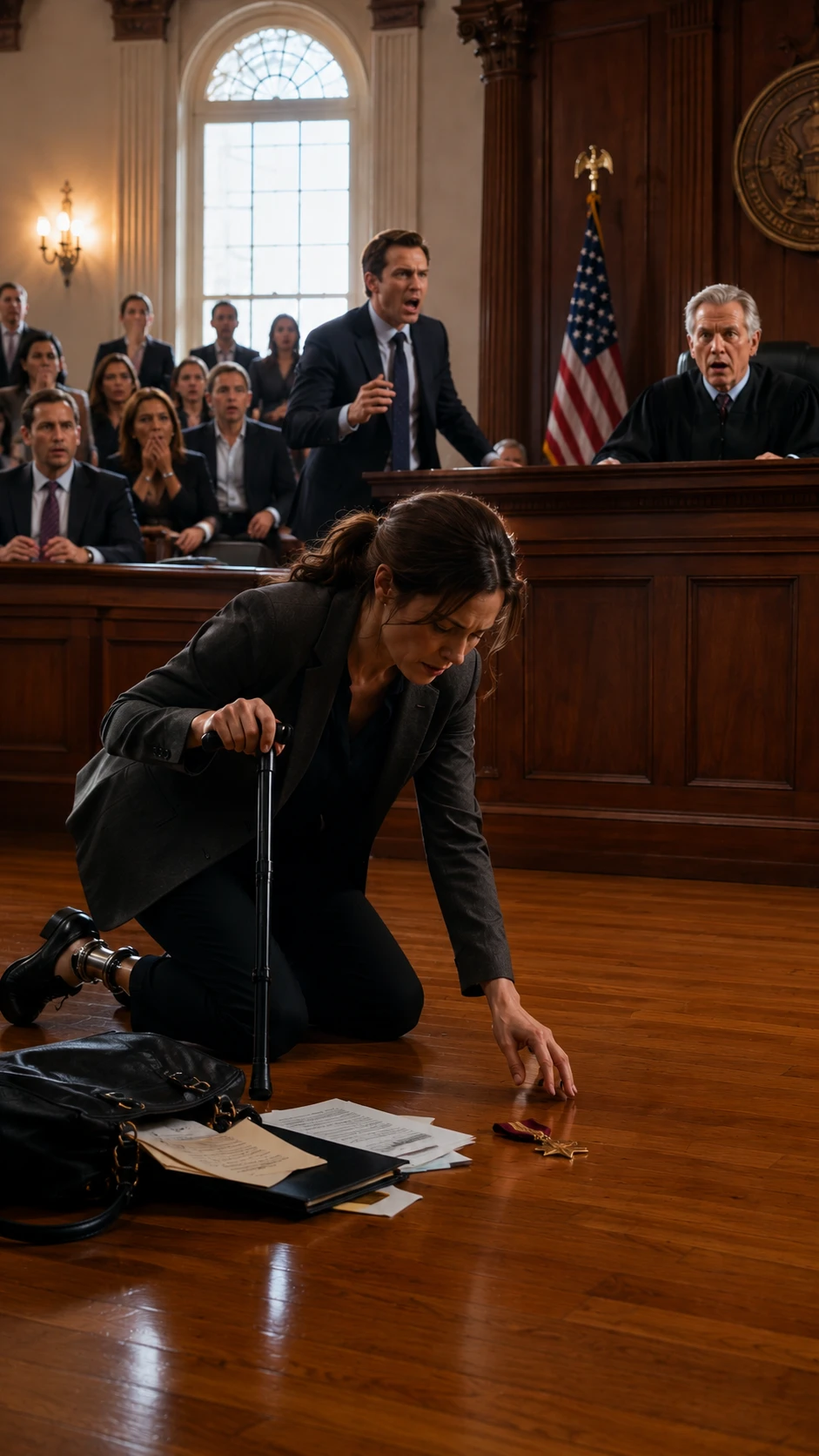
Her folder burst open as she hit the floor.
Papers scattered around her like white birds.
The cane clattered beside her.
Gasps filled the courtroom.
Someone said, “Oh my God.”
Talia lay there for half a breath, stunned more by shame than pain.
Then something small and bronze slipped from her open bag.
It spun across the polished floor, catching the light as it traveled toward the judge’s bench.
The object stopped near the court reporter’s desk.
A man in the second row leaned forward.
His face changed.
“That’s a Bronze Star,” he whispered.
This time, the murmur became a wave.
The judge looked down.
The color drained from his face.
Talia pushed herself up on one elbow, breathing hard.
Her eyes found the medal.
For a moment, the courtroom vanished.
She was back in the desert, tasting dust, hearing sirens, feeling Sergeant Hale’s hand slip from hers as fire swallowed the convoy road.
She reached for the medal, but her fingers shook too badly.
A woman from the gallery stepped forward, then stopped, unsure whether helping would embarrass her more.
Talia forced herself upright.
Her cheeks burned.
Her leg throbbed.
But her eyes remained steady.
The judge opened his mouth, then closed it again.
For the first time since the hearing began, he looked smaller than the bench he sat behind.
CHAPTER 3
The silence stretched until it became unbearable.
Then a chair scraped sharply against the floor.
A man in a navy suit stood from the second row.
He was tall, broad-shouldered, with tired eyes and a face that looked as if it had just recognized a ghost.
“Your Honor,” he said, voice tight, “I need to make a statement for the record.”
Judge Whitcomb frowned.
“Identify yourself.”
“Daniel Mercer,” the man replied.
“Attorney at law.”
The judge’s mouth tightened.
“Mr. Mercer, this matter does not concern you.”
Daniel’s gaze dropped to Talia.
His expression softened with something close to grief.
“I’m afraid it does.”
Talia stared at him.
She did not know him.
At least, she thought she didn’t.
But there was something familiar in the way he looked at the medal, not with curiosity, but with recognition.
Daniel stepped into the aisle.
“Five years ago, an Army medical convoy outside Kandahar was ambushed.”
Talia’s breathing changed.
The courtroom faded around the edges.
Daniel continued, each word heavier than the last.
“Captain Talia Monroe pulled three wounded soldiers from a burning vehicle after an explosion destroyed the road.”
The judge shifted uncomfortably.
“That is not relevant to unpaid parking tickets.”
“It is relevant,” Daniel snapped, then caught himself.
He took a breath.
“Because those parking tickets were issued while Ms. Monroe was attending mandatory treatment for injuries sustained during that same attack.”
Talia stared at him.
“How do you know that?”
Daniel’s eyes filled with regret.
“Because I was one of the men in that convoy.”
A shocked sound moved through the gallery.
Talia’s lips parted.
The memory struck her with brutal force.
A young soldier trapped under twisted metal.
Blood on his forehead.
A voice screaming for his brother.
She had dragged him free seconds before the vehicle exploded.
But she had never known whether he survived.
Daniel swallowed hard.
“My name then was Daniel Reyes. I changed it after law school.”
Talia’s fingers tightened around the medal.
“You were the one in the back seat,” she whispered.
Daniel nodded.
“You saved my life.”
The courtroom held its breath.
Judge Whitcomb looked down at the citations as if they had become dangerous.
Daniel turned toward the bench.
“And there is more, Your Honor.”
The judge stiffened.
“Mr. Mercer, choose your words carefully.”
“I am.”
Daniel reached into his briefcase and pulled out a thin stack of documents.
“I came here today for another case. I had no idea Ms. Monroe would be here.”
He placed the papers on the table.
“But two months ago, I filed a complaint against Jefferson Medical Center and the city parking authority.”
Talia frowned.
“What complaint?”
Daniel looked at her, and something in his face made her chest tighten.
“Disabled veterans have been ticketed repeatedly outside the rehabilitation wing while their appointments ran late.”
The audience erupted in whispers.
“Some were charged hundreds of dollars.”
Daniel’s voice grew colder.
“Some had their cars towed while they were inside receiving treatment.”
Talia felt the floor tilt beneath her.
She thought she had been alone.
She thought this was just another small cruelty life had thrown at her.
Daniel turned back to the judge.
“And today, this court was about to punish one of them without reviewing the full record.”
Judge Whitcomb’s jaw worked.
“That is a serious accusation.”
“It gets worse,” Daniel said.
CHAPTER 4
The courtroom seemed to lean toward him.
Daniel lifted the next page.
“The parking contractor responsible for enforcement near Jefferson Medical Center is Whitcomb Municipal Services.”
A heavy silence dropped.
The judge’s eyes flashed.
“Careful, counselor.”
Daniel did not blink.
“Founded by your brother, owned in part by a private trust connected to your family.”
The air left the room.
Talia stared at the judge.
For the first time, his sternness looked less like authority and more like fear.
“That has nothing to do with this hearing,” Judge Whitcomb said.
Daniel’s voice sharpened.
“It has everything to do with it.”
He held up another document.
“Because disabled patients were not simply being ticketed by mistake.”
Talia’s stomach twisted.
“They were targeted.”
A woman in the back gasped.
Daniel turned slightly so the gallery could hear.
“According to internal emails, enforcement officers were instructed to focus on vehicles near the rehabilitation entrance because patients there were less likely to contest citations.”
The judge slammed his hand down.
“That is enough.”
“No,” Daniel said, his voice rising.
“It is not enough.”
The bailiff stepped forward uncertainly.
Talia slowly stood straighter, not because the judge demanded it, but because the truth was lifting her.
Pain still burned through her body.
Her prosthetic still ached.
But shame had changed into something harder.
Daniel looked at her.
“Ms. Monroe, did you receive notices warning that unpaid citations could affect your veteran transportation benefits?”
“Yes,” she said.
Her voice was barely audible.
“I thought I had done something wrong.”
Daniel’s face darkened.
“You didn’t.”
The words almost broke her.
For months, she had blamed herself.
For months, she had rationed groceries to save money for fines she should never have owed.
For months, she had sat in her car outside therapy appointments, crying because she could not afford both treatment and penalties.
Judge Whitcomb leaned forward.
“This court will not entertain conspiracy theories.”
Daniel placed the last document on the table.
“Then perhaps the court will entertain this.”
The clerk carried it to the bench with trembling hands.
Judge Whitcomb read the first page.
His face changed completely.
“What is this?”
Daniel answered quietly.
“A signed affidavit from Evelyn Pierce, former operations manager at Whitcomb Municipal Services.”
Talia heard someone whisper, “No way.”
Daniel continued.
“She states the company pressured enforcement officers to target disabled parking zones and medical overflow areas.”
The judge’s hand tightened around the page.
“And she names the person who approved the policy.”
Everyone waited.
Daniel’s gaze did not move from the judge.
“Your Honor, she names you.”
The courtroom exploded.
CHAPTER 5
“Order!” Judge Whitcomb shouted, but his voice cracked.
The gavel struck once.
Twice.
Nobody settled.
Reporters in the back rushed toward the door.
The bailiff looked trapped between duty and disbelief.
Talia stood beside the table, medal in hand, watching the man who had humiliated her unravel in front of everyone.
“This is outrageous,” the judge said.
Daniel’s voice was quiet now.
“That policy destroyed people who were already suffering.”
Judge Whitcomb pointed at him.
“You will be held in contempt.”
Daniel smiled bitterly.
“You already tried that with her.”
The words landed like a blade.
Talia felt tears gather in her eyes, but she refused to let them fall.
Then the courtroom doors opened.
A gray-haired woman in a beige coat entered with two federal investigators behind her.
Daniel turned.
“Ms. Pierce.”
The judge went still.
Evelyn Pierce walked slowly down the aisle, holding a sealed envelope against her chest.
Her face was pale, but her steps were firm.
“I’m sorry I’m late,” she said.
Judge Whitcomb rose halfway from his chair.
“You should not be here.”
Evelyn looked at him with years of fear finally dying in her eyes.
“That’s what you told me when I refused to destroy the emails.”
The courtroom went silent again.
Talia could hear her own heartbeat.
Evelyn handed the envelope to Daniel.
Then she turned toward Talia.
“I saw your name on the citation list,” she said softly.
“I knew what they were doing to you.”
Talia’s voice trembled.
“Why didn’t you say something sooner?”
Evelyn’s eyes filled with tears.
“Because my son needed surgery, and they threatened my insurance.”
The anger inside Talia faltered.
Pain recognized pain.
Then Evelyn looked at the judge.
“But after today, after watching him tell you to stand straight, I couldn’t stay silent anymore.”
One of the federal investigators stepped forward.
“Judge Harold Whitcomb, we have a warrant to seize records connected to Whitcomb Municipal Services and possible judicial misconduct.”
The judge’s face turned ashen.
“You can’t do this in my courtroom.”
The investigator’s expression did not change.
“That is exactly why we are doing it here.”
A sound moved through the room, not a gasp this time, but something deeper.
A reckoning.
Talia looked at Daniel.
He nodded once, silently telling her the battle was not over, but the lie had finally cracked.
Then the judge looked at Talia with hatred burning beneath his fear.
“You think this makes you a hero?” he hissed.
Talia stepped closer to the bench.
Every eye followed her.
Her leg trembled.
Her cane shook.
But her voice was clear.
“No,” she said.
“Saving him made me a soldier.”
She glanced at Daniel, then at Evelyn, then at the stunned faces in the gallery.
“And surviving men like you made me dangerous.”
The words froze the room.
For the first time all morning, Judge Whitcomb had nothing to say.
But just as the investigators moved toward his chambers, the court reporter suddenly stood.
Her face was white.
“Wait,” she said.
“There’s something else.”
Everyone turned.
She lifted a small recorder from beneath her desk.
“I record backup audio for every session.”
The judge’s eyes widened in terror.
The reporter looked at Talia.
“And this morning, before Ms. Monroe’s case was called, the judge made a phone call from the bench.”
Daniel’s expression changed.
“What did he say?”
The reporter pressed play.
Static filled the courtroom.
Then Judge Whitcomb’s voice came through the tiny speaker, low and cruel.
“Yes, she’s here.”
A pause.
Then his voice again.
“Don’t worry. After I rule against her, she won’t have enough money left to keep asking questions.”
Talia stopped breathing.
The entire courtroom went cold.
Daniel whispered, “What questions?”
The reporter’s hand shook as she looked down at another page.
“She requested records about the convoy attack.”
Talia’s blood turned to ice.
“I never requested those records.”
Evelyn covered her mouth.
Daniel stepped closer.
“Talia… your name was used.”
The investigator opened the envelope.
Inside was a photograph, old and grainy, taken five years earlier near the burned convoy.
Talia saw the wreckage.
She saw herself on the ground.
She saw Daniel being carried away.
And in the background, standing beside a private military contractor vehicle, was Judge Whitcomb, younger, clean-shaven, watching the flames.
Talia’s knees nearly failed.
Daniel grabbed her arm.
Judge Whitcomb backed away from the bench.
Evelyn whispered the truth before anyone else could.
“The tickets were never about money.”
Talia stared at the photograph as the final piece of her past rose from the ashes.
“They were trying to scare me away from the attack records,” she said.
Daniel’s face went pale.
“Because the ambush wasn’t random.”
The judge turned toward the side door.
The bailiff blocked him.
Talia lifted her Bronze Star slowly, the medal shaking in her hand.
For five years, she had believed she lost her leg in an act of war.
For five years, she had believed the explosion that killed her friends was enemy fire.
But now, in the silent courtroom, with the judge trapped, the evidence exposed, and every witness watching, she realized the most horrifying truth of all.
The man who had ordered her to stand straight had been standing in the shadows the day she fell the first time.
And this time, Talia Monroe was not going to fall alone.