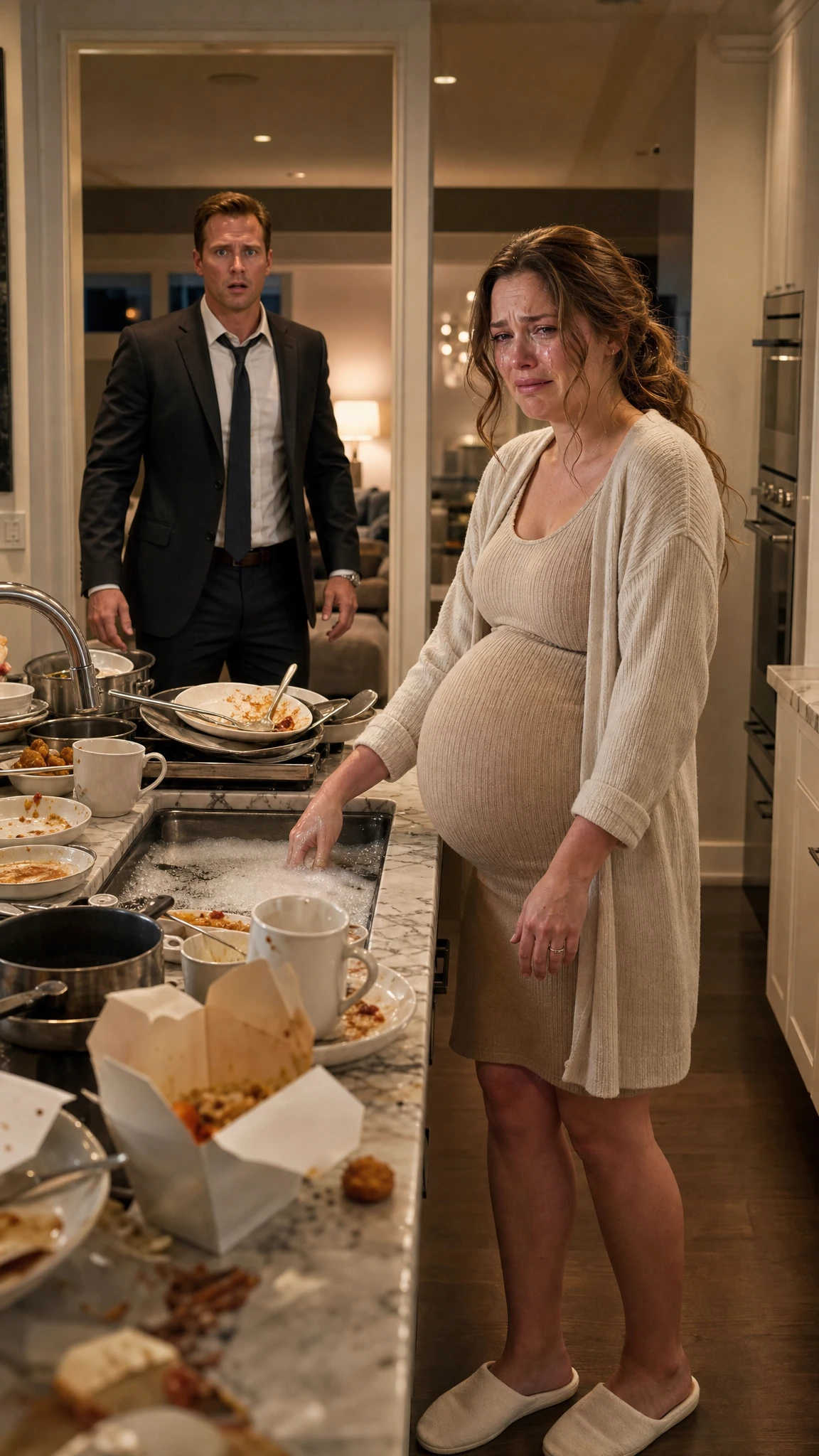
The moment my mother told my pregnant wife to go eat in the bathroom, something inside me broke so cleanly I knew there was no putting it back together.
She didn’t raise her voice. She didn’t need to.
“If you’re going to feel sick, Macy, then eat in the bathroom. Don’t ruin the evening for everyone else.”
She said it so calmly it almost sounded polite.
The waiter was still standing there, holding a bottle of wine Grant’s father had ordered like he wasn’t sure whether to keep pouring or disappear. Silverware clinked softly at nearby tables. Somewhere behind us, someone laughed. The restaurant smelled like butter, garlic, and roasted meat, warm and rich and expensive. Everything about the room was elegant, tasteful, carefully arranged.
And right there in the middle of it, my mother humiliated my wife like she was something unpleasant to be moved out of sight.
My sister Sydney sat beside her husband, Grant, dressed in cream silk and a smile that looked practiced. Grant’s parents were across from them, awkward and rigid, staring down into their glasses. And my wife—my Macy, six months pregnant with our first child—sat frozen in her chair, one hand over her belly, her eyes suddenly bright with tears she was trying not to let fall.
I didn’t yell.
I didn’t slam my hand on the table.
I didn’t give my mother the satisfaction of watching me lose control.
I just looked at Macy. Then I looked at my mother. And in that quiet second, for the first time in my life, I stopped making excuses for my family.
The dinner was in Asheville on a cold October night. Outside, the sidewalks had been wet from a late rain, and wind had chased orange leaves along the curb when we walked in. Inside, the restaurant glowed with amber light and polished wood, the kind of place my mother loved because it made her feel important.
She had insisted Sydney and Grant’s first wedding anniversary had to be “special.” In our family, “special” usually meant expensive.
And expensive usually meant me.
I was thirty-four, doing well in investment funds, and I had been paying for things for so long that everyone around me acted like it was as natural as breathing.
It started when I was sixteen.
My father died and left us with medical debt, a house on the edge of foreclosure, and a family that was barely staying upright. One heart attack, one ambulance ride, one ICU stay we couldn’t afford, and suddenly childhood was over. My mother worked double shifts at a diner after that, smelling like coffee and grease when she came home after midnight. Sydney was younger and frightened and angry all the time. Somehow I became the one who grew up fast enough for all of us.
I got an after-school job stocking shelves. Then a weekend job washing dishes. I learned how to talk to lenders before I learned how to enjoy being young. I helped Sydney with homework. I fixed things around the house. I lied to bill collectors and promised money we didn’t have.
Back then, I thought sacrifice was love in its purest form.
Maybe it was, at first.
When I started making real money years later, after college, after long nights and longer workweeks, I took care of them because I loved them and because some part of me still believed it was my job. I paid off my mother’s mortgage, though the house stayed in my name for tax reasons and because a financial advisor I trusted insisted it was smarter that way. I sent her money every month for groceries, medicine, utilities, and anything else she claimed she needed. I paid her insurance. Her credit cards. Even the “emergency” cards that somehow had emergencies every single month.
When Sydney got married, I paid for almost the whole wedding after she sobbed one night about not wanting to feel “cheap” in front of Grant’s family. I covered the venue, flowers, photographer, and honeymoon upgrade because she said this was the one day she’d remember forever.
Then I rented her and Grant one of my houses for far below market value, bought them a car when theirs died, and even set up a savings fund for the home they said they wanted to buy someday.
I never kept score.
But that night, sitting at that table, I realized they had.
Every dollar. Every sacrifice. Every rescue.
To them, it wasn’t generosity.
It was something they believed they were owed.
Macy was twenty-nine, a preschool teacher, and the gentlest person I had ever known. We met at a charity literacy fundraiser where she was helping children make paper crowns and somehow still looked calm with glitter on her cheek and three toddlers hanging on her arms. She had this quiet kindness that made children trust her instantly. She listened when people talked. She noticed when someone was uncomfortable and shifted the whole room gently without making a show of it. She was patient, thoughtful, and never tried to be anything she wasn’t.
My mother and Sydney hated that about her.
Not openly, of course. Nothing in my family was ever openly done. They preferred polished cruelty. Smiles with blades hidden behind them.
They covered it with fake warmth and soft little comments about her “simple” background, her “limited” career, her modest clothes, and how she was “too sweet” to ever stand up for herself.
“She’s nice,” my mother had once said after Macy left the room, in that tone people use when they mean the opposite of admiration. “A little plain, maybe. But nice.”
Sydney was worse because she made everything sound like concern.
“Do you think teaching preschool is enough for her? I mean, emotionally? She seems so… small-town.”
Macy always told me to be patient with them.
“They’re your family,” she’d say. “Maybe they just need time.”
I wanted to believe that. Maybe because it was easier than facing the truth.
Then she got pregnant.
And whatever restraint they had before disappeared.
My mother started saying a proper wife should stay home with the baby. Sydney criticized everything—what Macy ate, how much she rested, the nursery colors, the stroller brand, the prenatal yoga class, the way she sat, the way she walked, even the way she breathed if she seemed tired. Always with that same sugary tone that made it worse.
“Are you sure your doctor said that was okay?”
“Wow, you’re showing a lot already.”
“You should really think about natural birth. Medication is just the easy way out.”
“And are you certain that color for the nursery isn’t a little dull? Babies need stimulation.”
And still, Macy kept trying.
That night, she had spent hours baking Sydney’s favorite lemon cake with light frosting because she remembered Sydney mentioning once, years ago, that bakery frosting was too heavy. She bought a navy-blue dress because she wanted to look nice. She curled her hair even though lately standing too long made her back ache. She wanted, more than anything, to belong.
At dinner, she ordered sparkling water with lemon.
My mother actually laughed.
“How sad,” she said. “You can’t even have anything fun anymore.”
Macy smiled politely. “I’m okay with lemon.”
Then Sydney jumped in, saying carbonated drinks were bad for the baby. Macy said her doctor told her it was fine, but Sydney kept pushing, eyes wide with false innocence.
“Well, if it were me, I just wouldn’t risk it.”
Grant stared at his menu like he wished the pages might swallow him whole.
Finally Macy quietly changed her order to still water.
I noticed.
And I stayed silent.
That part bothered me most later—not just what they did, but all the little moments before, the smaller failures that paved the way for the bigger one. Every time I let a comment pass to “keep the peace,” I was really teaching my wife that her peace mattered less than theirs.
Halfway through dinner, Macy turned pale. I saw it happen gradually, the color draining from her face, the way she pressed her lips together and breathed through her nose. She touched my wrist under the table.
“I’m going to step away for a minute,” she whispered.
I squeezed her hand. “Do you want me to come with you?”
She gave the tiniest shake of her head, already embarrassed. “I’m okay.”
She excused herself and went to the restroom. Her pregnancy nausea had been unpredictable lately—some days almost gone, some days coming back without warning. When she returned a few minutes later, she looked shaky and ashamed in a way that made something ugly rise in my chest. She sat down gently and said she’d wait a little before trying to eat again.
That was when my mother leaned forward and struck.
“If you’re going to be like that, eat in the bathroom. This day isn’t about you.”
The table went silent.
Then Sydney nodded like that cruelty made perfect sense.
“Mom’s right,” she said. “You’re making everyone uncomfortable. If you couldn’t behave, you should’ve stayed home.”
I watched my wife’s face crumble.
And then, somehow, Macy apologized.
“I’m sorry,” she said softly. “I didn’t mean to interrupt dinner.”
For being sick.
For interrupting dinner.
For carrying my child at a table where she had just been humiliated.
That was the moment I stood up.
My chair scraped the floor sharply enough that a couple at the next table turned to look. Macy looked up at me, startled.
I took her hand.
Her fingers were cold and trembling.
Then I reached for the white cake box beside my chair, the one the staff had been holding in the back until dessert. I had asked them to bring it early because I suddenly couldn’t stand the idea of that cake sitting in front of people who didn’t deserve it.
I lifted it carefully, turned to my mother and sister, and smiled. It wasn’t a warm smile. It was the kind you give strangers when you’ve already decided something final.
“Enjoy your night,” I said. “I hope it’s exactly the dinner you deserve.”
“Don’t be dramatic,” my mother snapped, but I was already turning away.
Sydney let out a short laugh. “Seriously? You’re leaving over this?”
Grant’s mother whispered, “Sydney…” in a strained voice, but Sydney ignored her.
I looked back once. “Yes,” I said. “I am.”
Then I walked out with my wife.
The cold hit us the second the restaurant door opened. Macy’s eyes spilled over the moment we got outside. She covered her face with one hand, the other still clutching mine, and I felt something in me crack all over again.
“Hey,” I said gently, setting the cake on the hood of my car so I could pull her into me. “Hey, no. Don’t cry over them.”
“I’m sorry,” she choked out. “I really tried. I didn’t want to ruin it.”
I pulled back just enough to look at her. “Listen to me. You did not ruin anything. You have nothing to apologize for. Nothing.”
Her mascara had smudged at the corners. Her cheeks were cold. I brushed them with my thumbs.
“They were cruel to you,” I said. “And I should have stopped it a long time ago.”
She shook her head immediately because that was Macy, always protecting everyone even when she was the one hurt. “You don’t have to—”
“I do,” I said. “I should have.”
She stared at me for a second, searching my face, maybe hearing something in my voice she hadn’t heard before. Then she nodded once.
I opened the passenger door, settled her inside, buckled her when her hands were still shaking too much, and put the cake carefully in the back seat.
As I drove us home through the dark mountain roads, one hand wrapped around Macy’s trembling fingers, I already knew exactly what I was going to do next.
I wasn’t going to call my mother and argue. I wasn’t going to text Sydney and demand an apology I knew wouldn’t be sincere. I wasn’t going to have one more circular conversation where I explained basic human decency to people who understood perfectly well what they were doing.
I was going to remove the privileges they had mistaken for permanent rights.
By the time we got home, my mind was strangely calm.
Macy changed into one of my old T-shirts and sat curled on the couch with a blanket around her shoulders while I made her peppermint tea and brought her crackers. The house was quiet except for the low hum of the refrigerator and the rain beginning again against the windows.
“I hate that this happened on their anniversary,” she said after a while, staring into her mug.
I almost laughed—not because it was funny, but because it was so painfully like her to still worry about their evening.
“They should be grateful you came at all,” I said.
She looked up at me. “What are you going to do?”
I sat beside her. “What I should’ve done years ago.”
Her expression changed then, some mix of relief and concern. “I don’t want to be the reason—”
“You are not the reason,” I said firmly. “You’re the reason I finally stopped pretending.”
She was quiet a moment, then she leaned her head on my shoulder. “I don’t want our baby growing up around people who make kindness feel like weakness.”
Neither did I.
After she fell asleep, curled on her side with one hand under her cheek and the other over her stomach, I went into my office and started making calls.
First, I logged into the accounts. My mother had an authorized-user card tied to one of my accounts “for emergencies.” Sydney had one too. I canceled both.
Then I sent an email to my accountant and property manager.
Effective immediately, I wrote, stop all discretionary transfers to Beverly Carter. Monthly support is suspended pending further notice. Also begin preparing formal rental adjustment notice for the Oak Ridge property currently occupied by Sydney and Grant. Market-rate lease to begin in sixty days, or they may vacate by that date.
I stared at that sentence for a long time before sending it. Not because I doubted it was right, but because it represented a life I was done financing.
Next, I contacted the bank that managed the home savings account I had established for Sydney and Grant. It was still legally under my control, something I had set up to release later as a gift when they were ready to purchase. I instructed them to freeze any future contributions and prepare closure documents.
Then I called the restaurant and paid the bill anyway, including a generous tip for the waiter who had been trapped in the middle of the whole thing. I didn’t want anyone else paying for my family’s ugliness.
By midnight, my phone was vibrating so often on the desk it sounded like an angry insect.
Mom.
Sydney.
Mom.
Sydney.
Grant, surprisingly.
I let them all go to voicemail until the texts started.
WHERE DID YOU GO???
You embarrassed us.
Mom is in tears.
Grant’s parents were horrified.
How could you do this on our anniversary?
Macy is too sensitive.
If she can’t handle family dinners that’s not our fault.
Then the one from my mother:
After all I’ve sacrificed for this family, you choose that girl over your own blood?
I stared at those words a long time.
That girl.
My wife. The mother of my child.
For years I would have drafted careful responses. Something diplomatic. Something measured. Something designed to lower the temperature and preserve the illusion of family.
Instead, I typed one message and sent it to both my mother and sister.
Macy is my family. What happened tonight was cruel and unacceptable. Until you both offer a sincere apology and demonstrate changed behavior, do not contact her again. Also, effective immediately, all financial support has ended. You will receive details regarding housing and accounts in writing.
The reply from Sydney came in less than ten seconds.
You’re punishing us because your wife can’t take a joke?
My mother’s followed right after.
How dare you threaten me in my own home.
I answered that one.
It is not your home. It is mine. I let you live there. Don’t confuse generosity with obligation.
Then I turned my phone off.
The next morning, I woke up feeling like I’d been bracing for an explosion that had already gone off. The world was still there. The walls were standing. The sky outside was gray and ordinary.
Macy was in the kitchen, pale but steady, slicing strawberries into yogurt. When she saw me, she studied my face carefully.
“Did you sleep?”
“Some.”
She nodded toward my phone on the counter. “I heard it buzzing for half the night.”
“I handled it.”
She set the knife down. “What does that mean?”
So I told her.
Not with anger. Just facts. The cards canceled. The monthly support stopped. The rental terms changed. The account frozen. The boundaries set.
Her eyes widened slowly. “You really did it.”
“Yes.”
“Your mother is going to lose her mind.”
“Probably.”
“And Sydney too.”
“Definitely.”
A tiny smile pulled at the corner of her mouth despite everything. “That part I believe.”
Then her expression softened. “Are you okay?”
It was such a simple question, but no one in my family had ever really asked it in moments that mattered. They asked what I could fix, what I could pay, what I could handle. Macy asked how I was.
I exhaled. “I think so. Sad, maybe. But clear.”
She walked over and put my hand on her stomach, where our daughter—I already knew in my heart that was what she was, though we hadn’t announced it widely yet—gave a small fluttering kick.
“There’s your family,” she said.
The calls from my mother escalated over the next week. She left voicemails crying, then raging, then sounding wounded and noble.
“I don’t know who you’ve become.”
“I was only trying to protect the evening.”
“You’re letting that girl turn you against us.”
“How can you do this to your own mother after everything I went through?”
Sydney was less subtle.
You can’t make us pay market rent with sixty days’ notice.
You promised to help us get ahead.
Grant says this is extreme.
Mom’s blood pressure is up because of you.
I finally replied once, and only once.
What’s extreme is telling a pregnant woman to eat in a bathroom. My decisions stand.
A few days later, Grant asked to meet.
We met at a coffee shop near his office. He looked tired, tie loose, face drawn in a way I hadn’t seen before. He wrapped both hands around his cup and avoided my eyes for a moment.
“I’m not here to fight,” he said.
“Okay.”
He sighed. “Sydney says you’re destroying our lives over one bad dinner.”
I said nothing.
Then he looked up at me, and to his credit, he didn’t hide behind her version of events. “But that isn’t really what happened, is it?”
“No,” I said. “It isn’t.”
He nodded slowly. “My parents were appalled, by the way. My mother cried in the car. She kept saying, ‘That poor girl.’”
Something in me loosened hearing that, not because I needed validation, but because someone else had witnessed the truth and named it.
Grant rubbed his forehead. “Sydney thinks if you calm down, this will blow over. She wants me to convince you.”
“And what do you think?”
He gave a humorless laugh. “I think Sydney and your mother have been taking advantage of you for years, and I’ve benefited from it too.”
That surprised me enough that I leaned back.
“I didn’t say anything because it was easier not to,” he continued. “And because, if I’m honest, the cheap rent and help made our life a lot easier. But what they did to Macy was cruel.”
I waited.
“I can’t make Sydney apologize sincerely if she doesn’t mean it,” he said. “But I wanted you to hear at least one person say you were right to leave.”
“Thank you,” I said, and I meant it.
He looked miserable. “We’ll be out of the house by the deadline.”
After that meeting, I didn’t hate Grant. I just saw him clearly—a man who had gone along with a bad system because it benefited him, and who was only now finding a spine when the cost had changed. Still, truth was truth, even late.
My mother attempted one dramatic final move the following Sunday.
She showed up at our door unannounced.
Macy was napping, and I stepped outside before my mother could ring again. She stood on the porch in a wool coat with a leather handbag on her arm and outrage in every line of her body.
“So this is how I’m treated now?” she demanded.
“You need to leave.”
“I am your mother.”
“And you are not welcome here after what you said to my wife.”
Her eyes flashed. “For heaven’s sake, I told her to be considerate. She’s pregnant, not fragile crystal.”
I stared at her. “You told a sick pregnant woman to eat in a bathroom.”
“She was making a scene.”
“She was quietly trying not to throw up.”
My mother folded her arms. “You’ve always been dramatic when it comes to women.”
That almost made me laugh, because if anything the story of my life had been the opposite: endless restraint, endless swallowing of anger, endless loyalty purchased with silence.
“No,” I said. “I’ve been dramatic when it comes to rescuing people who treat me badly. That ends now.”
For the first time, some uncertainty entered her face. “You don’t mean this.”
“I do.”
“What am I supposed to do about bills?”
“Figure them out. Like other adults.”
“You would let your own mother struggle?”
“I’ve carried you for eighteen years,” I said quietly. “You are not struggling. You are angry that I stopped making your life effortless.”
She drew herself up. “This is because of her.”
“It’s because of you.”
We stood there in the cold, the wind moving dead leaves across the walk. I realized then that I wasn’t afraid of disappointing her anymore. Maybe that was freedom—not rage, not victory, just the absence of fear.
“If you want any kind of relationship with me going forward,” I said, “you will apologize to Macy. Not a fake apology. Not ‘I’m sorry you were offended.’ A real apology. And then you will treat her with respect. If you can’t do that, this conversation is over.”
Her mouth tightened into a thin line. She looked past me toward the house as if expecting Macy to appear.
“I will not be dictated to by a preschool teacher,” she said.
And there it was. The truth stripped of performance.
I opened the door. “Goodbye, Mom.”
She called after me as I went inside, voice shaking with fury. “You’ll regret this.”
But I didn’t.
In the weeks that followed, the silence from my family was loud at first and then strangely peaceful. Sydney sent one last vicious message accusing Macy of “isolating” me, and I blocked her number. My mother stopped trying to call when the money no longer followed the guilt. Grant and Sydney moved out of the rental just before the deadline. I had the place repainted, repaired the damage they’d ignored, and rented it to a young couple who sent their payments on time and thanked me for replacing the water heater.
Life, it turned out, kept moving.
At home, the air felt lighter. Macy smiled more. She stopped bracing before family-related dates on the calendar. We spent Saturday mornings assembling the crib, arguing mildly about baby monitor brands, and laughing over how many tiny socks one person could possibly need. We ate leftover lemon cake from the freezer one night because Macy had wrapped slices before the dinner, and we both agreed it was too good to waste on people like them.
A month later, at one of our prenatal appointments, I heard our daughter’s heartbeat again—fast and steady, like a little determined drum—and I felt something settle inside me. Families can be inherited, but they can also be built. Protected. Chosen every day by what you allow and what you refuse.
Near Thanksgiving, a letter arrived from my mother.
Not a text. Not a voicemail. A letter.
Her handwriting was careful, almost formal. She wrote that she had been “upset” that evening and that perhaps some things had come out wrong. She said she loved me. She said families should stay together. At the bottom, in a single line squeezed as if added at the last minute, she wrote: Tell Macy I’m sorry her feelings were hurt.
I read it once and set it down.
Macy looked at me from across the kitchen table. “How bad?”
“Not good enough.”
She nodded, not asking to see it.
I threw it away.
Our daughter was born on a snowy January morning after sixteen exhausting hours of labor and more strength from Macy than I knew one human being could hold. When the nurse placed that tiny red-faced, furious little person into my arms, everything narrowed to something pure and simple.
This. This is what matters.
Macy was pale and exhausted and beautiful. I kissed her forehead and whispered, “You did it.”
She smiled weakly. “We did.”
We named our daughter Claire.
At the hospital, my phone stayed mostly quiet. A cousin must have passed the news along, because there was one brief text from my mother: Congratulations.
Nothing else.
For the first time in my life, that felt appropriate.
Three weeks later, when Claire was sleeping on my chest and Macy was dozing beside me on the couch, I thought back to that restaurant in Asheville—the amber lights, the smell of garlic and wine, the hush after my mother’s words. For years I had believed love meant enduring almost anything from the people who shared my blood. I thought forgiveness had no edges. I thought being needed was the same as being valued.
I know better now.
Love without respect becomes permission.
Generosity without boundaries becomes expectation.
And silence, when someone you love is being hurt, is its own kind of betrayal.
I can’t undo the years I spent smoothing over my family’s behavior or the times I asked Macy to be patient when I should have been protecting her. But I did learn, finally, that there are moments in life when the kindest thing you can do is let something break.
Because some things need to break before anything healthier can be built.
My mother and sister didn’t lose me because I chose my wife over my family.
They lost me because when it mattered most, they revealed that they did not see my wife as family at all.
I did.
And I chose accordingly.
Sometimes people ask whether I miss them. The honest answer is that I miss the idea of who I wanted them to be. I miss the family I kept trying to buy back with loyalty and money and patience. But I don’t miss the tension. I don’t miss watching Macy shrink herself to keep the peace. I don’t miss the quiet resentment that came from being loved mainly for what I provided.
What I have now is smaller, maybe, but it’s real.
A wife who still tears up when she sees fathers holding newborns.
A daughter who curls her whole hand around one of my fingers like she’s making a promise.
A home where nobody has to earn kindness.
That’s enough. More than enough.
And if one cold October night in Asheville was the price of finally seeing the truth, then strangely, painfully, it was worth it.