The slap landed with a crack so sharp it seemed to split the air in half.
For one frozen second, the ballroom held its breath.
Two hundred guests sat beneath strings of golden lights and crystal chandeliers, surrounded by roses, satin, and the warm scent of expensive champagne. The wedding band had just finished a bright, jazzy version of “At Last.” My daughter, Lily, still stood beside the towering five-tier cake in her white lace gown, bouquet trembling in her hand. Her new husband, Marcus Vale, stood in his perfect tuxedo with one palm still raised from where it had struck my face.
And me?
I was seventy-one years old, standing in front of everyone with my cheek burning, my ears ringing, and the taste of blood in my mouth.
The room went dead silent.
Marcus stared at me with a coldness that made him look less like a groom and more like a man who had finally stopped pretending. His blue eyes were polished and hard. He didn’t seem embarrassed. He didn’t seem shocked by what he’d done.
He looked irritated.
Like I had forced his hand.
“Keys,” he said again, extending his hand toward me as though I were a lazy servant. “Don’t make this uglier than it needs to be.”
I lifted my eyes to him slowly.
“The keys,” I repeated, almost softly, “to my farm?”
He gave a humorless laugh and glanced around the ballroom, inviting the guests to enjoy the spectacle. “Listen to her. She still says my farm.”
His mother, Denise, sitting at the head family table in a silver gown and a necklace that glittered like frost, raised her champagne glass with a thin smile. “Some people struggle to accept when their time has passed.”
A few guests shifted in their seats.
Most looked away.
Cowards. Every last one of them.
Because that farm was not just land and paperwork and acreage. It was forty years of work carved into dirt and wood and bone. It was waking before sunrise to break ice in water troughs. It was the smell of hay, diesel, and rain. It was frozen pipes, late calves, failed crops, and whispered prayers over kitchen bills. It was the porch where my husband, George, and I drank coffee every morning for thirty-two years. It was where he built the red barn with his own hands. It was where he taught Lily to ride her first pony. It was where his ashes rested beneath the east oak tree, because he had asked me, with what little breath cancer left him, to keep him home.
That farm was my life. My marriage. My promise.
And now this smug, ambitious man in a white tuxedo wanted it handed over between the salad course and dessert.
Marcus stepped closer, lowering his voice. “You already signed the papers last month, Martha. Don’t embarrass yourself.”
At that, Lily flinched.
It was small.
Barely anything.
But I saw it.
And something cold slid into place inside me.
I turned to my daughter. “Lily,” I said quietly, ignoring the sting on my cheek, “look at me.”
Her lips parted.
Tears shimmered in her eyes.
“Is this,” I asked, each word steady despite the storm in my chest, “what you want?”
Marcus’s hand shot out and grabbed her wrist before she could answer.
“She wants a future,” he snapped. “One I’m trying to build while you cling to dead land and old memories.”
Dead land.
Old memories.
The words went through me like knives.
I saw my brother Harold lurch to his feet from a nearby table, red-faced and shaking with fury. He was seventy-five and broad as an oak stump, but grief and age had slowed him in recent years.
Marcus pointed at him like a king ordering an execution. “Sit down, old man, unless you want security dragging you out too.”
Harold looked ready to launch himself across the room.
I gave the slightest shake of my head.
Then, with every eye in the ballroom fixed on me, I bent, picked up my purse from the floor where it had fallen, and straightened my spine.
My cheek was on fire.
My knees trembled.
But deep inside me, where fear had been clawing all evening, everything became calm.
I looked at Lily one more time. Tears were running freely down her face now, but she still said nothing.
That silence broke something in me.
And then it hardened something too.
Without another word, I turned and walked toward the ballroom doors.
Behind me, Marcus laughed loudly enough for the whole room to hear.
“Where are you going, Martha?” he called. “To cry in the parking lot?”
I didn’t look back.
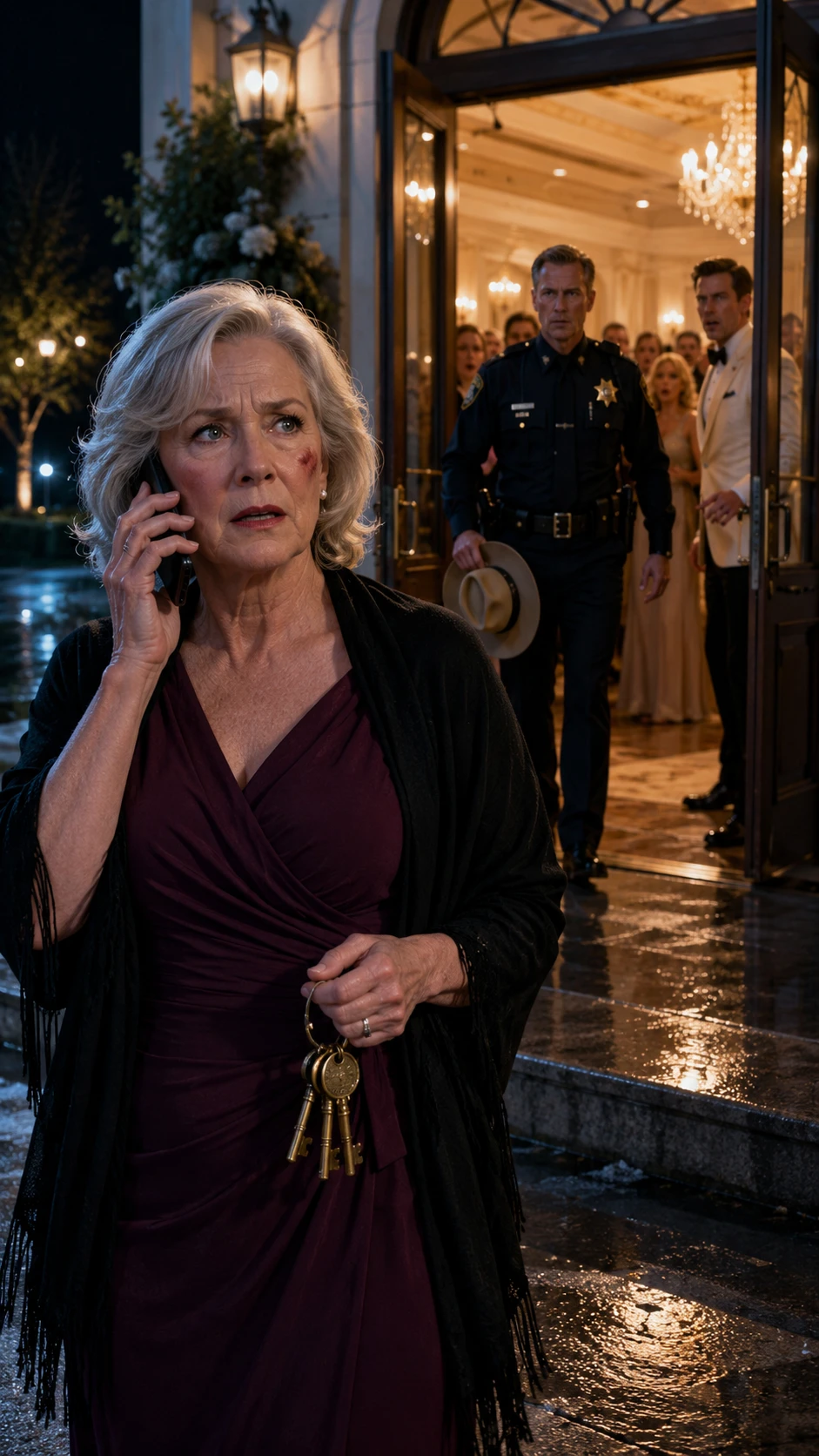
I stepped outside into the cold night air, where the sounds of the reception became muffled behind heavy doors. The autumn wind cut across the stone terrace. My hands shook as I pulled my phone from my purse, but not from fear now.
From certainty.
I had prayed all night I would not need to make that call.
But Marcus had just made the choice for me.
I dialed the number from memory.
The line picked up on the first ring.
When the familiar voice answered, I said only four words.
“Come in now, Sheriff.”
There was a pause.
Then a calm reply.
“On my way.”
I lowered the phone and stood very still, staring at my own reflection in the dark glass doors. The red mark on my cheek looked almost unreal, like stage makeup at a performance too ugly to be true.
But it was true.
All of it.
And in a few moments, the truth Marcus had been so eager to hide was about to walk right through those doors.
I had first met Marcus a year earlier at the county fundraiser Lily insisted I attend.
“He’s different, Mama,” she had said, glowing in a way only daughters in love can glow. “He’s driven. Smart. He sees big possibilities.”
He certainly looked the part.
Marcus wore tailored suits, spoke with practiced confidence, and knew exactly how long to hold eye contact to make people think he was sincere. He asked intelligent questions. He laughed at the right moments. He called me ma’am and carried my coat to the car.
For the first two months, I thought perhaps Lily had finally found someone steady.
Then little things began to show.
He corrected her in public.
He ordered for her at restaurants.
He once told her, right in front of me, that the blue dress she wore made her “look broader through the middle.” He smiled when he said it, as if cruelty wrapped in charm didn’t still cut.
When I confronted Lily, she brushed it off.
“He’s under stress.”
“He didn’t mean it that way.”
“You don’t understand how ambitious he is.”
But I had lived too long, buried too much, and survived too many hard men to mistake control for love.
Then came the papers.
Three weeks before the wedding, Marcus’s lawyer visited my farmhouse with a stack of documents and a polished explanation. They were, he said, “routine wedding cost agreements” and “liability protections” since the reception would feature family assets and private property references in the vows and photos.
It sounded absurd even then.
But Harold had been in the hospital that week, Lily had been crying every time I asked about the wedding, and my arthritis was flaring so badly I could hardly hold a pen. I skimmed. I signed. I hated myself the moment the lawyer drove away.
That night, I called my oldest friend, Evelyn Price.
Evelyn had served as county clerk for twenty-six years before retiring. If there was anything rotten in paperwork, she could smell it from three counties away.
She came the next morning with reading glasses, a legal pad, and the expression of a woman preparing to gut a snake.
She didn’t even make it through the first page before she whispered, “Oh, Martha. These aren’t wedding forms. These are preliminary property transfer agreements.”
I thought I might faint.
We spent the next two hours going through every clause. Hidden among legal jargon and cross-references was a plan so slick and ugly it made my hands go cold. Marcus had intended to gain management authority over the farm immediately after the wedding, then challenge my competency if I resisted. There were notes attached from his office suggesting that due to my age, it would be easy to argue I signed willingly but no longer remembered doing so.
He was planning to paint me as senile.
I wanted to march straight to Lily and expose him.
But Evelyn stopped me.
“Not yet,” she said. “Men like this don’t unravel when cornered in private. They lie. They charm. They isolate. If Lily’s already under his thumb, he’ll turn this around before you finish your first sentence.”
“Then what do I do?”
Evelyn looked at me for a long time.
Then she smiled.
“You let him believe he’s winning.”
That was when she made the second call.
Not to a lawyer.
To Sheriff Daniel Cross.
Daniel had been George’s friend since high school, a steady man with a quiet voice and the patience of granite. By then he had already heard whispers about Marcus—small contractors cheated, debts disputed, one elderly widow claiming she’d nearly signed over mineral rights before her son intervened. Nothing enough to charge. Nothing enough to stop him.
Yet.
So we built a trap.
Evelyn prepared new paperwork that looked nearly identical to the originals. I signed those too—only this time, every clause had been rewritten. The documents did not transfer my farm to Marcus.
They created an irrevocable agricultural land trust.
Control of the farm would never belong to a spouse, investor, or outside developer. Not Lily. Not Marcus. Not anyone who married into the family. The land, the barn, the equipment, even the future profits would be protected under a board of oversight chaired by the county historical conservancy until one condition was met:
The next true heir had to choose the farm freely, without coercion.
Marcus, of course, never bothered to read past the signature lines. Men like him never do when greed blinds them.
But Daniel wanted more than fraud.
He wanted evidence of coercion, assault, extortion—something undeniable.
So we waited.
And tonight, Marcus delivered it in front of two hundred witnesses.
The ballroom doors swung open.
Warm golden light spilled onto the stone terrace.
Sheriff Daniel Cross stepped through wearing his dark uniform, his tan cowboy hat in one hand, his face carved into a hard, controlled calm. Behind him, Marcus appeared in the doorway, breathing fast, fury flashing in his eyes.
“This is ridiculous,” Marcus barked. “She’s unstable. She’s causing a scene.”
Daniel didn’t even look at him at first. He looked at me.
His gaze flicked to my cheek.
A muscle tightened in his jaw.
Then he turned to Marcus. “Step away from her.”
Marcus laughed. “This is a family matter.”
“No,” Daniel said, voice low as thunder rolling over distant hills. “It became a criminal matter the second you hit her.”
A ripple of shock moved through the crowd clustered inside the ballroom doors.
Denise swept forward, pearls trembling at her throat. “Sheriff, honestly, this old woman is confused—”
“Careful,” Daniel said, without raising his voice. “I’d think very carefully before you finish that sentence.”
Inside, guests were standing now, craning necks, whispering, lifting phones. Lily stood just inside the doorway, white-faced, staring at me as if she were seeing me clearly for the first time all evening.
Marcus spread his hands, performing innocence. “She signed the farm over. Ask her yourself.”
“Oh, I know what she signed,” I said.
He turned sharply toward me.
And for the first time all night, I saw uncertainty crack his confidence.
I reached into my purse and drew out the antique brass key ring George had given me on our tenth anniversary—the same keys Marcus had demanded like a conqueror collecting tribute.
I lifted them between us.
“These,” I said, “open barns, gates, tack rooms, storage sheds, and the feed house.”
Marcus’s eyes fixed on them.
“They do not,” I continued, “open ownership.”
His expression hardened. “What are you talking about?”
I smiled then.
Not kindly.
“You never read the final documents, did you?”
Silence.
Even the wind seemed to stop.
Denise’s face drained of color. “Marcus?”
“The farm,” I said, my voice carrying through the open ballroom, “was transferred three weeks ago. Not to Lily. Not to you. Not to any developer, lender, or spouse.”
Marcus stared at me.
I took one step closer.
“It now belongs to the Hayes Agricultural Trust.”
His face went blank.
Then furious.
“That’s impossible.”
“It’s filed,” Daniel said. “Recorded and witnessed.”
Marcus lunged toward me.
Daniel moved faster.
In one brutal, efficient motion, he caught Marcus’s arm, twisted it behind his back, and slammed him against the stone doorframe. Gasps erupted from the guests.
“Marcus Vale,” Daniel said, snapping cold steel around one wrist, “you are being detained on suspicion of assault, attempted fraud, coercive financial abuse, and document deception pending formal charges.”
“Get your hands off me!” Marcus shouted, thrashing.
Lily gave a strangled cry.
Denise began screaming about lawyers.
Phones rose everywhere now, capturing every second.
I should have felt triumph.
Instead, what I felt was grief.
Because while Marcus struggled in handcuffs and Denise shouted herself hoarse, my daughter stood there like a little girl lost in a burning house.
Then Lily whispered, “Mom?”
I looked at her.
Really looked.
And suddenly I saw it—the truth that had been there all along, hidden beneath makeup and lace and trained smiles.
The faint yellowing bruise beneath the powder on her wrist.
The way she flinched whenever Marcus raised his voice.
The terror in her eyes.
Not greed.
Not betrayal.
Fear.
My heart nearly stopped.
“Lily,” I said, stepping toward her, “come here.”
She didn’t move.
Marcus twisted his head, wild-eyed, and shouted, “Don’t you dare go with her!”
Lily jerked like she’d been struck again.
And that was the moment everything changed.
Not because of what she did.
But because of what another voice said from the back of the room.
“Actually,” came a clear, trembling female voice, “she won’t be going with either of you.”
The crowd parted.
A young woman stepped forward from among the guests—thin, blonde, maybe twenty-six, wearing a catering uniform under a black serving jacket. I had noticed her earlier carrying trays of champagne, but now she was staring at Marcus with an expression so raw and haunted that the room seemed to tilt.
Marcus went white.
Not pale.
White.
The woman swallowed hard. “My name is Anna Reed.”
Lily frowned in confusion.
Marcus stopped fighting.
Denise made a small choking sound.
Anna looked at Lily first, and tears filled her eyes. “I’m sorry. I’m so sorry to do this tonight. But he was going to do to you what he did to my mother.”
The room fell into a silence deeper than before.
Anna reached into her serving apron and pulled out a folded photograph.
Daniel took it from her, opened it, and handed it to me.
My fingers trembled.
It was a picture of a farm.
My farm.
Taken thirty-two years earlier.
George stood in front of the barn, younger and smiling, holding a baby wrapped in a pink blanket.
I looked up sharply.
Anna’s voice cracked. “My mother worked one summer on your farm when she was seventeen. Before she died last year, she told me the truth. George Hayes was my father.”
The world vanished.
I couldn’t breathe.
I stared at her face—at the shape of her mouth, the green in her eyes, the exact tilt of her chin.
George.
Oh, dear God.
George.
Lily let out a broken whisper. “What?”
Anna was crying openly now. “My mother never wanted anything. She never asked for money. She kept the truth hidden because your father married your mother and she refused to break that family apart. But when she was dying, she made me promise I would tell the truth if that man”—she pointed at Marcus with a shaking hand—“ever tried to take what wasn’t his.”
My knees nearly gave way.
Harold caught my arm from behind.
Marcus’s mouth opened and closed, but no sound came out.
Anna took a breath so shaky it looked painful. “Marcus found me six months ago. He’d hired someone to search old land records and probate archives. He learned about me before any of you did. He promised me money if I stayed quiet. Then he threatened to expose everything publicly in the ugliest way possible unless I helped him prove Lily wasn’t the only heir.”
Lily looked as if she had been struck by lightning.
I think perhaps I had too.
Anna’s face crumpled. “I refused. That’s why I took this job tonight. I came to tell you myself before he could use me.”
No one moved.
No one spoke.
Daniel’s grip on Marcus tightened as the truth settled over the room like ash.
And then, through the wreckage of it all, one realization rose above every other.
Marcus hadn’t wanted the farm because Lily was the heir.
He had wanted it because he had already discovered there were two daughters—one known, one hidden—and he planned to use that secret to tear the family apart, invalidate any clean inheritance, and force a sale while we drowned in scandal.
It was monstrous.
It was brilliant.
And it had failed.
I looked at Anna again.
At George’s eyes in a stranger’s face.
At thirty-two years of silence standing in front of me, trembling.
My heart should have broken from betrayal.
It did.
But something even stranger happened too.
I saw her fear.
Her shame.
Her longing.
And I knew, with a sudden aching certainty, that this young woman had not come to steal from me.
She had come to save us.
Lily began to cry—not delicate bridal tears, but harsh, shattered sobs torn from somewhere deep. She crossed the room like someone waking from a nightmare and stopped in front of Anna.
“You’re my sister?” she whispered.
Anna nodded once.
Lily stared at her for one suspended second.
Then she threw her arms around her.
The entire ballroom exhaled.
I pressed my hand to my mouth and wept.
Not for the ruined wedding.
Not for the slap.
Not even for George’s long-buried betrayal.
I wept because in the same night I nearly lost everything, I found a daughter I never knew I had—and Lily found the one person Marcus never imagined she would choose over him.
Daniel led Marcus away in handcuffs while Denise shouted after him, her voice shrill and useless.
The guests would talk for years. The newspapers would feast on it. The town would hum with gossip until Christmas.
Let them.
Because by the time dawn rose over the east oak, the farm would still be standing.
George would still rest beneath his tree.