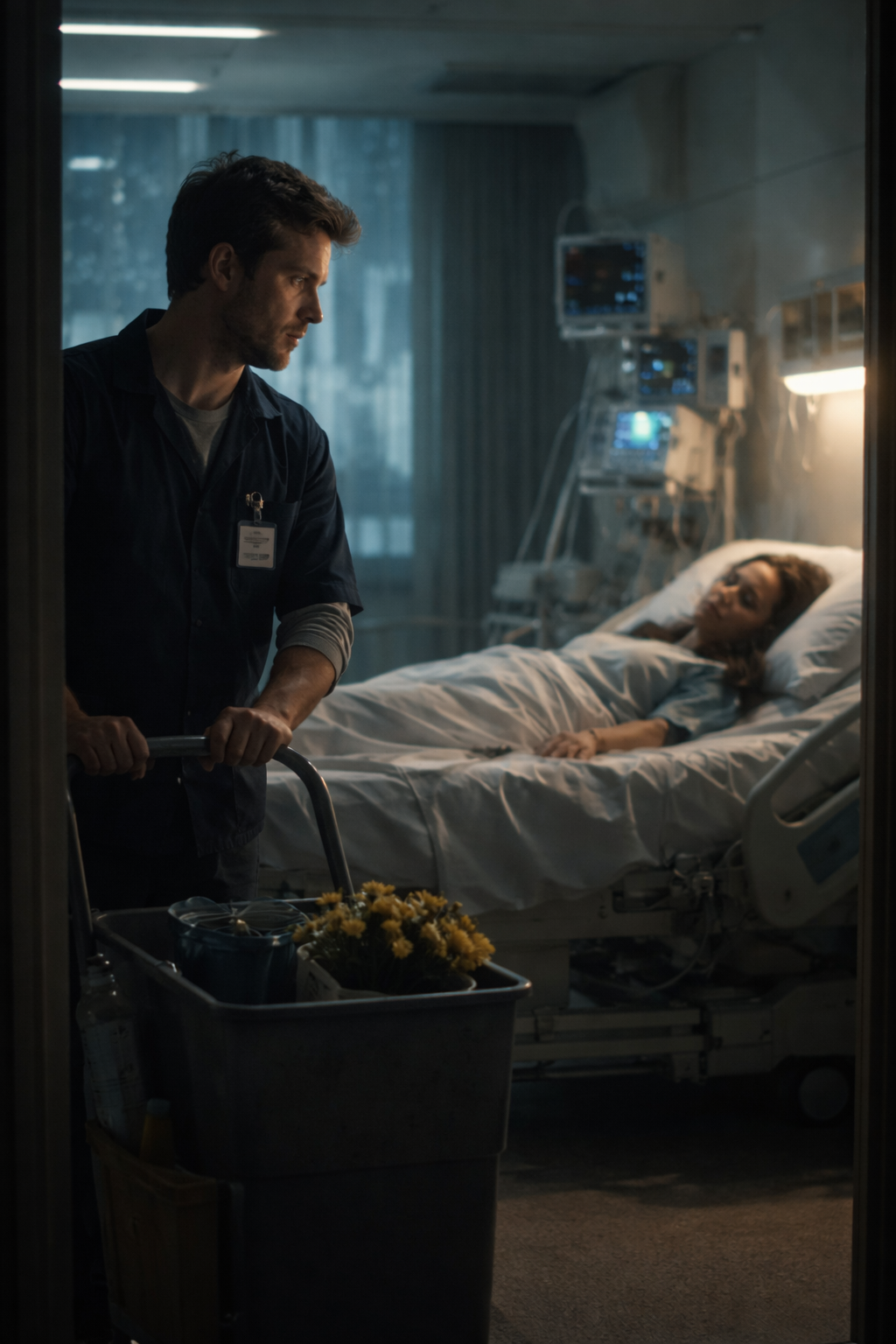
Rain came in sideways off Puget Sound that October night, needling the glass of Street Aurora Medical Center until the whole building seemed to hum with cold. The city outside looked blurred, unfinished, like God had dragged a wet thumb across the skyline, and inside, under the hard glow of hospital lights, Ethan Brooks pushed his cleaning cart down Corridor C and told himself not to forget Lily’s aquarium permission slip again.
He was thirty-eight, tired in the bones, and so practiced at carrying too much that he barely noticed the weight anymore. Single father. Night janitor. Former engineering student. Divorced husband. Keeper of small emergencies. He had two children asleep at home in a cheap apartment with a radiator that clanked like a dying engine and a refrigerator door that had to be kicked shut. He had exactly ninety-three dollars until payday, a car that coughed every morning before agreeing to start, and a son who still believed bedtime songs could keep monsters out of closets.
That belief mattered to Ethan more than he ever said aloud.
Tucked into the side of his cart was a small bunch of yellow chrysanthemums wrapped in crackling plastic. They were meant for Mrs. Hargrove in room 408, a retired schoolteacher recovering from hip surgery whose family visited just often enough to tell themselves they were trying. Ethan had gotten into the habit of bringing small things to lonely patients. A candy bar if their chart allowed it. A magazine from the break room. A four-dollar bouquet from the gas station. Nothing grand—just proof that someone had thought of them.
He cut through the fourth-floor ICU because the service elevator was dead again.
That was the only reason.
Later, when everything in his life had been torn open and reassembled in a shape he never could have imagined, Ethan would think about that detail until it hurt. A broken elevator. A shortcut. A wrong turn. That was all it took.
The ICU felt like another country. The air there was sharper, colder, cleaner. Machines whispered and beeped in strange little languages. The lights were dimmer, the shadows longer. Time didn’t move there the way it moved anywhere else. It pooled. It stalled. It waited.
At the nurses’ station, Gerald gave Ethan a brief nod without looking up. Gerald had worked nights for eleven years and seemed to communicate mostly through eyebrow movements and silence.
Ethan nodded back and kept going.
Then, just beyond the bend, he heard music.
Not from a radio. Not from a phone speaker. It was too soft for that. Just a thin thread of melody drifting through a half-open ICU door, as if someone inside the room had left a dream playing by mistake.
Ethan stopped.
He glanced toward the room number, frowned, and realized he’d already pushed his cart a few feet past where he meant to go. He should have kept moving. He should have minded his business.
Instead, he turned.
Inside the room, a woman lay motionless in a hospital bed. Her face was pale but striking, the kind of face people turned twice to look at, even now beneath the dull glow of machines and the cold blur of rain beyond the window. Dark hair spread over the pillow. IV lines. Oxygen cannula. A monitor pulsing steady green above her shoulder.
She looked expensive, Ethan thought immediately, then felt guilty for it.
Not rich in the loud way some people were rich. Not flashy. She looked like power made human—contained, elegant, impossible to ignore even in complete stillness.
The room was empty.
Ethan hesitated at the doorway. “Sorry,” he murmured. “Wrong room.”
No answer, of course.
He set the chrysanthemums down on the little table by the bed out of reflex, then almost laughed at himself. “Not for you,” he said softly. “Those belong to somebody else.”
Still nothing.
The silence in the room pressed on him.
He looked at her again, really looked this time, and something inside him shifted. It wasn’t romance. It wasn’t even pity. It was recognition. Not of her face, but of aloneness. Of being somewhere difficult with no one there to witness it. Ethan knew that feeling better than he knew his own reflection.
“My son fell asleep in mashed potatoes yesterday,” he said, because somehow the silence felt too cruel. “Face-first. Thought I was gonna have a heart attack.”
The monitor answered with a soft, indifferent beep.
He should have left.
Instead, with one hand resting lightly on the bed rail, Ethan began to hum.
It was the lullaby he’d sung to Lily after thunderstorms and to Noah after nightmares. An old, plain tune. Nothing special. A melody worn smooth by repetition and love.
Halfway through the second line, the woman’s finger twitched.
Ethan stopped singing.
He stared.
Maybe exhaustion was making him hallucinate. Maybe he wanted the world to answer back so badly he was inventing movement where there was none.
Then her hand moved again.
A sharp voice behind him said, “Don’t stop.”
Ethan turned so fast he nearly hit the bed rail. Gerald stood in the doorway, tablet hanging forgotten at his side, all the composure drained from his face.
“What?”
“Sing,” Gerald snapped. “Now.”
“I—I don’t understand—”
“Do it!”
So Ethan did.
His voice came out shaky this time, thin and raw in the cold room. The melody trembled. The monitor changed. Not dramatically at first, but enough that Gerald lunged forward, eyes locked on the screen. Then the woman’s eyelids fluttered.
Once.
Twice.
Alarms exploded into life.
Within seconds the room filled with people—nurses, a resident, two respiratory techs, then a physician Ethan had seen before but never spoken to. Orders flew. Machines were checked. Vitals were called out. Somebody shoved Ethan gently toward the wall, then farther, until he was flattened against the doorway clutching the empty flower wrapper in one fist.
The woman’s lips parted.
Her voice, when it came, was so faint Ethan thought he imagined it.
“…Ethan.”
Everything in the room seemed to stop.
Gerald stared at him.
The physician turned.
Even Ethan forgot how to breathe.
“How does she know your name?” Gerald demanded.
“I don’t—I’ve never seen her before.”
But that wasn’t entirely true.
He knew her face.
Not from life. From newspapers. From business magazines abandoned in waiting rooms. From television screens mounted in airport bars years ago, back when he and his wife used to talk about taking trips they never took.
Vivian Vale. CEO of Vale Meridian Technologies. Billionaire. Corporate ghost story. One of the most powerful women in the Pacific Northwest. And now she was staring at him with unfocused eyes from the middle of a medical miracle and whispering his name like it belonged there.
By dawn, Ethan had been interviewed by hospital administration, security, and a doctor from neurology who kept asking him to repeat every detail of what had happened. He gave the same answer each time because it was the truth.
“I took a shortcut. I heard music. I went in. I sang.”
When he finally got home, Lily was already up at the kitchen table, coloring fish onto the back of a cereal box.
“You forgot to sign it again,” she said, pointing to the aquarium permission slip.
Ethan signed it automatically, his hand shaking.
Noah wandered in rubbing one eye. “Daddy, why do you look scared?”
Because a woman with half a billion dollars and a coma chart had said my name like a prayer, Ethan thought.
Instead he smiled weakly. “Long night.”
He got three hours of sleep before his phone rang.
Not his cell—his apartment landline, which almost nobody used.
“Mr. Brooks?” a woman asked. Her voice was clipped, polished, expensive. “This is Marianne Cole, chief of staff to Ms. Vivian Vale. Ms. Vale is awake. She is asking to see you.”
Ethan sat up so fast he nearly pulled a muscle in his back.
“What for?”
A pause.
“Mr. Brooks,” Marianne said carefully, “that is what all of us would like to know.”
Vivian’s recovery stunned the hospital.
Three weeks in a coma after a car accident on Mercer Bridge. Minimal response. Poor outlook. Then a janitor walked into the wrong room and sang, and by morning she was asking for tea, legal counsel, and Ethan Brooks.
When Ethan entered her private room two days later, he felt like he was walking into a trap built out of silk and glass. Two suited security men stood outside. Marianne sat in a corner with a tablet. Vivian herself was upright in bed, pale but unmistakably formidable, her dark eyes bright and unnervingly clear.
“Close the door,” she said.
Ethan obeyed.
For a moment she just looked at him. Really looked. It made him deeply uncomfortable.
Then, to his astonishment, tears filled her eyes.
“You sound exactly like him,” she whispered.
“Like who?”
“My brother.”
The room tilted.
Vivian clasped her hands to keep them from shaking. “Twenty years ago, my mother gave birth to a son. She was nineteen. She wasn’t married, my grandfather was a monster, and when the boy was six months old, he disappeared.”
Ethan frowned. “Disappeared?”
“He was reported as a failed private adoption. Buried. Erased.” Her voice hardened on the last word. “My mother never believed the paperwork. She spent years trying to find him. She died before she could.”
Marianne lowered her eyes.
Vivian took a breath. “In the coma, I dreamed of being little again. I was in my mother’s kitchen. She was singing to the baby. The same lullaby you sang. When I heard your voice in that room, I woke up already knowing.”
Ethan gave a startled laugh. “You think I’m your brother because I know a lullaby?”
“No,” Vivian said. “I think you’re my brother because I already had your DNA.”
That punched every thought clean out of his head.
“What?”
Vivian nodded once to Marianne.
Marianne turned the tablet around. On the screen was a report from a consumer genealogy company Ethan vaguely recognized. His stomach dropped.
“Three months ago,” Vivian said, “my legal team was pursuing a sealed-adoption investigation. We used every database we could lawfully access. One of the family matches that surfaced belonged to your daughter.”
Ethan stared. “My daughter has never—”
“You submitted a cheek swab at a school science fair fundraiser last spring,” Marianne said quietly. “A genetics awareness project run through a university partner. The consent forms included database sharing.”
Lily.
The room spun harder.
Vivian’s voice broke. “I didn’t know how to approach you. Then the accident happened before I decided. And when I heard you sing…” She pressed trembling fingers to her lips. “I knew.”
Ethan sank into the chair beside her bed because his knees had stopped cooperating.
“No,” he said weakly. “No, that’s impossible. My parents—”
“Your adoptive parents,” Vivian corrected gently. “The ones who raised you. The ones listed on amended records. We found enough to petition the court for the sealed file. It came through while I was unconscious.”
She handed him a copy.
At the top was his birth name.
Elias Vale.
Ethan stared until the letters blurred.
He didn’t cry then. He didn’t speak. He just sat there while the past rose out of the ground and put a hand around his throat.
The weeks that followed were chaos wrapped in wonder.
There were legal consultations, press containment strategies, DNA confirmations, late-night conversations, and one catastrophic dinner where Noah asked Vivian if being a CEO meant she was “the boss of all computers.” Lily, more observant, watched Vivian the way children watch adults when they sense something enormous is happening.
“Are you really Dad’s sister?” she asked.
Vivian smiled through tears. “Yes.”
Lily considered that. “Then you’re my aunt.”
That was the first time Vivian openly sobbed.
For Ethan, the discovery fractured something old and healed something older. He loved the parents who raised him, even though they were gone now, even though they had hidden the truth. Yet every memory had shifted. Every unanswered feeling from childhood—every vague sense of being misplaced, every strange absence—now had a name.
But that was not the twist.
That came later.
Three months after Vivian woke, Ethan was called to the offices of Vale Meridian. He arrived in his one decent blazer, hands sweating, convinced there had been some mistake.
Vivian stood at the head of the conference table.
Beside her were attorneys.
In front of her was a folder.
“I’ve updated my will,” she said.
Ethan stiffened. “Vivian, no.”
“This isn’t charity.”
“I don’t want your money.”
Her expression sharpened. “Good. Because that’s not what this is.”
She slid the folder toward him.
Inside were documents forming a new charitable foundation seeded with two hundred million dollars. Not in his name. Not hers.
In their mother’s.
The Helena Vale Foundation for Displaced Children and Single-Parent Families.
Ethan looked up, stunned.
Vivian smiled softly. “You spent your whole life carrying what the world dropped on you. I built my whole life trying to outrun what was done to our family. I think maybe we were both walking toward this.”
He swallowed hard. “Why me?”
“Because,” she said, “you know what survival costs. And because the night I woke up, you didn’t sing to a CEO. You sang to someone who looked alone.”
He opened his mouth to answer.
Then the glass wall behind Vivian flickered with reflected movement from the lobby television.
Breaking news.
A federal investigation. Vale Meridian’s former chairman—Vivian’s late father’s business partner—had been arrested. Charges: fraud, child trafficking conspiracy, document falsification tied to illegal private adoptions dating back decades.
The man who had stolen Ethan’s life had been sitting on the company board until that morning.
Vivian went white.
Marianne gasped.
And Ethan, staring at the screen, understood the final, horrifying truth.
He had not been lost by accident.
He had been sold.
The lullaby in the ICU had not simply awakened a woman from a coma.
It had awakened a buried crime.
Within a year, the investigation spread across three states. More children were identified. Families were reunited. Headlines called it the Vale Reckoning. Reporters tried to turn Ethan into a symbol, but he refused every interview except one, and in that one he said only this:
“Some people survive because someone powerful saves them. Sometimes the truth is stranger. Sometimes a janitor with a tired voice walks into the wrong room, and the whole lie finally breaks.”
At home, life remained gloriously ordinary.
Noah still drew dragons that looked like buses. Lily still forgot her lunchbox twice a week. Ethan still checked on them while they slept, standing quietly in their doorway, letting the sound of their breathing steady him.
Only now, some nights, there was one more person beside him.
Vivian, barefoot on the worn apartment floor, listening to the children dream as if she were hearing lost music returned at last.
And every so often, when thunder rolled in from the Sound and Noah called out from his room, Ethan would sit on the edge of the bed and sing that old lullaby into the dark.
Not because songs could erase the past.
Not because miracles happened twice.
But because once—just once—a man with a mop bucket, a broken elevator, and a heart too kind for the life he’d been given had sung to a stranger in a hospital room…
…and discovered she had been family all along.