He Held Up the Blanket They Said Meant Nothing. Then He Told the Whole Gym Who His Real Mother Was.
By the time my son’s high school graduation began, the gym already felt too hot to breathe in—thick with nerves, cheap flower bouquets, camera flashes, and the kind of pride that makes people cry before anything has even happened.
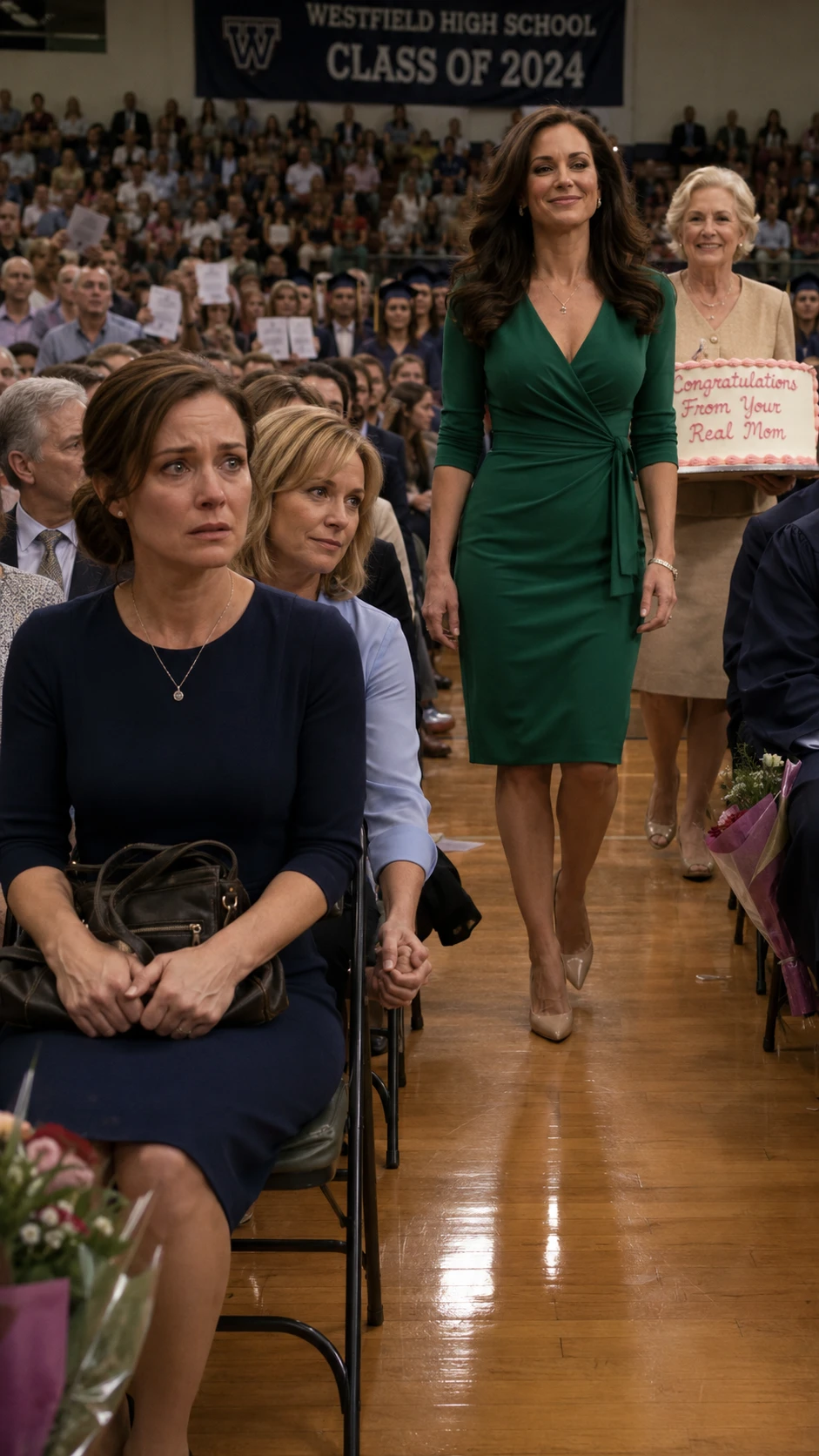
Programs fluttered like paper fans. A violin in the corner kept scraping through the same wrong note. Somewhere behind me, an old woman was already sniffling into a tissue. I sat in the third row with both hands wrapped around my purse, trying not to fall apart before Dylan’s name was called.
Then my sister walked in like she was the honored guest.
Vanessa came down the center aisle in a fitted green wrap dress and glossy heels, smiling that smooth smile she only used when she wanted a room to believe something false. Right behind her, our mother followed with a white bakery cake trimmed in pink frosting. I looked at the writing once, then again, because my mind would not accept what my eyes were seeing.
Congratulations From Your Real Mom.
The whole gym seemed to go underwater.
Claire, my best friend, reached beneath the folding chairs and squeezed my hand, because she knew exactly what my family was doing. They had been doing versions of it for nineteen years.
My name is Myra Summers. I was twenty-two when my sixteen-year-old sister got pregnant, and my parents decided the greatest emergency was not a terrified girl or a baby coming into the world. It was gossip. Church whispers. Neighbors talking. Family embarrassment. Before that week was over, my mother slid a faded yellow baby blanket across the kitchen table and said four words that rearranged my life forever.
“Help your sister, Myra.”
Help meant giving up everything that belonged to me.
I let go of my graduate scholarship. I brought a newborn home to a tiny one-bedroom apartment with a borrowed crib, dollar-store diapers, and less than a hundred dollars left in my checking account. I learned how to function on almost no sleep. I stirred canned soup with one hand while rocking a screaming baby with the other. I wrapped Christmas presents in newspaper because real wrapping paper meant not buying milk. I signed every school form, every doctor form, every emergency contact line. I stayed through fevers, storms, braces, nightmares, science fairs, heartbreak, and every ordinary little miracle that makes a mother.
My family called it helping.
Vanessa called it temporary.
She checked in just enough to keep up appearances. A random phone call. A birthday card sent late. A promise she never meant to keep. Never enough to know his shoe size. Never enough to know that thunderstorms made him panic until he was nine. My mother hung Vanessa’s achievements over the fireplace like museum pieces, while Dylan’s school photos covered my refrigerator under a red ladybug magnet. In our family, Vanessa was always the shining future. I was just the structure holding it all up.
But Dylan noticed more than they thought.
When he was eight, he asked if he could call me Mom. When he was thirteen, I told him the truth—not dramatically, not with bitterness. Just facts. Signed papers. Responsibilities transferred. A baby handed over. He sat very still and listened, then said quietly, “I’m not mad at her. I’m sad for her. She missed everything.”
I carried those words inside me for years.
By junior year, his teachers were calling him exceptional. Debate captain. Straight-A student. Volunteer tutor on Saturdays. His college essay was titled The Woman Who Chose Me. I read it in my Honda outside the school parking lot and cried so hard I had to lower the window to breathe. One sentence has never left me:
Biology is an accident. Love is a decision.
Then came the family group chat he was never meant to see. My relatives discussing him like a coat stored in a closet. When Vanessa is ready, she’ll take him back. Myra is only keeping him for now. I didn’t yell. I didn’t plead. I went upstairs, opened the fireproof safe beneath my bed, and touched every document with my name on it—guardianship papers, school records, medical forms, nineteen years of proof. That night, something in me stopped asking to be recognized.
Six weeks before graduation, my mother called and finally told the truth. Vanessa had started dating a wealthy developer in Chicago. “He believes in traditional family values,” my mother said proudly. Then she delivered the part that made my stomach turn. “This could finally be Vanessa’s chance.”
Three weeks later, Vanessa messaged Dylan on Instagram as if motherhood could be restarted with a cheerful hello. He answered politely. Coldly. No warmth. No “Mom.” On the morning of graduation, I watched him tuck that same faded yellow baby blanket into the inside pocket of his vest.
“For luck,” he said.
Now, in the gym, Vanessa touched my shoulder and smiled sweetly for the crowd. “Thank you for taking care of my son,” she said in a voice soft enough for everyone nearby to hear.
Then she bent lower and whispered into my ear, “You’ve been a wonderful babysitter.”
I said nothing.
Across the gym, Dylan was staring at us, and the expression on his face gave me one clear message.
Wait.
So I waited through the speeches, the applause, the fake smiles, and the cake balanced on Vanessa’s lap like a public claim. Then the principal announced the valedictorian address. Dylan walked to the podium in his navy gown, adjusted the microphone, and began. At first, it sounded normal. Gratitude. Memories. A few jokes. The audience laughed. Vanessa laughed loudest.
Then Dylan stopped.
He folded his speech in half and laid it on the podium.
The gym went still.
He lifted his eyes, searched the crowd, and found me.
“The person I want to thank most today,” he said, “is the woman who was twenty-two years old when she was handed a newborn and told, ‘This is your responsibility now.’”
Vanessa’s smile disappeared.
Then Dylan reached inside his vest and pulled out the faded yellow baby blanket.
A rustle moved across the gym like wind over dry leaves.
He held the blanket up carefully with both hands, not like it was old fabric, but like it was evidence. Like it was sacred.
“This,” he said, his voice steady, “is the blanket I was wrapped in when I came home from the hospital. My aunt kept it. She kept me too.”
Someone near the back gasped.
My mother’s face drained of color so quickly I thought she might faint. Vanessa sat frozen, one hand still resting on the cake box, the pink writing suddenly looking childish and vicious at the same time.
Dylan glanced down once at the folded speech, then back up. “I wrote a different valedictorian speech. It was full of the usual things. Hard work. Opportunity. Teachers. The future. All of that matters. But if I stand here and talk about achievement without telling the truth about love, then none of those words mean anything.”
The principal shifted in his chair behind him, alarmed, but Dylan kept going.
“I was raised by a woman who gave up her future so I could have mine. She was told she was helping. But what she really did was become a mother overnight with no money, no sleep, no applause, and no guarantee anyone would ever thank her.”
I pressed my fingertips against my mouth. Claire was crying openly now, one hand clutching mine, the other pressed to her own chest.
“She packed my lunches,” Dylan said. “She sat through every fever. She stayed up all night when I had pneumonia in third grade. She worked extra shifts when I needed braces. She learned algebra again so she could help me with homework. She came to every debate meet, every band concert, every science fair, every parent conference. She knows I hate cantaloupe, love thunderstorms now but didn’t when I was little, and still check the back seat at night because I watched one scary movie when I was eleven and never fully recovered.”
A shaky laugh broke through the silence.
Dylan’s mouth trembled then steadied. “She is the reason I am standing here.”
He turned fully toward the audience. “My mother is Myra Summers.”
The gym exploded.
Not with chaos at first—with sound. A gasp, then applause from one corner, then more applause, then people rising to their feet in a strange, stunned wave. Claire stood first beside me. Then the old man in front of us. Then two teachers near the aisle. Then nearly everyone.
I stayed seated, not because I wanted to, but because my knees had forgotten how.
Vanessa shot to her feet.
“That is not appropriate,” she snapped, loud enough for the microphone to catch. “Dylan, stop this right now.”
The room quieted just enough for the ugliness to land.
Dylan looked at her the way a person looks at a stranger who has used their name without permission. “No,” he said.
It was one small word, but I felt it all the way in my bones.
Vanessa’s face turned hard. “I’m your mother.”
He didn’t raise his voice. “You are the woman who gave birth to me.”
The gym went silent again.
Then he looked toward the principal. “Sir, I know I’m not following the approved speech. I’m sorry for that. But I’ve been listening to people rewrite my life since before I could understand the words. I am done letting them.”
The principal, to my amazement, gave one slow nod and leaned back.
Dylan continued. “For years, some members of my family talked about me like I was on loan. Like I was something temporary. Like one day I could be reclaimed for convenience, image, or timing. But a child is not a coat you leave in storage until it matches your life.”
A few people murmured. Someone said, “That’s right,” from the bleachers.
He lifted the blanket again. “This stayed in my mother’s drawer for nineteen years. Not because she was waiting to give me back. Because she never let go of the day I was placed in her arms and became hers in every way that mattered.”
At that, my mother abruptly stood. “That is enough,” she called. “This is a family matter.”
Dylan turned toward her. “Exactly,” he said. “And for nineteen years, everyone expected the wrong woman to stay quiet.”
I had never seen my mother sit down so fast.
Vanessa looked around, realizing for the first time that the room was no longer hers. The cake wobbled in her hands. Her mouth opened, closed, opened again. Finally she said, “I was young.”
Dylan nodded once. “You were.”
“And I made mistakes.”
“Yes.”
Her eyes brightened, hopeful, because she thought agreement meant mercy.
Then he said, “But being young explains a choice. It doesn’t erase nineteen years of other choices.”
The breath left her face.
He stepped away from the podium, blanket still in his hand, and came down the side stairs from the stage. Every eye in the gym followed him. Even the violinist had stopped moving.
When he reached the front row, he stood directly in front of me.
“Stand up, Mom,” he said softly.
I looked at him through tears so thick the whole gym had gone to watercolor. “Dylan—”
“Please.”
I stood.
He turned back toward the audience, put one arm around my shoulders, and held the yellow blanket between us like a banner no one could burn anymore.
“This is the woman who chose me,” he said. “Every day. When it was hard. When it was unfair. When no one thanked her. This is my mother. And if any college, any employer, any future person in my life wants to know where I learned commitment, sacrifice, and love—I learned it from her.”
People were crying everywhere now. Teachers. Parents. Students. The superintendent was dabbing his eyes with a folded program. Someone in the bleachers shouted, “Go, Mama!” and the whole room broke into laughter and applause at once.
Then Dylan reached into the pocket of his gown and pulled out a sealed envelope.
He handed it to me.
My fingers shook so badly I could barely open it. Inside was a printed letter on thick cream paper.
“Read the first line,” he whispered.
I looked down.
Dear Myra Summers, We are honored to offer you the newly established Ruth Campbell Family Scholarship for Returning Graduate Students…
I stared at it, unable to understand the words in the order they were arriving.
Dylan smiled through tears. “I asked Mr. Campbell to come today.”
A man stood near the back of the gym—silver-haired, expensive suit, kind eyes. I recognized him then from the newspaper. Ruth Campbell had been a beloved teacher in our district for thirty years. The scholarship was new, funded by her son, a real estate developer from Chicago.
Not Vanessa’s boyfriend.
Someone else entirely.
He walked down the aisle, smiling gently. “Your son sent me your story with your permission forms, your old academic records, and an essay you wrote before you gave up graduate school,” he said. “My mother did the same for her younger siblings. She never got to finish her degree. I created this scholarship for women like you.”
Vanessa went white as paper.
Dylan didn’t even look at her. “The man in Chicago?” he said quietly, so only our row could hear. “He never wanted a ready-made family. Grandma lied because it sounded prettier than the truth.”
Claire made a sound that was half laugh, half choke.
Mr. Campbell shook my hand and then Dylan’s, while the gym gave another round of applause—this time warmer, deeper, less shocked. The kind that rises when people know exactly what they are clapping for.
Vanessa set the cake down on an empty chair like it was suddenly too heavy to hold. My mother stared straight ahead, her face fixed and brittle.
For one wild second, I thought maybe that was the ending. Public truth. Public recognition. Justice, at last, arriving with stage lights and witnesses.
But real endings are quieter than that.
After the ceremony, when the crowd spilled across the parking lot in waves of navy gowns and flowers and flashing phones, Dylan and I walked together to my old Honda. He still had the blanket draped over one arm. The evening air was cool, and after the heat of the gym, it felt like stepping into another life.
He leaned against the car and said, “You okay?”
I laughed, because it came out somewhere between a sob and a cough. “Absolutely not.”
He smiled. “Good. Me neither.”
We stood there a moment, shoulder to shoulder.
Then I said the thing I had buried for nineteen years. “I never wanted you to feel chosen against someone else. I only wanted you to feel loved.”
He looked at me, wounded by the idea that I had ever doubted it. “Mom,” he said, “those are not opposites.”
Behind us, the gym doors opened again. Vanessa and my mother came out together.
Vanessa hesitated, then started toward us.
I felt Dylan straighten beside me.
But before she could say a word, he reached for my hand, squeezed it once, and together we turned away from them, toward the car, toward the future, toward the life no one would ever rename again.