“You stole the look, not the structure.”
I said it quietly.
Victoria Lane froze halfway down the grand staircase.
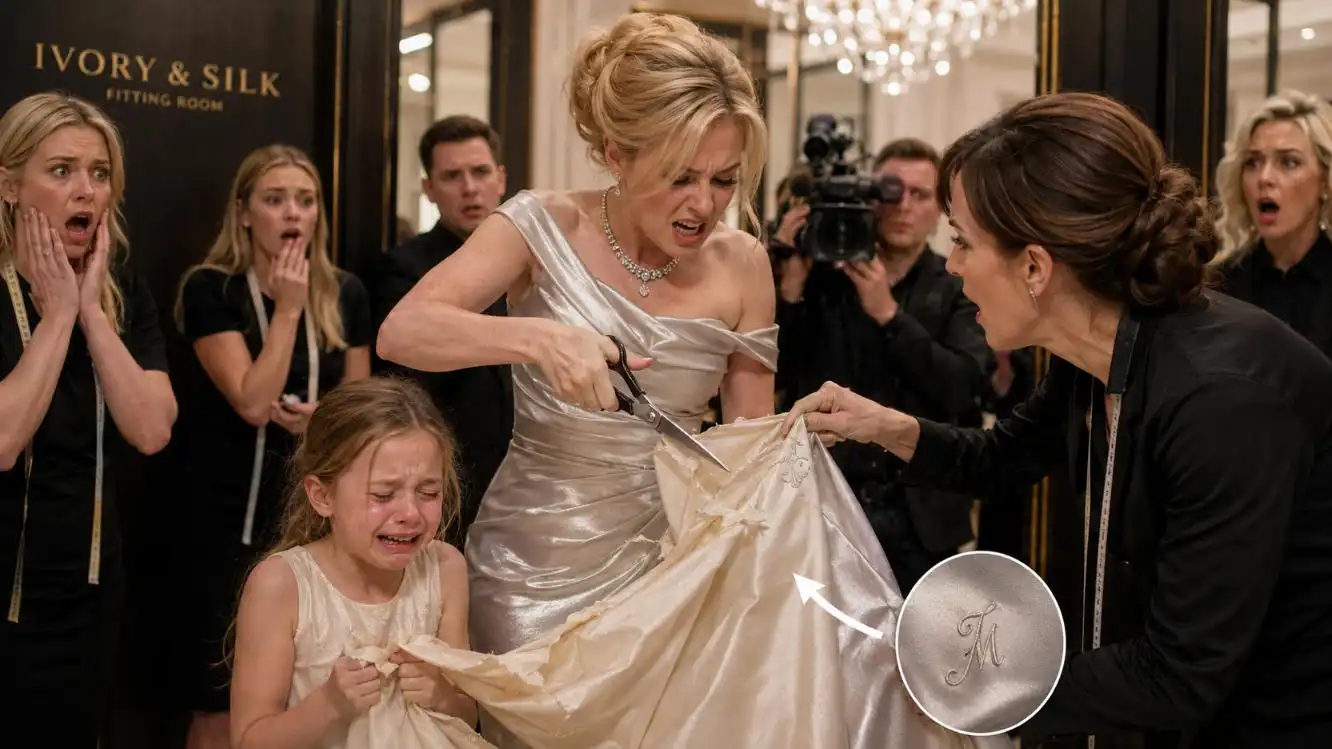
My daughter Lily was still crying beside the fitting room, her handmade ivory dress cut open at the skirt, one shoulder ribbon torn, tiny silk roses scattered on the carpet.
Victoria stood above us in a silver gown the whole city believed was hers.
But I knew every line of that dress.
Every hidden pleat.
Every curved seam.
Every secret weight point.
Because I had designed it.
And Victoria had stolen it.
She laughed first.
Cruel people always do that when truth gets too close.
“Clara,” she said softly, “you sound jealous.”
I looked down at Lily’s ruined dress.
Then back at the woman wearing my work like a crown.
“No,” I said. “I sound finished.”
Before fashion forgot me, people used to call me Clara Vale.
Not loudly.
Not in magazines.
Not on red carpets.
But in the rooms that mattered.
The back rooms.
The fitting rooms.
The quiet midnight studios where gowns were saved three hours before a gala.
I was the tailor designers called when beauty needed engineering.
I built corsets that didn’t bruise.
Trains that moved like water.
Hidden supports that let women breathe, dance, and look impossible under bright lights.
My signature was never flashy.
A curved inner waist seam.
A blue thread hidden inside the hem.
A tension system that held a gown together only if the maker understood where the pressure lived.
Victoria understood applause.
She never understood construction.
Years ago, she was my closest client.
Then my friend.
Then my thief.
She came into my studio when her husband’s money was new and her social circle still treated her like a visitor.
I dressed her.
Quietly.
Perfectly.
I taught her which shapes made her look powerful.
I altered every gown she bought from famous labels until reporters called her “the woman with impossible taste.”
Then she asked to see my sketch archive.
“Just inspiration,” she said.
I trusted her.
That was my mistake.
Six months later, my patterns appeared in her new “private couture capsule.”
Different fabric.
Same bones.
Same seam logic.
Same internal structure.
Same blue thread replaced with silver so she could pretend it was a signature.
When I confronted her, she smiled.
“Clara, no one knows who you are.”
That sentence did more damage than the theft.
Clients stopped calling.
A magazine credited Victoria with “redefining structural femininity.”
One designer dropped me after Victoria whispered I was unstable.
Then my husband got sick.
Bills came.
Grief came.
Fashion moved on.
I closed my studio and took private alteration work from home.
I told myself peace mattered more than recognition.
Then Lily grew old enough to ask why I kept old gowns covered in muslin.
“Were you a princess maker?” she asked.
I laughed for the first time in weeks.
“Something like that.”
For her sixth birthday, I made her a dress.
Not expensive.
Not grand.
Leftover ivory silk.
Hand-stitched roses.
A soft ribbon at the shoulder.
A tiny blue thread hidden inside the hem because she loved secrets.
She twirled in front of the mirror and whispered:
“Mommy, I feel like your best work.”
She was.
That evening was the city’s largest children’s hospital charity dinner.
Victoria chaired it.
I had been hired quietly to repair gowns backstage.
No public credit.
No table.
Just a service badge and my kit.
I accepted because the hospital mattered.
And because work was work.
Lily came with me because my sitter canceled and the event coordinator said children were welcome backstage before dinner.
I should have known Victoria would not allow anything beautiful to exist near her without trying to own it or break it.
The trouble started outside the fitting room.
Victoria was already dressed in silver.
Cameras waited downstairs.
Assistants hovered around her like she was royalty.
Then she saw Lily.
My daughter was standing under the warm hallway light, turning slowly to watch the silk roses move.
Victoria’s face changed.
Just for a second.
Recognition.
Not of Lily.
Of the work.
She knew the seam.
The hem.
The hand.
Mine.
“What a charming little copy,” she said.
Lily looked confused.
“My mommy made it.”
The hallway went cold.
Victoria stepped closer.
“Did she?”
I moved between them.
“Victoria, don’t.”
She smiled toward the assistants.
“Children should learn early that imitation has consequences.”
Then she picked up the silver scissors from the fitting table.
Before I could grab her wrist, she cut through Lily’s skirt.
The sound of silk splitting is soft.
That made it worse.
Lily screamed.
Victoria cut again, faster, slicing through the hand-stitched rose panel.
My daughter grabbed the fabric with both hands.
“Stop! Mommy made it!”
Victoria yanked the shoulder ribbon until it tore.
Then she shoved the ruined dress into my hands.
“Teach your child not to imitate her betters.”
Lily sobbed so hard she could barely breathe.
I dropped to my knees and wrapped my arms around her.
“You’re safe. I’ve got you.”
Victoria leaned closer.
“You always did get emotional around fabric.”
Then she turned toward the staircase.
Every person in that hallway stayed silent.
That is how powerful thieves survive.
Not because nobody knows.
Because nobody wants to be the first to speak.
Victoria paused at the stairs and looked back.
“What are you going to do, Clara? Sew revenge?”
I looked at her gown.
Really looked.
The silver fabric shimmered beautifully.
The outer silhouette was mine.
The hip lift.
The side drape.
The floating overskirt.
The sculpted neckline.
But then I saw the fatal flaw.
The inner anchor was missing.
She had copied the pattern from an old sketch, but not the handwritten construction notes.
She didn’t know the left tension seam had to be reinforced under the waist with a hidden anchor loop.
Without it, the overskirt would hold only while standing.
Walking might survive.
Sitting would stress it.
A ballroom bow would kill it.
And Victoria loved dramatic bows.
Always had.
That was when my anger became calm.
Not petty.
Precise.
A good tailor knows when fabric is already telling the truth.
I stood and handed Lily to my assistant, Mara.
“Take her to the green room. Warm tea. Don’t let anyone photograph her.”
Mara’s eyes were wet.
“Yes.”
Then I picked up one of the cut roses from Lily’s dress and placed it inside my sewing kit.
Not as evidence yet.
As a promise.
Downstairs, the dinner began.
The ballroom glittered.
Crystal lights.
Gold chairs.
White flowers.
Photographers.
Donors.
Designers.
Every person Victoria needed to impress.
She stood near the main table, laughing, waving, soaking in admiration.
People praised the silver gown.
“Genius structure.”
“Like architecture.”
“Victoria, you’ve outdone yourself.”
She accepted every compliment like a woman who had earned them.
I stood near the service entrance with my kit and watched the stolen dress breathe wrong.
Only a tailor would notice.
A slight pull at the left waist.
A ripple where no ripple should be.
The hidden stress traveling down the side seam.
Then the auction host called Victoria to the stage.
Of course, she turned it into theater.
She stepped into the center of the ballroom.
Lifted her arms.
Bowed deeply.
Too deeply.
The missing anchor gave way.
First, a soft pop.
Then a seam release.
Then the silver overskirt loosened from the waist and slid down over the full inner lining like a curtain falling off a stage.
Gasps filled the ballroom.
The dress did not expose her.
She was fully covered by the structured underlayer.
But the illusion collapsed.
The famous outer gown pooled around her ankles in shimmering pieces.
The draped side panel dangled from one hip.
The sculpted silhouette became a broken costume.
And every camera caught it.
Victoria grabbed at the fabric.
“What is happening?”
I walked forward.
Slowly.
Not smiling.
Not rushing.
I picked up one fallen silver panel and turned it inside out.
There it was.
The copied seam.
The stolen pattern mark.
And one fake silver thread where my blue thread should have been.
The room watched.
I held it up.
“This gown failed because whoever stole the design didn’t know how to build it.”
The ballroom went silent.
Victoria’s face turned white.
“Security,” she snapped.
But nobody moved.
A famous designer near the front table stood.
“Clara?”
He recognized me.
Not from magazines.
From workrooms.
The real places.
Then another woman stood.
An old client.
Then a museum costume curator.
One by one, people who had known my hands before Victoria stole my name began looking at the broken gown differently.
I opened my phone and projected the archive file onto the ballroom screen through the event technician Mara had already warned.
Original sketch.
Dated.
Signed.
Construction notes.
Blue-thread signature.
Photographs from my old studio.
Pattern registration.
Emails from Victoria requesting “temporary access” to my archive.
Then images of Victoria’s so-called original capsule.
Same structure.
Same seam logic.
Same theft.
Victoria shouted, “This is slander!”
I turned to the screen and showed the final image.
Lily in her ivory dress that afternoon.
Then the hallway security still.
Victoria cutting it.
The ballroom went dead quiet.
The stolen gown had embarrassed her.
The child’s ruined dress destroyed her.
A donor near the front whispered:
“She cut a little girl’s dress?”
The hospital chair stood up.
Victoria looked at him like he might save her.
He did not.
“Mrs. Lane,” he said, “you are removed from tonight’s program.”
Short.
Cold.
Final.
Victoria tried to gather the fallen silver fabric around her waist.
It only made the dress look worse.
Fashion people can forgive a failed seam.
They cannot forgive being fooled in public.
And mothers cannot forgive a woman who humiliates a child to protect a lie.
The videos spread before dessert.
Not just the gown collapse.
Everything.
The hallway footage.
Lily crying.
The side-by-side sketches.
The fake signature thread.
The moment Victoria realized the dress on her body was not proof of her genius.
It was proof of her theft.
By morning, her empire was burning.
Designers issued statements.
Former assistants came forward.
Pattern makers posted quiet receipts.
A seamstress from Chicago showed her stolen sleeve design.
A young bridal designer recognized her bodice structure in Victoria’s “exclusive collection.”
The plagiarism was not one mistake.
It was a system.
Victoria had built a fashion reputation by stealing from the women in workrooms.
Women without press teams.
Women without lawyers.
Women with rent due and children asleep under cutting tables.
This time, she had stolen from the wrong mother.
My attorneys filed first.
Copyright and design claims.
Trade dress documentation.
Professional defamation.
Business interference.
And one separate civil claim for intentionally destroying Lily’s dress and causing emotional harm to a child.
Victoria tried to settle quietly.
I refused.
Not because I wanted money most.
Because silence was how she had stolen for years.
At the hearing, Victoria’s lawyer said fashion is “inspired by shared ideas.”
My lawyer placed Lily’s cut dress on the evidence table.
Then the silver gown’s failed panel.
Then my original pattern.
Then the archive logs.
Then the hallway video.
The judge looked at Victoria and said:
“Inspiration does not require scissors in a child’s dress.”
That line made every fashion blog in the country.
Victoria’s contracts vanished.
Her charity posts disappeared.
Brands denied collaboration.
Social friends called it “tragic” in public and unfollowed her by lunch.
Her husband’s family issued a statement distancing itself from her “individual business conduct.”
That was society language for:
You are no longer useful to us.
She lost everything that depended on illusion.
And illusion had been her whole life.
As for me, I returned to the workroom.
Not immediately to fame.
First to Lily.
She would not wear dresses for weeks.
She asked if pretty clothes made people angry.
That question hurt more than any stolen sketch.
So I made her something simple.
Blue cotton.
Soft pockets.
No silk.
No roses.
Just comfort.
She touched the hem.
“Did you make it strong?”
“Yes.”
“Can bad scissors hurt it?”
“They can cut fabric,” I said. “But they can’t cut who made it.”
She thought about that.
Then asked:
“Can I help sew?”
So I taught her.
One stitch.
Then another.
Small hands.
Big focus.
A child repairing the world one thread at a time.
Months later, I reopened my studio under my own name.
Not hidden.
Not silent.
Clara Vale Atelier.
On the wall above the cutting table, I framed Lily’s ruined ivory dress.
People asked why I didn’t hide it away.
Because it was not shameful.
It was evidence.
Beside it, I framed the sentence:
Stolen beauty falls apart.
The first collection sold out before it launched.
Not because of scandal.
Because people finally knew whose hands had been holding the seams all along.
My comeback gown was called The Witness Dress.
Ivory silk.
Hand-stitched roses.
Blue thread inside every hem.
And a structure so perfect critics called it “architecture with a heartbeat.”
At the final show, Lily sat in the front row wearing the blue cotton dress we made together.
When the models walked, she leaned toward Mara and whispered:
“My mommy builds dresses that tell the truth.”
I heard her.
I had to turn away before the lights caught my tears.
Victoria tried one last time to reenter society a year later.
A small dinner.
A borrowed dress.
A vague apology about “creative overlap.”
No one bought it.
Not after the footage.
Not after the court ruling.
Not after every woman she stole from had finally found a voice.
She became a cautionary name in fashion schools:
Do not copy what you cannot construct.
Do not steal from the workroom.
And never mistake a quiet tailor for a powerless one.
Lily eventually wore silk again.
On her seventh birthday, she asked for a tiny rose dress.
I hesitated.
She noticed.
“Mommy,” she said, “bad people don’t get to keep roses.”
So I made it.
This time, Lily stitched one rose herself.
Crooked.
Beautiful.
Perfect.
At her birthday dinner, she twirled in the living room and laughed without looking over her shoulder.
That was the real victory.
Not Victoria’s humiliation.
Not the lawsuits.
Not the headlines.
The victory was my daughter believing beauty still belonged to her.
Money can buy gowns.
It can buy headlines, fake genius, and stolen applause for a while.
But it cannot buy craftsmanship.
And it cannot protect a thief who only copied the outside and never understood what held the truth together. 💔✨
So choose a side:
Stand with Clara and Lily, the mother and daughter who turned torn silk into justice…
Or defend Victoria, the plagiarist who cut a child’s dress and watched her stolen masterpiece fall apart in public.
Share this if you believe the hands that create the beauty deserve the credit. 👇🚨