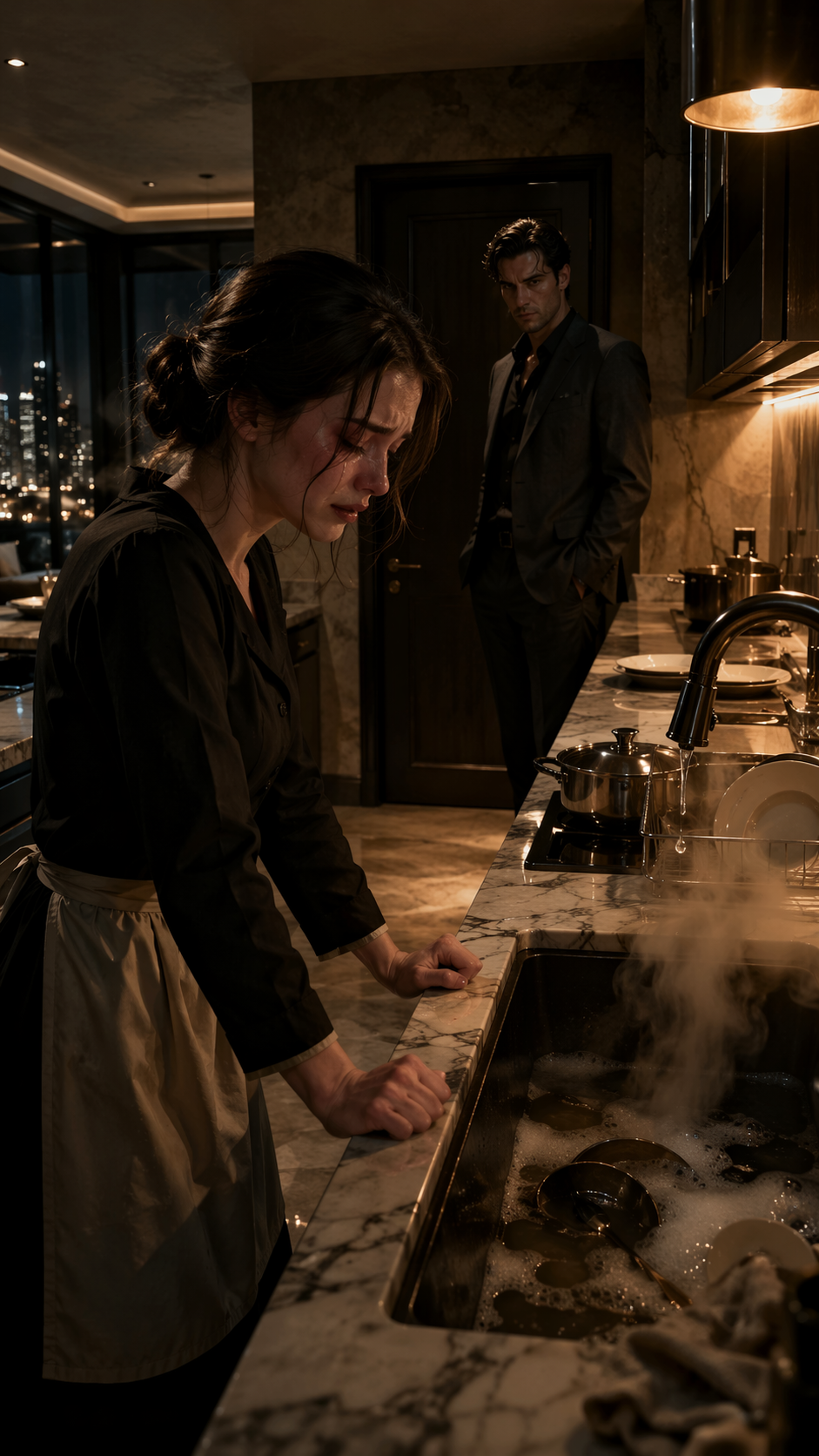
At 11:47 p.m., the penthouse kitchen looked like a cathedral built for silence.
Amber light spilled low and golden across Italian marble countertops, catching in the steam that curled from the sink in pale, ghostlike ribbons. The faucet dripped in slow, echoing beats. Beyond the glass walls, Manhattan glittered like a field of knives. Inside, the world had narrowed to one trembling woman gripping the edge of the counter so tightly her knuckles had gone white.
Saraphene Hail was trying not to make a sound.
That was the worst part of pain, she had learned. Not the bruises. Not the fear. Not even the waiting. It was the discipline of it. The art of swallowing every cry before it could become real.
She had waited for this moment with the patience of the condemned.
She had waited until the rest of the staff clocked out. Waited until the security rotation changed. Waited until the penthouse fell so quiet it seemed to forget it contained human beings. Only then had she let herself break. Only then had she bowed her head over the sink, pressed her lips together, and allowed one traitorous tear to slide down her cheek and disappear into the dishwater.
She thought she was alone.
That was her first mistake.
The kitchen door closed behind her with a slow, deliberate click.
Not a slam. Not a warning. A verdict.
Saraphene froze.
Then came the footsteps—measured, unhurried, expensive leather soles gliding over stone. Every step sounded calm enough to terrify her. She didn’t turn around. Her breath snagged in her throat.
A man’s voice, low and smooth and quietly lethal, cut through the room.
“Who did this to you?”
Her fingers dug into the marble harder.
The footsteps stopped three feet behind her. Not crowding. Not retreating. The distance felt intentional, calculated by someone who understood that fear had dimensions.
When she didn’t answer, the voice came again, almost gentle.
“And don’t insult me with a lie.”
Saraphene reached for the dish towel beside the sink and wiped quickly at her face. Her first instinct was to hide. Her second was to apologize. Those instincts had kept her alive more times than dignity ever had.
“It’s nothing, Mr. Vale,” she whispered. “I’m sorry. I didn’t realize anyone was still awake.”
“I didn’t ask for an apology.”
His tone never changed.
“I asked you a question.”
So she turned.
And there he was.
Ronan Vale.
Thirty-four years old. Six foot two. Broad-shouldered, dark-haired, sharply cut from expensive cloth and something far more dangerous than money. The charcoal suit he wore looked effortless. The pale blue of his eyes did not. Those eyes were too clear, too still, as if they missed nothing and forgave even less.
The papers called him a restaurateur. Manhattan society called him exclusive. Men in quieter rooms called him worse things in much softer voices. He owned four elite restaurants, yes. But people like Ronan Vale did not accumulate fear around their names because of truffle menus and reservation waitlists.
Everyone in certain circles knew his restaurants were merely the beautiful surface of something much darker underneath.
Saraphene swallowed.
“I was just finishing the kitchen,” she said, her voice unsteady. “I’ll be out of your way in a minute.”
“Sit down.”
It wasn’t cruel. That was the part that shocked her.
He pulled out a chair beside the island and set it there for her without scraping the floor. Then, instead of taking the higher seat like most powerful men would have done, he sat on the edge of the counter across from it, lowering himself until his eyes were level with hers.
It was such a small thing.
And it rearranged the entire room.
She sat because her knees no longer trusted themselves.
For a moment, neither of them spoke.
Then Saraphene forced out, “I’m fine.”
But the word fine fractured in the middle, thin as glass under pressure.
Ronan did not rush to fill the silence. He simply watched her with the focused stillness of a man who had spent his entire life learning how people broke.
And he noticed everything.
The faint yellowing bruise hidden at the inside of her left wrist where her sleeve had slipped back. The way she flinched when a pot lid shifted in the drying rack. The way her eyes kept snapping toward the kitchen door—not like she wanted to escape through it, but like she was waiting for something to come through it.
“How long?” he asked softly.
She looked up, confused. “How long what?”
His gaze never moved.
“How long have you been afraid of closed doors?”
The question landed with surgical precision.
Shock flashed over her face. Then denial. Then something deeper—something old, buried, rotting.
Saraphene’s lips parted, but no answer came.
Ronan leaned forward a fraction. “He comes in that way, doesn’t he?”
A violent tremor ran through her hands.
“Mr. Vale,” she whispered, “please. You don’t understand.”
“Then make me understand.”
The words were quiet. Absolute.
She lowered her eyes to her lap, but that only exposed the bruise more clearly. Ronan’s jaw tightened almost imperceptibly.
“How many times?”
“It doesn’t matter.”
“It matters to me.”
Her head snapped up.
The force of those four words hit harder than accusation ever could. Because he did not say them with pity. He said them like fact. Like something already decided.
Tears filled her eyes again. “If he finds out I said anything…”
Ronan’s voice dropped lower. “Who?”
And then they both heard it.
The faint metallic scrape of a key at the far penthouse door.
Saraphene went white.
Not pale. White. As if every drop of blood inside her had rushed inward to protect what little life remained.
Her breathing turned sharp and shallow. She half-rose from the chair, then froze.
Ronan was off the counter in a single smooth motion, moving with the deadly speed of a man whose body had been taught violence so thoroughly it no longer looked like effort. One second he was seated; the next he stood between her and the kitchen entrance, shoulders squared, expression gone cold enough to crack bone.
The door handle began to turn.
Saraphene made the smallest sound all night—a broken whisper.
“Please… don’t let him see me with you.”
The latch clicked.
A man stepped into the penthouse.
He was in his late forties, broad through the stomach, expensive watch, expensive shoes, the stale smugness of someone who had mistaken borrowed power for his own reflection. His name was Gideon Voss, Ronan’s financial director and one of the few men allowed access to the upper floors without announcement.
His eyes landed first on Ronan.
Then on Saraphene.
And in the second before he masked it, Ronan saw it: recognition. Ownership. Panic.
“Mr. Vale,” Gideon said, recovering too quickly. “I didn’t realize you were still up.”
“I was,” Ronan replied.
The air turned glacial.
Gideon gave Saraphene a smile so false it made her flinch. “There you are. I’ve been looking everywhere for you.”
Ronan did not move aside.
“She’s busy.”
Gideon’s smile tightened. “She works for the household, doesn’t she?”
Ronan’s eyes never left his face. “Tonight, she works for me.”
Something dark and furious flashed in Gideon’s expression before it disappeared.
Saraphene understood then, with a kind of numb horror, that she had not only been found—she had just become a line in the sand between two men who were both used to control, and only one of them was accustomed to being challenged in public.
Gideon took one step forward.
Ronan did not raise his voice. “Take another step, and you’ll regret it.”
The room went still.
Even the city outside seemed to hold its breath.
Gideon laughed, but it came out thin. “This is ridiculous. She’s upset. She gets emotional. I was only trying to help.”
Saraphene’s stomach turned.
That was how men like him always described damage. Help. Discipline. Affection. A misunderstanding.
Ronan glanced back once, briefly, at Saraphene.
“Did he touch you?”
She stared at him.
Then at Gideon.
Then back at the closed kitchen door behind Gideon, as if all the years of fear still stood there blocking the way out.
Gideon’s voice sharpened. “Be careful what you say.”
Ronan’s smile appeared so faintly it was worse than a threat. “No,” he said. “You should be.”
Saraphene’s throat worked. Her whole body shook. For one horrible second she thought no words would come. Then they did.
“Yes.”
The room changed.
It was invisible, but absolute. A line crossed. A decision made.
Gideon started talking immediately, too fast. “She’s lying. She’s unstable. You don’t know where she came from, what kind of games—”
Ronan struck him.
Not with wild rage. Not with mess. One clean, brutal punch that sent Gideon crashing sideways into the marble island hard enough to knock the breath from him. A plate shattered on the floor.
Saraphene gasped.
Ronan stood over Gideon with terrifying calm. “That,” he said, “was for calling her a liar in my house.”
Gideon tried to rise. Ronan planted a hand on his shoulder and shoved him back down.
“And the next one,” he said softly, “will be for touching what was never yours.”
Security burst in seconds later, summoned by some silent signal Saraphene had never seen him make. Two men in black pinned Gideon before he could fully recover.
He started shouting then. Threats. Denials. The names of judges, police captains, councilmen. Men who owed him favors. Men who apparently mattered very much in his world.
Then Ronan said something that silenced everyone.
“Bring him to the wine cellar.”
Gideon’s bravado vanished. “Ronan—”
“No.”
For the first time that night, Ronan’s voice held open violence.
“You should have prayed for the police.”
They dragged Gideon out.
The silence that followed rang louder than the struggle had.
Saraphene sat rigid in the chair, unable to feel her fingers. Ronan turned back to her, and in that instant something in his face changed. Not softened exactly. But humanized. As if the brutality had closed one door in him and opened another.
“It’s over,” he said.
But she shook her head violently. “No. You don’t know men like him. He’ll come back. They always come back.”
Ronan held her gaze for a long moment.
Then he said, “No one comes back from where he’s going.”
She should have been frightened by that.
Instead, she felt the first fragile thread of safety she had known in years.
He crouched in front of her then, this man half the city feared, and spoke with the careful control of someone handling a wound too deep to touch directly.
“You’re staying here tonight. In the guest suite on the east wing. Two women from staff will remain with you. No one enters without your permission. Tomorrow, we go to the police, your doctor, your choice of lawyer, and anyone else you want.”
Her lips trembled. “Why?”
The question surprised him. It showed.
“Why what?”
“Why are you doing this for me?”
His answer came too quickly to be prepared and too quietly to be false.
“Because no one did it for my mother.”
The confession struck the air between them like a match.
Saraphene stared.
Ronan looked away toward the dark windows, toward the city and its thousand glittering lies.
“My father owned silence the same way weak men always try to,” he said. “By teaching everyone else to fear sound. My mother learned how to cry without breathing. I was twelve when I figured out what the bruises really meant. Fourteen when I broke his jaw. Sixteen when he disappeared.”
He looked back at her then, blue eyes cold and burning all at once.
“I built everything after that on one promise: no man hurts women under my roof and leaves standing.”
Something in Saraphene broke open completely. Not in fear this time. In grief. In relief. In the unbearable shock of being believed.
She bent forward, covering her face, and sobbed.
Not quietly anymore.
Not carefully.
Ronan remained where he was until the storm passed, saying nothing, because some mercies are ruined by language.
At last, when her breathing steadied, he stood and offered her his hand.
She took it.
His grip was warm. Steady. Human.
He led her out of the kitchen and down the eastern hallway, past museum-silent walls and pools of golden light. At the guest suite door, he paused.
“You’ll be safe here.”
Saraphene nodded, then hesitated. “Mr. Vale?”
“Yes?”
She looked up at him, her eyes swollen, voice raw.
“You asked how long I’d been afraid of closed doors.”
He waited.
Her fingers tightened around the edge of the doorway. “The truth is… I wasn’t afraid of closed doors.”
A stillness passed over his face.
She swallowed.
“I was afraid of open ones. Because when they were closed, at least I knew where he was.”
For the first time all night, Ronan looked shaken.
Not by violence.
By understanding.
He stepped back slightly, giving her the room, the choice, the dignity of distance.
“Then tomorrow,” he said, “we start teaching you the difference between a prison and a home.”
She almost smiled through the wreckage of her tears.
He closed the guest room door gently behind her.
And that should have been the end.
It would have been, if Ronan Vale had not gone downstairs to the wine cellar and discovered that Gideon Voss was laughing.
Not crying. Not bargaining.
Laughing.
Ronan stood in the doorway, the cellar lit low around rows of vintage bottles and old stone walls. Gideon sat tied to a chair, blood at the corner of his mouth, eyes bright with something close to triumph.
“You think you won,” Gideon said.
Ronan descended the stairs in silence.
Gideon smiled wider. “She didn’t tell you, did she?”
Ronan stopped.
“Tell me what?”
Gideon leaned back against the chair, as if savoring the moment.
“That she wasn’t my victim.”
The words hit like ice water.
Ronan’s face gave away nothing, but every instinct sharpened.
Gideon laughed again. “You really don’t know who’s sleeping in your east wing.”
Ronan stepped closer. “Speak carefully.”
“Oh, I will.” Gideon’s eyes glittered. “Because Saraphene Hail isn’t a maid.”
The cellar went utterly still.
“She came here six weeks ago under a false name,” Gideon said. “Forged references. Fabricated records. Perfect behavior. Perfect tears. And you never questioned it because men like you always think you can smell danger before it reaches your door.”
Ronan said nothing.
Then Gideon delivered the final blow.
“Her real name,” he said, smiling through split lips, “is Serafina Hale Voss.”
The world stopped.
“Your fiancée?” Ronan asked flatly.
“My daughter.”
For the first time in years, Ronan Vale felt true shock.
Gideon’s smile turned monstrous.
“She came here to get close to you. To find the account books. To steal what I couldn’t. I found out two days ago.” He leaned forward as far as the ropes allowed. “So tell me, Ronan—did you save a terrified maid tonight?”
His voice dropped to a whisper.
“Or did you just hand your heart to the one person sent here to destroy you?”
Upstairs, in the east wing, Saraphene—Serafina—stood alone in the guest suite mirror, wiping away the last of her tears.
Then, with hands that no longer shook, she reached into the hem of her maid’s uniform and removed a stolen flash drive slick with dried blood.
And smiled.
Because everything Gideon had said was true—except for one thing.
She had not come to betray Ronan Vale.
She had come to kill him.
And after one night in his kitchen, she no longer knew whether that was the mission… or the mistake that would ruin her forever.