At twenty-two years old, I moved into my very first apartment believing independence would feel exciting, glamorous, and freeing. Instead, most nights felt painfully quiet.
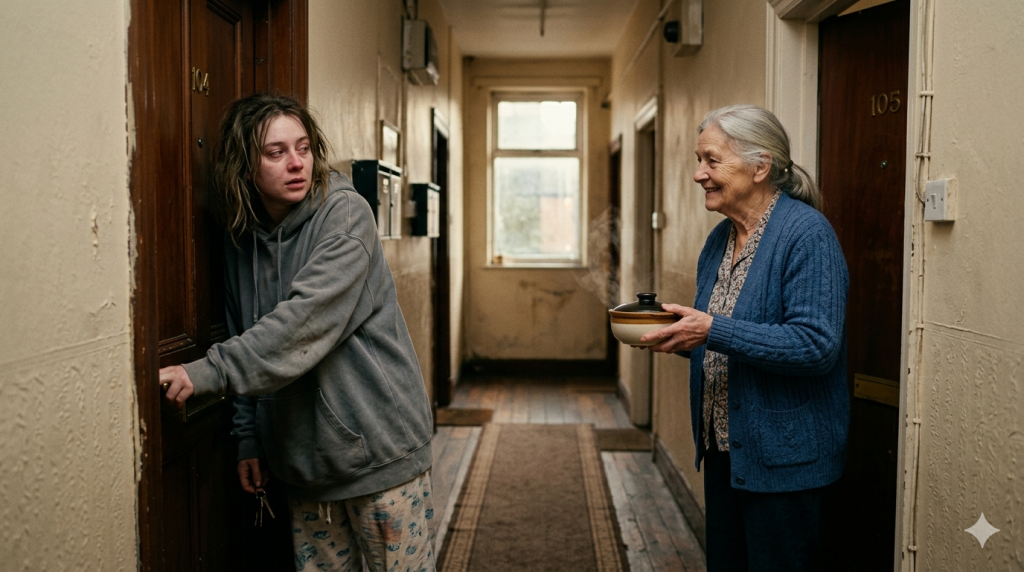
The building itself was old but sturdy, tucked between two crowded streets that never really slept. During the daytime, sunlight slipped through narrow gaps between neighboring buildings, barely touching the windows. At night, the hallway lights flickered softly, buzzing like tired insects above faded carpets and peeling cream-colored walls.
I moved in with exactly three suitcases, a secondhand coffee maker, and the stubborn confidence people carry when they are too young to understand loneliness yet.
“I moved into my first apartment at 22 and did not know a single person in the building.”
At first, I told myself that was normal.
Everyone in the city seemed busy rushing somewhere important. Neighbors passed each other without speaking. Elevators stayed silent except for the dull hum of machinery and the occasional awkward nod from strangers avoiding eye contact.
I had just started working exhausting night shifts that blurred weekdays and weekends together. By the time most people were waking up, I was stumbling home exhausted, carrying greasy takeout bags and fighting sleep during crowded morning commutes.
“I was working night shifts and sleeping during the day, so my blinds stayed closed most of the time.”
The apartment slowly became less of a home and more of a cave.
Dirty mugs gathered beside the sink. Laundry piled onto a chair I kept promising myself I would organize tomorrow. I rarely cooked. I rarely explored the neighborhood. Sometimes entire days passed without hearing my own voice.
Back then, loneliness did not arrive dramatically.
It arrived quietly.
It lived in unopened mail, cold leftovers, glowing phone screens, and the strange emptiness that filled the room after long shifts ended. I convinced myself I liked being alone because admitting otherwise somehow felt like failure.
Then I got sick.
Not just tired sick. Completely miserable sick.
The flu hit me hard one freezing week in November. My body ached constantly, my throat burned, and even standing long enough to pour a glass of water felt impossible. I called out of work for the first time in months and spent two straight days drifting in and out of sleep beneath heavy blankets.
Outside my window, rain tapped endlessly against the glass.
Inside the apartment, everything felt still.
No calls.
No visitors.
No one checking in.
I remember staring at the ceiling one afternoon, feeling smaller than I ever had before. That was the moment loneliness finally stopped feeling independent and started feeling frightening.
Then came the knock.
Soft.
Careful.
Almost hesitant.
“One afternoon I woke up to a soft knock and panicked, thinking I had missed rent or something.”
Half asleep and feverish, I dragged myself to the door expecting bad news. Maybe management. Maybe a complaint. Maybe another bill I could barely afford.
Instead, standing across from me was a small older woman wearing a knitted gray sweater and holding a plastic container with both hands.
Steam fogged the lid.
Her silver hair curled gently around her cheeks, and her expression carried the kind of warmth that instantly disarms people.
“It was an older woman from across the hall holding a small container of soup.”
For a second, neither of us spoke.
I must have looked awful because her face softened immediately.
“She said she had not seen my lights on for a few days and wanted to check if I was okay.”
No one had asked me that in weeks.
Not really.
Not in a sincere way.
I remember gripping the edge of the doorframe, embarrassed by how emotional those simple words suddenly made me feel.
“I had been sick with the flu and honestly, miserable.”
The woman gave a small understanding nod, almost like she already knew.
“She told me her name was Laura and said she had made extra soup anyway.”
To this day, I still remember the smell drifting from that container. Chicken broth, garlic, herbs, and something homemade that instantly reminded me of childhood winters before adulthood became complicated.
I tried apologizing for looking terrible.
Laura waved it away immediately.
She acted like bringing soup to a sick stranger was the most ordinary thing in the world.
That somehow made it even more meaningful.
I thanked her at least five times before she finally laughed softly and told me to rest.
Then she walked back across the hallway and disappeared into her apartment.
The entire interaction lasted maybe three minutes.
But after closing the door, I stood there holding that warm container against my chest like it was something fragile and priceless.
Because in that moment, it was.
“That tiny check made me feel all warm and fuzzy for days.”
The soup itself was incredible, but honestly, that was not what stayed with me.
What stayed with me was the realization that someone had noticed my absence.
Someone had paid attention enough to worry.
In a city where millions of people passed each other anonymously every single day, one person had looked at my dark windows and cared enough to knock.
After that afternoon, things slowly began to change.
Not dramatically.
Not all at once.
Just quietly, steadily, in small human moments that stitched themselves into everyday life.
“For the next year, we would leave notes on each other’s doors when one of us traveled.”
Sometimes the notes were practical.
Gone for the weekend. Watered your plant.
Sometimes they were funny.
Do not trust the laundry machine on floor two. It steals socks.
Sometimes they were surprisingly thoughtful.
Saw your light on late. Hope work was not too rough tonight.
Without planning it, Laura became part of my routine.
Every few evenings, I would hear her television through the hallway wall. Old black-and-white movies usually played softly while she cooked. Sometimes she knocked just to hand me leftover banana bread or ask if I wanted extra pasta she accidentally made too much of.
I eventually learned she had lived in the building for nearly thirty years.
Her husband had passed away long before I moved in.
Her children lived in different states and visited only occasionally.
Yet somehow, despite her own loneliness, she still made room to care for other people.
Especially me.
Winter turned into spring.
Spring became summer.
Life stayed messy and exhausting sometimes, but it no longer felt empty.
There were nights after difficult shifts when I came home emotionally drained, only to find a handwritten note taped to my door reminding me to eat properly or sleep more.
There were mornings when I carried groceries upstairs and found Laura struggling with hers at the same time, both of us laughing breathlessly halfway up the stairs because the elevator had broken again.
There were holidays we accidentally spent together because neither of us had family nearby.
One Thanksgiving, we shared microwave mashed potatoes and watched terrible reality television for hours while rain hammered against the windows outside.
It was imperfect.
It was ordinary.
And somehow, it became one of my favorite memories.
Looking back now, I realize Laura gave me something much bigger than kindness.
She gave me visibility.
Before meeting her, I thought adulthood meant surviving everything alone. I thought strength looked like isolation. I thought independence meant never needing anyone.
Laura quietly proved all of that wrong.
Human beings are not meant to move through life completely unnoticed.
Sometimes the smallest gestures become lifelines.
A bowl of soup.
A handwritten note.
A soft knock on the door.
Tiny acts of care can reach people in places far deeper than we realize.
Eventually, the time came for me to move out.
I had found a better job across the city and an apartment closer to work. Packing everything felt strangely emotional this time because now the building actually meant something to me.
On my final day there, cardboard boxes filled the hallway while rain clouds gathered outside like they had the day we first met.
Laura stood in her doorway watching me carry the last bag downstairs.
Then she stepped forward and hugged me tightly.
“When I finally moved out, she hugged me and said, “Now I will have to worry about someone else.””
I laughed when she said it.
But the truth is, I nearly cried.
Because somewhere between exhausting night shifts, lonely afternoons, and handwritten notes taped to apartment doors, this woman had become family to me.
“It felt like having a grandmother in a city where I thought I was invisible.”
Years later, I still think about that first knock sometimes.
Not because it was dramatic.
Not because it changed the world.
But because it changed mine.
In a time when loneliness has become so common that many people barely talk about it anymore, I think about how easily Laura could have ignored my dark windows.
She could have assumed someone else would check.
She could have minded her own business.
Instead, she chose kindness.
And that single choice reminded me that even in the busiest, coldest, most anonymous places, people still have the power to make each other feel seen.
Sometimes we imagine life-changing moments as huge events filled with noise and spectacle.
But often, they arrive quietly.
Sometimes they sound like a soft knock on the door.