My bedroom door cracked open at 2:17 a.m.
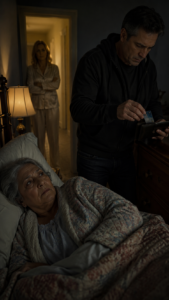
“Don’t wake her,” my son whispered.
I kept my eyes shut while his shadow crossed my wall.
There are sounds a mother never forgets.
The first cry of her baby.
The cough of a sick child in the next room.
The soft, guilty breathing of a grown man stealing from the woman who gave him everything.
I lay perfectly still under my quilt, one hand curled around the edge of the sheet, my body stiff in a way only fear can make an old body stiff. The hallway night-light threw a thin yellow stripe across my dresser, just enough for me to see Jason’s outline move toward my purse.
My son.
My only child.
The boy I had once carried through snow in Chicago because I could not afford a cab. The boy I fed before I ate. The boy whose engineering school I helped pay for with double shifts and the last pair of gold bracelets his father had ever bought me.
Now he was standing beside my dresser like a stranger.
Not even a desperate stranger.
A careful one.
A few minutes earlier, his voice had slid through the wall from the guest room, low and tender in a way he had not spoken to me in years.
“Take everything out, baby,” he whispered to Brittany. “Mom has over ninety-five thousand on that card. She’s asleep. She won’t notice until tomorrow.”

I had opened my eyes in the dark without moving.
For a second, I thought grief had made me misunderstand. Maybe he said some other number. Maybe he was talking about his own account. Maybe a mother’s mind, tired from too many years of worry, could twist words into something cruel.
Then he said it again.
“I’ll give you the PIN. Write it down.”
And he began whispering the numbers I had trusted him never to use against me.
Four.
Seven.
Nine.
Each one hit me quieter than a slap, but deeper.
That money was not luxury. It was not a cruise fund or a fancy purse fund or one of those smiling retirement dreams on television. It was my medical cushion. My property tax money. My grocery money. My emergency wall between me and the kind of helplessness old women learn to fear.
It was the reason I could sleep without wondering whose couch I would need to beg for.
Jason knew that.
Brittany knew that too.
Five days earlier, they had come over with a pink bakery box and smiles too polished to trust. Brittany wore cream-colored slacks, red nails, and a perfume that always reached the room before she did. Jason kept rubbing his thumb across his wedding band, the way he did when he wanted something but hoped I would make it easy for him.
“Mom,” he said at my kitchen table, “we should put your accounts somewhere safer. Maybe a shared account. Just in case something happens to you.”
Brittany nodded like she was blessing the idea.
“You’re at that age,” she added softly.
At that age.
She said it with a little sympathetic tilt of her head, as if sixty-five meant I had already begun disappearing.
I looked from her perfect nails to my son’s face. Once, that face had turned toward me for help with homework, with scraped knees, with nightmares after his father died. Now it was arranged into something patient and hard.
“If something happens to me,” I told them, “my will and legal papers are already handled.”
Brittany’s smile stayed in place, but her eyes stopped smiling.
Jason leaned back in his chair.
Then came the truth.
They needed forty thousand dollars. Temporarily, he said. Mortgage trouble, he said. Family helps family, he said.
When I told him no, my son’s mouth twisted in a way I had never seen on the face of the child I raised.
“You’re old, Mom,” he snapped. “What the hell are you saving it for? You can’t take it with you when you die.”
The kitchen clock kept ticking.
Brittany looked down at her manicure.
And I learned something terrible.
Some people do not wait for you to die before they start dividing what you survived to keep.
The next night, I saw Brittany outside by my mailbox. She thought the curtain hid me. It didn’t. She stood under the porch light with her phone raised, taking pictures of my bank statements one envelope at a time.
She smiled when she came inside.
I smiled back.
By Wednesday, a downtown law office called to ask about paperwork filed for a competency evaluation. Someone had claimed there were concerns about my mental fitness. Someone wanted me declared unable to manage my own affairs.
The woman on the phone used professional words.
I heard my son’s voice behind all of them.
So I did not cry.
I called Daniel, the attorney whose mother had been my best friend for thirty-eight years. He had already helped me update my will, secure my accounts, and file every document I needed. Two days earlier, my doctor had signed a certificate stating that my mind was clear, sound, and fully capable.

Jason did not know that.
Brittany did not know that either.
So when I heard them whispering in the guest room that night, when I heard my own son give away the PIN to the money I had earned standing over restaurant stoves until my knees swelled, I did not run in and beg.
I did not shout.
I did not ask why.
I simply sat up in the dark, opened the drawer beside my bed, and took out an expired bank card from three years ago. I slipped it into the easiest pocket of my wallet, the one any thief would find first.
Then I lay back down and closed my eyes.
Now Jason stood beside my dresser, breathing through his nose.
The zipper of my purse sounded enormous in the quiet room.
I heard him search through my wallet. Heard the tiny plastic tap of a card against his fingernail. Heard him pause, as if waiting for me to stir.
I kept my face loose.
A mother spends years pretending not to be tired so her child can feel safe. That night, I pretended to be asleep so my child could reveal exactly who he had become.
Jason slipped out without looking back.
From the guest room, Brittany whispered, “Did you get it?”
“Yeah,” he said.
Their door clicked shut.
I stared at the ceiling until the house went silent again. Then, with hands that no longer trembled, I reached for the phone Daniel had told me to keep beside my bed.
Because in less than an hour, Jason and Brittany would stand in front of an ATM with my expired card in their hands.
And the machine would not be the only thing waiting for them.
Daniel answered on the second ring.
He did not sound sleepy, even though it was nearly three in the morning. That was one thing I had always liked about him. Some men made you feel like every call was an inconvenience. Daniel had his mother’s steadiness. When he listened, he listened all the way.
“Evelyn?” he said.
“They took it.”
There was one breath on the other end of the line. Not surprise. Confirmation.
“The card?”
“The old one. The expired one. Jason took it from my wallet.”
I could hear him shift papers. Somewhere in his house or office, a drawer slid open. His voice remained low.
“Are they still inside?”
“For now.”
“Do not confront them alone.”
I looked toward the dark hallway. My bedroom door sat open an inch, like the house itself was holding its breath.
“I wasn’t planning to.”
“Good,” Daniel said. “The bank alert is already in place. The fraud department has the account flagged. If they try anything, it will document the attempt. I’m also going to call the officer we spoke with earlier.”
I closed my eyes.
Officer.
That word should not belong in a sentence about your child.
A small framed photo of my late husband, Raymond, sat on the nightstand beside my lamp. He was wearing his good black suit in the picture, the one from Jason’s college graduation. Raymond had been gone twelve years, but in that moment, I could almost hear what he would have said.
Don’t let love make you stupid, Evie.
He had told me that once when Jason was sixteen and had lied about a school trip. I had cried because I thought being strict meant being cold. Raymond had stood at the sink washing a plate, his big hands gentle around the chipped ceramic.
“Love him,” he said. “But don’t teach him that love has no walls.”
I had remembered the first part for years.
I had forgotten the second.
“Evelyn,” Daniel said softly, “are you there?”
“Yes.”
“I need you to listen carefully. You are not responsible for protecting Jason from the consequences of a crime he chose to commit.”
The sentence went through me slowly, like medicine with a bitter taste.
“He’s my son,” I whispered.
“I know.”
“No,” I said, and my voice cracked before I could stop it. “You don’t. Not like this. I held him when his fever was 104. I watched him sleep on my kitchen floor during finals because he was too tired to make it to bed. I buried his father and still got up the next morning to pack his lunch.”
Daniel let the silence stay.
That was another thing I liked about him. He did not rush grief just because the law had paperwork waiting.
Finally he said, “And tonight, he walked into your bedroom and stole from you.”
I looked down at my hands. They were brown and wrinkled, the knuckles swollen from years of chopping onions, scrubbing pans, kneading dough, carrying trays, and holding my life together without applause.
“Yes,” I said.
“Then we protect you first.”
The word protect landed harder than I expected.
For years, I had been the one protecting everyone else. Protecting Jason from hunger after Raymond’s hours were cut. Protecting Raymond from worrying about bills during his last illness. Protecting customers at the diner from seeing how badly my back hurt when I smiled and refilled their coffee. Protecting my own pride when Brittany looked around my little Lincoln Park house like she was evaluating what could be sold.
I had grown so used to being the wall that I had forgotten walls crack.
Daniel told me to stay in my room, keep the phone nearby, and make no move that would warn them. He said the bank had already noted that the card in my wallet was inactive, and the accounts connected to my real money were locked behind two-step verification and in-person authorization.
“Evelyn,” he added, “there’s something else.”
My fingers tightened around the phone.
“What?”
“The competency petition wasn’t just an inquiry.”
I sat very still.
“It was drafted,” he said. “Not filed successfully yet, but prepared. They used language suggesting progressive confusion, memory problems, and financial vulnerability.”
I tasted metal in my mouth.
“Financial vulnerability,” I repeated.
“They also named Jason as the proposed temporary guardian.”
For a moment, I forgot how to breathe.
Not because I was surprised. Maybe that was the worst part. A piece of me had already known. The same piece that saw Brittany at the mailbox. The same piece that heard Jason say, “What are you saving it for?” and understood that he was not asking about money.
He was asking why I was still standing between him and it.
Daniel’s voice softened. “I’m sorry.”
I looked at Raymond’s picture. The glass reflected a little blue from my phone screen across his face.
“Don’t be sorry,” I said quietly. “Just be ready.”
After we hung up, I sat there for a while with the legal folder across my lap. Inside were the things a woman prepares when she finally accepts that love is not a legal strategy.
My updated will.
My bank protections.
My physician’s certificate.
Copies of the strange call from the law office.
A printed photograph from my porch camera of Brittany at my mailbox, phone raised, envelopes spread in her hands.
And, tucked in the back, a document Daniel had insisted on drafting after Jason’s first demand for money.
A statement revoking Jason from every emergency role he had once held.
I had signed it with a shaking hand.
Not because I doubted the decision.
Because I remembered the day I signed his birth certificate.
Down the hall, I heard soft movement.
A door opening.
Brittany’s whisper.
Then the faint scrape of Jason’s suitcase wheel against the hallway floor.
They were leaving.
Not sneaking out like teenagers after a party. Sneaking out like people who believed they had already won.
I rose slowly and went to the window facing the street.
The city outside was asleep in shades of orange streetlight and blue shadow. Jason’s car sat at the curb, its engine already running. Brittany slipped into the passenger seat first, holding her purse tight against her stomach. Jason came out seconds later, shoulders hunched against the cold, one hand in his pocket.
My card was in that pocket.
The expired card.
He glanced back at the house once.
Not toward my window. Not in the way a son checks on his mother. More like a man checking whether a door he had picked was still closed.
Then he got in the car.
As they pulled away, I did something that surprised me.
I did not cry.
I watched the taillights turn the corner and disappear.
Then I went to the kitchen and made coffee.
At 3:26 a.m., my phone buzzed.
Daniel.
“They tried it.”
I set my mug down carefully.
“Where?”
“ATM on Clark Street. Attempt declined. Then another attempt with a different amount. Declined. The bank fraud line caught both. The camera will have them clearly.”
I looked at the coffee trembling slightly in the cup.
“How much?”
“First withdrawal request was nine hundred. Then they tried three thousand. After that, they attempted a balance inquiry.”
There was something obscene about that last part.
The balance inquiry.
As if the theft itself wasn’t enough. They wanted to see the size of the feast before deciding where to cut.
Daniel continued. “They may panic and come back. Don’t open the door unless officers are present.”
I almost laughed at that. Not because anything was funny, but because for decades I had opened doors for Jason before he knocked. He forgot lunch, I drove it over. He needed rent in college, I mailed a check. He brought Brittany home and she wrinkled her nose at my couch, I cooked her favorite chicken anyway.
I had opened every door.
Tonight, for the first time, I would let one stay locked.
The knock came at 4:08.
Not gentle.
Jason hit the front door with the side of his fist.
“Mom!”
I sat at the kitchen table in my robe, both hands around my coffee mug, and stared toward the hallway.
“Mom, open the door!”
Brittany’s voice followed, sharp and panicked under a layer of fake concern. “Evelyn, we know you’re awake.”
That sentence told me enough.
They had tried the card. It failed. Their story had not yet been invented fully, but they were already angry at me for not making the crime easier.
I walked to the front door and looked through the peephole.
Jason stood under the porch light, hair messy, face flushed. Brittany stood behind him in that expensive coat she wore over pajamas, her red nails tapping her phone case. She looked less like a frightened daughter-in-law than a woman whose shopping cart had been declined.
“Open the door,” Jason said again.
I did not unlock it.
“What do you need?”
His head jerked back, insulted by the wood between us.
“What do you mean, what do I need? Let us in.”
“It’s four in the morning.”
“Don’t start with me.”
Brittany stepped closer, her face appearing beside his in the peephole.
“Evelyn,” she said, using the soft voice she saved for witnesses, “Jason was worried about you. We realized you might have given us the wrong card.”
There it was.
Not apology.
Not fear.
Correction.
As if I had failed a task.
I leaned my forehead lightly against the door.
“I didn’t give you any card.”
The porch went quiet.
Jason looked away first.
Brittany recovered faster.
“You know what I mean. The card in your wallet. We were checking something for you.”
“At an ATM on Clark Street?”
Jason’s face changed.
It was small, but I saw it. The boyish panic under the grown man’s anger. The moment he realized the house had eyes he had not counted on.
“How do you know where we were?”
I did not answer.
Behind them, headlights turned onto my street.
Jason did not notice at first. Brittany did. Her face tilted toward the approaching car, and her mouth parted just enough to let her fear show.
A police cruiser stopped behind Jason’s sedan.
Then Daniel pulled in behind it.
Jason turned toward the curb.
For a second, nobody moved.
The street was quiet except for the low idle of engines and the winter wind pushing dry leaves along the sidewalk.
An officer stepped out of the cruiser, a tall woman with her hair pulled tight at the nape of her neck. Daniel got out more slowly, carrying his leather folder.
Brittany immediately stepped back from the door.
Jason knocked again, softer now.
“Mom,” he said. “This is a misunderstanding.”
I opened the door.
Not all the way.
Just enough for the cold air to slip in and touch my bare ankles.
The officer approached the porch. “Mrs. Morales?”
“Yes.”
“I’m Officer Reed. Mr. Carter called us. Are you safe?”
Jason let out a hard breath. “Unbelievable.”
Brittany grabbed his sleeve.
Daniel’s eyes met mine over the officer’s shoulder. He gave one small nod, not triumphant, not dramatic. Just steady.
The kind of nod that says, You are not alone now.
I opened the door wider.
“I’m safe,” I said. “But they took a card from my bedroom while they thought I was asleep.”
Jason’s face reddened.
“Mom, stop. We didn’t take anything. You’re confused.”
The word came out too easily.
Confused.
There it was, polished and ready.
Officer Reed turned her head toward him.
“Sir, let her finish.”
“I’m her son.”
“That doesn’t answer anything.”
Brittany tried to smile at the officer. It was almost impressive, how quickly she could assemble innocence from scraps.
“We’ve been worried about Evelyn’s memory,” she said. “She misplaces things. She gets paranoid. Jason and I were only trying to help organize her finances.”
Daniel opened his folder.
“That’s interesting,” he said.
Brittany looked at him with immediate dislike.
Jason pointed. “Who the hell is this?”
“My attorney,” I said.
The word changed the porch.
Not loudly.
Not like thunder.
More like a glass lowered at a dinner table when someone realizes the joke may have been about the wrong person.
Jason stared at me.
“Attorney?”
Daniel stepped beside Officer Reed, still calm. “Daniel Carter. I represent Mrs. Morales regarding estate planning, financial protections, and the attempted guardianship inquiry recently initiated without her consent.”
Brittany’s smile disappeared.
Jason swallowed.
I watched it happen, the beginning of the recalculation. For days, they had treated me like a locked cabinet with old hinges. Something to pry open. Something too worn to fight back.
Now there was a lawyer on my porch at four in the morning.
There was an officer taking notes.
There was a bank alert already waiting.
And there was me, standing in my faded robe, not begging them to love me better.
Jason found his anger again because anger had always served him when shame got too close.
“You called the police on your own son?”
I looked at him.
Under the porch light, he looked suddenly younger. Not innocent. Just young in the worst way. A man who wanted the privileges of being a child and the authority of being an heir.
“No,” I said. “You brought them here.”
His mouth opened, then closed.
Officer Reed asked if I wanted to make a report. Daniel did not speak for me. He simply stood close enough that I could feel the choice belonged to me, not to the loudest person on the porch.
Jason stared at me with a warning in his eyes.
Brittany stared at me with calculation.
For a second, old habits rose inside me. The urge to soften. To say maybe it was a misunderstanding. To protect Jason from a record, from embarrassment, from the hard machinery of consequences.
Then I remembered the bedroom door opening.
I remembered the zipper of my purse.
I remembered my son whispering, “She won’t notice until tomorrow.”
“Yes,” I said. “I want to make a report.”
Brittany made a small sound.
Jason stepped toward me. Officer Reed shifted, not dramatically, but enough.
“Mom,” he said, and now his voice had changed. It was the voice from childhood, scraped raw and scared. “Don’t do this.”
That was the cruelest part.
He still knew which door to knock on inside me.
He still knew how to sound like the boy with a fever, the boy at his father’s funeral, the boy who once fell asleep holding my hand during a thunderstorm.
But I had heard the man through the wall.
“I didn’t do this,” I said. “You did.”
The statement took nearly an hour.
Officer Reed came inside with Daniel while Jason and Brittany waited on the porch, then in their car, then back on the porch when the cold got too sharp. They kept glancing through the front window as if my little living room had turned into a courtroom without their permission.
I showed the officer my purse.
The wallet.
The drawer where the expired card had been.
The porch camera clip of Brittany photographing my mail.
The call log from the law office.
Daniel provided copies of the medical certificate and the paperwork connected to the competency petition. He did not embellish. He did not need to. Paper has a quiet way of humiliating liars.
Officer Reed looked at the physician’s letter, then at me.
“This is dated two days ago.”
“Yes.”
“And it states you are fully competent to manage your affairs.”
“Yes.”
She glanced toward the window, where Jason’s silhouette paced across the porch boards.
“Were you aware your son was seeking authority over your finances?”
I folded my hands in my lap.
“Not from him.”
The officer’s pen stopped for one second.
Then she kept writing.
By sunrise, Jason and Brittany had stopped looking angry and started looking tired. That was when people like them became most dangerous—not when they were loud, but when they needed a new story before daylight found the old one.
Jason asked to speak to me privately.
Officer Reed looked at me. Daniel looked at me too.
I shook my head.
Jason saw it through the window and his face hardened.
Brittany pulled out her phone.
That was the next shift.
I watched her step down from the porch and turn her back to the house, one hand cupped around the phone. Her lips moved quickly. Jason stood behind her, rubbing his forehead.
“Who is she calling?” I asked.
Daniel followed my gaze.
“Probably someone who thinks this is still controllable.”
He was right.
At 7:12 a.m., my sister-in-law Marlene called.
I did not answer.
At 7:15, Jason’s cousin Teresa called.
I did not answer.
At 7:18, my phone began lighting up with messages.
Evelyn, what is going on?
Jason says you’re confused.
Please don’t ruin your family over money.
Brittany says you accused them after they tried to help.
The family system had woken up.
Not to protect me.
To manage me.
I set the phone face down on the table.
Daniel saw the movement.
“You don’t owe every person an explanation this morning.”
“Apparently Jason is giving them one.”
“He can talk,” Daniel said. “Evidence answers.”
A few years earlier, I would have hated that sentence. Evidence answers. It sounded cold. It sounded legal. It sounded like something people used when love had failed.
But I was beginning to understand that evidence is sometimes the only language liars respect, because it cannot be guilted into silence.
Officer Reed left shortly after eight, after explaining the next steps. The bank footage would be requested. The attempted withdrawals were logged. The mail issue could be added. The guardianship paperwork would need further review.
Jason and Brittany were not arrested on my porch that morning. Life is not always that clean. But the officer spoke to them for a long time beside the cruiser, and I watched Jason’s shoulders sink inch by inch.
Brittany kept trying to interrupt.
Officer Reed kept writing.
When the officer finally drove away, Jason walked back to my door alone.
Daniel stood beside me.
Jason looked at him. “Can I speak to my mother without a lawyer hovering?”
“No,” I said.
The answer surprised even me with how clean it felt.
Jason’s jaw flexed.
“Mom, you are blowing this out of proportion.”
The sentence was so familiar I almost smiled.
When Jason was twelve and broke a neighbor’s window, it was “out of proportion.” When he was twenty and forgot to pay his tuition bill until late fees hit, my worry was “out of proportion.” When Brittany insulted my food at Thanksgiving and I stopped cooking extra dishes for her, my hurt was “out of proportion.”
Some children grow up and learn responsibility.
Some grow up and learn better words for entitlement.
“You took a card from my bedroom,” I said.
“I thought you gave it to me.”
“You thought I gave it to you while I was asleep?”
He looked away.
Brittany came up behind him. “We were trying to protect you from scammers.”
Daniel’s eyebrows lifted slightly.
I looked at her red nails wrapped around her phone.
“By using my PIN at an ATM?”
Her mouth opened.
No sound came out.
It was the first honest thing she had done all week.
Jason stepped in front of her. “Okay, fine. Maybe we handled it wrong. But you don’t understand the pressure we’re under.”
There it was.
The soft doorway to forgiveness.
Pressure.
Mortgage.
Embarrassment.
Bills.
The same little path he expected me to walk down until somehow the crime became a family misunderstanding and my pain became a lack of compassion.
“What pressure made you try to have me declared incompetent?” I asked.
Jason stared at me.
Brittany’s face went flat.
Daniel removed one paper from his folder and held it loosely at his side.
Jason tried to laugh.
“That’s not what that was.”
“No?”
“We were just asking questions.”
“About taking legal control of my life?”
“Because you’re not acting like yourself!” he snapped.
The street seemed to quiet around us.
A woman walking her dog slowed on the sidewalk, then wisely kept moving.
Jason pointed toward Daniel. “This man is manipulating you. You never used to be like this. You used to care about family.”
That one found flesh.
Not because it was true.
Because it was old.
Mothers like me are trained to bleed quietly when someone says family. We hear the years in it. The packed lunches. The birthday cakes. The waiting rooms. The rent checks. The forgivenesses so frequent nobody counted them as gifts anymore.
I looked at Jason, and for one terrible second I saw him at six years old, standing on a chair beside me at the stove, stirring pancake batter too hard. Raymond had laughed and called him Chef Jason. Jason had flour on his nose.
Then the memory blinked away.
In its place stood a man who had whispered my PIN to his wife.
“I cared about family,” I said. “That’s why it took me this long to call it what it is.”
Brittany made her mistake then.
She had been quiet too long, and quiet did not suit her.
“Oh, please,” she said. “You love playing the poor old mother. Jason has been carrying guilt for years because you sacrificed and made sure he knew it.”
Jason turned toward her, warning in his eyes.
But she was already too angry to notice.
“You sit in this house with all that money while we struggle. You act like a saint because you worked in kitchens. Everybody works, Evelyn. You’re not special because you saved cash and made your son feel indebted.”
The words came fast, hot, uncontrolled.
A phone camera can catch theft.
But anger catches motive.
Daniel’s gaze shifted.
Jason saw it too. His face drained.
“Brittany,” he said under his breath.
She stopped.
Too late.
Because my porch camera was still recording.
Daniel slowly looked at Jason.
“I’ll want a copy of that audio.”
Jason’s head snapped toward the little black camera mounted above the doorframe.
For the first time that morning, he looked afraid of an object in my house.
Not me.
Not my pain.
The evidence.
By noon, the family had divided itself the way families do when truth threatens comfort.
Half wanted details.
Half wanted peace.
Almost none wanted justice if justice meant inconvenience.
Marlene finally left a voicemail so long my phone stopped recording before she finished.
“Evelyn, I know Jason shouldn’t have done whatever happened, but involving police is extreme. Raymond would never want this. Think of your grandchildren someday. Think of Christmas. Think of what people will say.”
I played that one twice.
Not because it mattered.
Because of Raymond.
People love recruiting the dead when the living stop obeying.
Raymond, who worked until his hands cracked in winter.
Raymond, who counted grocery money at our kitchen table and still slipped five dollars into Jason’s backpack before school trips.
Raymond, who once drove across the city at midnight because Jason forgot a science project due the next morning.
Raymond would have loved his son.
But he would not have let him rob his mother.
That afternoon, Daniel drove me to the bank.
I wore my good gray coat, the one with the missing inside button, and carried the leather folder against my chest. The lobby smelled of floor polish and burnt coffee. I had been in that bank many times before, but never with my spine so straight.
The branch manager, Ms. Patel, met us in a small glass office.
She was in her fifties, composed, with silver reading glasses hanging from a chain. She did not speak to me like I was fragile. I appreciated that more than she knew.
“We’ve secured the accounts,” she said. “No funds were accessed. The attempted transactions are logged. We’ll preserve the ATM footage for law enforcement.”
Daniel asked a few precise questions.
I listened.
Then Ms. Patel turned her monitor slightly—not enough to show private details, just enough for me to see the alert history.
Attempted withdrawal.
Declined.
Attempted withdrawal.
Declined.
Balance inquiry.
Declined.
Three little lines.
Three little nails in the coffin of the story Jason wanted to tell.
My eyes moved to the timestamps.
3:19 a.m.
3:20 a.m.
3:21 a.m.
I thought of him standing under the ATM glow with Brittany beside him, both of them expecting the machine to open my life for them.
Instead, it had kept a record.
Ms. Patel handed me a document to sign for additional restrictions.
My hand did not shake this time.
When we were done, she said, “Mrs. Morales, may I say something?”
I looked up.
She folded her hands on the desk.
“My father is seventy-nine. Last year, my brother tried something similar. Not the same facts, but the same idea. He called it helping.”
Her mouth tightened.
“It is a particular kind of betrayal when someone uses age as a weapon.”
I sat very still.
Daniel lowered his eyes to the folder, giving the moment privacy.
Ms. Patel slid the final paper toward me.
“You did the right thing.”
I nodded once because if I spoke, I would cry, and I was tired of crying in places where other people had desks.
The midpoint came the next day.
Not from Jason.
Not from Brittany.
From the law office downtown.
Daniel called me at 10:40 in the morning and said, “Evelyn, I need you to sit down.”
I was standing at the sink washing a cup.
I dried my hands and sat at the kitchen table.
“What happened?”
“The guardianship draft listed supporting observations.”
I waited.
“One of those observations claims you forgot to pay your property tax installment and that Jason had to intervene.”
I frowned.
“That never happened.”
“I know. Your payments are current.”
He paused.
“There’s more. The draft references a physician’s concern.”
I felt the room narrow.
“My doctor?”
“No. A clinic you haven’t visited.”
The refrigerator hummed loudly in the corner.
Daniel continued carefully. “Someone attached an unsigned note suggesting cognitive decline. It wasn’t valid. It would not survive review. But they were preparing a file that looked official enough to scare you or pressure you.”
I stared at the kitchen table. There was a tiny burn mark near the edge from a pan Raymond had set down too quickly in 1998. I touched it with my fingertip.
Jason had not only tried to take money.
He had tried to build a version of me that could be erased.
Forgetful Evelyn.
Confused Evelyn.
Vulnerable Evelyn.
Evelyn who needed Jason to step in.
A paper mother, weaker than the real one, created so my son could control her.
“Who prepared it?” I asked.
“The attorney says Brittany contacted them first.”
I closed my eyes.
Of course.
Jason had greed.
Brittany had architecture.
“She claimed she was acting on behalf of a concerned spouse and son,” Daniel said. “They didn’t proceed because the documents were incomplete and they needed direct medical support. But Evelyn…”
He stopped.
“What?”
“There was a scheduled follow-up meeting for Friday.”
“With who?”
“With Jason and Brittany.”
Friday.
Two days away.
They had planned to steal the card, drain what they could, and keep walking toward the legal door if the theft did not finish the job.
That was when something inside me became very calm.
Not cold.
Calm.
There is a difference.
Cold wants revenge.
Calm wants the truth arranged where everyone can see it.
“Daniel,” I said, “can that meeting still happen?”
He was quiet.
“I wouldn’t recommend you attend without preparation.”
“I didn’t say without preparation.”
Another silence.
Then I heard the faintest exhale.
“What are you thinking?”
“I’m thinking Jason keeps telling everyone I’m confused,” I said. “Maybe it’s time we let him say it in the right room.”
On Friday morning, I dressed carefully.
Not fancy. That would have felt like a costume.
I wore a navy dress, low black shoes, and Raymond’s old watch. It was too large for my wrist, so I had to fasten it tight. The worn leather band smelled faintly of time and cedar, or maybe I only imagined that because I needed him with me.
Daniel picked me up at nine.
We drove downtown through gray Chicago light. People hurried across crosswalks with coffee cups and shoulders lifted against the wind. The city was awake, indifferent, enormous. I had spent half my life cooking for people who worked in buildings like these—lawyers, bankers, executives who ordered eggs exactly one way and sent them back if the toast was pale.
Now I walked into one of those buildings with my own lawyer beside me.
The receptionist at the law office looked startled when Daniel gave our names.
“Mrs. Morales,” she said carefully. “I wasn’t aware you would be attending.”
“I wasn’t invited,” I said. “That seems to be the problem.”
Her eyes flicked to Daniel.
He smiled politely.
“We’ll wait.”
We sat in a small conference room with a glass wall facing the hallway. On the table was a pitcher of water, six empty glasses, and a box of tissues placed there like a decoration for other people’s breakdowns.
At 9:28, Jason arrived with Brittany.
They were both dressed for respectability.
Jason wore a gray sport coat. Brittany wore a cream blouse and pearl earrings, her hair smooth, her face arranged into concern. She looked like she had rehearsed in a mirror.
Then she saw me.
Her step faltered.
Jason nearly walked into her.
For one second, through the glass wall, we all simply looked at one another.
No shouting.
No porch light.
No police cruiser.
Just polished floors, a receptionist pretending not to watch, and my son realizing that I was not at home waiting to be discussed.
Daniel stood.
I remained seated.
Jason entered first.
“Mom,” he said, stunned. “What are you doing here?”
I glanced at the empty chair across from me.
“Managing my affairs.”
Brittany’s lips pressed together.
A young attorney I had never met came in behind them, carrying a tablet and wearing the nervous expression of someone who had been told half a story and was beginning to suspect the other half had teeth.
“Mrs. Morales,” he said, “I’m Aaron Whitby. I want to clarify that no formal petition has been filed by this office.”
Daniel placed his folder on the table.
“We’re aware.”
Aaron swallowed.
Jason looked between the two lawyers.
“Wait. This isn’t necessary.”
Brittany touched his arm.
“Jason,” she murmured, “let the professionals handle this.”
That almost made me laugh.
The professionals.
For days, she had wanted professionals to take my voice away.
Now that I had brought one of my own, she wanted order.
Aaron sat down slowly.
Daniel opened with calm precision. He did not accuse at first. He simply established facts.
My age.
My current medical certificate.
My estate documents.
My account protections.
The attempted ATM withdrawals.
The porch camera.
The unauthorized photographs of my mail.
With each item, Brittany’s face lost a little color beneath her makeup.
Jason shifted in his chair.
When Daniel slid a still image from the porch camera across the table, Brittany did not touch it.
The picture showed her clearly: my mailbox open, my bank envelope in her hand, her phone lifted.
Aaron Whitby looked at it for a long moment.
Then he turned to Brittany.
“Mrs. Morales-Hale, did you have permission to access this mail?”
Brittany blinked.
Her married name sounded strange in that room, too formal for the woman who had stood in my porch light rifling through envelopes.
“I was helping,” she said.
Aaron’s expression changed by half an inch.
Lawyers hear that word differently after enough time.
Jason leaned forward. “Look, my mother is making this adversarial because she’s scared.”
I looked at him.
He was using the voice again. The reasonable son. The tired caretaker. The man burdened by an aging parent.
“She’s been forgetting things,” he said. “She gets suspicious. She thinks everybody wants something from her.”
Daniel lifted one page.
“Mrs. Morales’s physician evaluated her three days ago. No cognitive impairment.”
Jason barely glanced at it.
“Doctors miss things.”
Brittany added softly, “Evelyn can present very well for short periods.”
There it was.
The sentence she had practiced.
Aaron looked at me then.
Not dismissively.
Carefully.
“Mrs. Morales,” he said, “would you like to respond?”
I rested my hand on Raymond’s watch.
The leather was warm from my skin.
“For years,” I said, “I thought the worst thing that could happen was needing help and having no one come. I was wrong.”
Nobody moved.
“The worst thing,” I continued, “is needing protection from the people who keep calling themselves help.”
Jason’s eyes flashed.
“Mom.”
“No,” I said, not loudly. “You will not Mom me through this.”
The room changed then.
I saw it in Aaron Whitby’s face. In the receptionist slowing outside the glass. In Brittany’s hand tightening around her purse strap.
People expect old women to cry, ramble, or soften.
They do not expect us to speak plainly.
I turned to Aaron.
“My son asked me for forty thousand dollars. I said no. My daughter-in-law photographed my bank mail. Someone contacted your office to question my competency. Then my son entered my bedroom while I pretended to sleep, removed a card from my wallet, and attempted to use it at an ATM before dawn.”
Jason stood halfway.
“That’s not true.”
Daniel pressed play.
The audio from my porch camera filled the room.
Brittany’s voice, sharp and contemptuous:
“You sit in this house with all that money while we struggle. You act like a saint because you worked in kitchens.”
Jason froze.
The room listened.
Everybody listened.
“You’re not special because you saved cash and made your son feel indebted.”
Daniel stopped the recording.
Brittany looked as if someone had slapped her, but the hand had been her own voice.
Aaron Whitby removed his glasses.
Jason slowly sat down.
For several seconds, the only sound was the air system whispering through the ceiling vent.
Then Aaron said, “I believe this office has been given incomplete and misleading information.”
Brittany recovered enough to speak.
“That was taken out of context.”
Daniel looked at her. “Which part?”
She said nothing.
Jason rubbed his hands over his face.
And I saw, with a sadness so deep it almost felt like mercy, that he still did not understand what he had lost.
He was worried about the recording.
The attorney.
The police report.
The money.
He was not grieving the fact that his mother had heard him through a wall and chosen evidence over trust.
That was when I knew the son I was mourning was not the man in front of me.
The rest happened quietly, which made it worse for them.
Aaron Whitby formally withdrew any involvement from the guardianship matter. He asked Daniel to send copies of relevant documentation and stated that his office would preserve all communications from Jason and Brittany.
That sentence landed hard.
Preserve all communications.
Brittany understood it immediately.
Jason understood one beat later.
Their private emails, their claims, their invented concerns, their carefully written little cage for me—all preserved.
Brittany stood.
“This is ridiculous. We came here out of concern.”
Aaron did not stand with her.
“Mrs. Morales-Hale, I recommend you seek independent counsel.”
Independent counsel.
Not family therapy.
Not mediation.
Counsel.
Jason stared at the table.
I picked up my folder.
As I rose, he finally looked at me the way I had wanted him to look the first night—with fear, yes, but also something close to pleading.
“Mom,” he said quietly, “please don’t destroy my life.”
The words hung between us.
I thought of all the times I had built his.
Science fair boards. College applications. Rent checks. Hospital bills. Groceries dropped off when he said he was too busy to shop. Silence when Brittany made little jokes about my house. Forgiveness before he asked for it.
I leaned slightly across the table.
“I am not destroying your life, Jason.”
His eyes shone.
I kept my voice even.
“I am refusing to let you destroy mine.”
I walked out before he could answer.
The aftermath did not come all at once.
It came in small humiliations they could not control.
By Saturday, Jason had called eleven times. I did not pick up. Brittany sent one long text that began with “as a woman” and ended with “you will regret choosing strangers over blood.” I deleted it after taking a screenshot for Daniel.
Marlene called again, softer this time.
“I didn’t know about the ATM,” she said.
I looked out my kitchen window at the empty winter branches.
“No,” I said. “You didn’t ask.”
She cried a little. Not enough to take responsibility. Just enough to suggest discomfort.
“Jason told us you were confused.”
“I know.”
“I’m sorry if I made it worse.”
If.
That small word stood there with its hat in its hands, hoping I would let it in.
“I’m tired, Marlene.”
“I know, honey.”
“No,” I said. “You don’t. But you can learn by not calling me about Jason again.”
She went quiet.
Then she said, “Okay.”
It was the first useful thing she had said all week.
On Monday, Daniel helped me file additional protective instructions with my bank, my doctor, and the county. Jason was removed from every emergency contact list. Brittany was banned from accessing any records. My mailbox was rekeyed. My porch camera was upgraded.
Practical things.
Unglamorous things.
The kind of things that become sacred when someone has tried to make you unsafe in your own home.
The police investigation moved at its own pace. There were interviews. Footage requests. Statements. The ATM video showed exactly what we expected: Jason at the machine, Brittany standing close beside him, her hand on his arm, both of them staring at the screen after the first denial.
Daniel did not show me the video until I asked.
When he finally did, I watched it once.
Only once.
The camera was grainy, the color poor. Jason looked tired and irritated. Brittany kept glancing over her shoulder. At one point, after the second failed attempt, Jason hit the side of the machine with his palm.
I paused the video there.
Not because the image was dramatic.
Because I knew that hand.
I had held that hand when it was small enough to wrap around one of my fingers.
I closed the laptop.
“I don’t need to see more.”
Daniel nodded.
A month later, Jason came to my house alone.
It was late afternoon, not night. Maybe he thought daylight would make him look less guilty. He stood on the porch in a dark coat, thinner than before, his face unshaven. No Brittany.
I watched him through the camera before opening the door.
The chain stayed on.
He noticed.
His eyes dropped to it, and a flush climbed his neck.
“Mom,” he said.
I waited.
“I’m sorry.”
Two words.
All those years.
All that damage.
Two words standing on my porch with nowhere to put their hands.
“What are you sorry for?” I asked.
He looked wounded by the question.
“For everything.”
“That’s a blanket, Jason. I asked what you’re sorry for.”
His jaw worked.
Behind him, a car passed slowly down the street. Somewhere a dog barked. The world went on doing ordinary things while my son tried to find a sentence that did not fully indict him.
“I’m sorry we took the card.”
I said nothing.
“And for the legal stuff.”
Legal stuff.
I almost closed the door then.
He saw it.
“I’m sorry,” he said quickly. “I’m sorry I tried to say you weren’t competent. I’m sorry I let Brittany push it that far.”
There.
Not enough.
But closer.
“You let Brittany?”
He looked down.
“She was scared. We were both scared. The mortgage, the debt…”
“How much debt?”
He closed his eyes.
“More than I told you.”
Of course.
“Brittany had credit cards I didn’t know about. Then I took loans trying to fix it. It got out of control.”
I listened to the rhythm of it. Not because I owed him, but because truth has a shape. I had spent weeks living under the weight of what they had done. I wanted to understand the size of the lie.
“So you came for my money.”
His shoulders sagged.
“Yes.”
“And when I said no, you came for my rights.”
He flinched.
That answer was clearer than any apology.
“I don’t know what happens next,” he said.
“No,” I said. “You don’t.”
He looked up.
“Are you going to press charges?”
“The report has been made. The evidence is with the proper people.”
“But are you going to push it?”
There it was again.
The request beneath the apology.
Mother, soften the world for me.
Mother, stand between me and what I did.
Mother, become smaller so I can survive my own choices.
I looked at him through the narrow opening.
“I spent your whole childhood protecting your future,” I said. “I will not spend my old age protecting you from your character.”
His eyes filled then.
Maybe from shame.
Maybe fear.
Maybe both.
“Do you hate me?”
I hated that question.
Not because the answer was yes.
Because the answer was harder.
“No,” I said.
He let out a breath.
“I love you,” I continued. “But I do not trust you. And love without trust does not get a key to my house.”
His face folded in a way that reminded me of Raymond’s funeral.
This time, I did not reach through the door.
“Mom…”
“I need you to leave.”
He stared at me.
Then he nodded once, badly, like his neck hurt.
He walked down the porch steps and stopped by the path.
For a moment, I thought he might turn back.
He didn’t.
After his car pulled away, I closed the door and locked it.
Then I went to the kitchen.
On the counter sat Raymond’s watch, the legal folder, and a grocery list I had started that morning. Milk. Oatmeal. Apples. Coffee.
Ordinary things.
Beautiful things.
Things belonging to a life still mine.
The final turn came in spring.
By then, the worst of the family noise had faded. People who had sent me messages about forgiveness now sent me recipes, weather complaints, and church announcements, as if pretending normal hard enough could make them innocent.
Jason and Brittany’s house went up for sale.
I learned from Teresa, who said it in the cautious voice people use when they want to deliver news without looking too interested.
“Apparently they’re separating,” she added.
I stirred sugar into my tea.
“I’m sorry to hear that.”
I was.
Not in the way Teresa expected.
I was sorry for the waste. Sorry for the young man Jason had been before resentment taught him to count my money as his. Sorry for the marriage that had turned pressure into conspiracy. Sorry for all the love that had been mistaken for weakness until it finally had to become a boundary.
The case did not end with a dramatic courtroom scene. Most real endings don’t. There were agreements, legal consequences, restitution conditions for costs and damages, and a record that would follow them in ways quieter than handcuffs but not painless.
The guardianship attempt died completely.
The bank kept my accounts secure.
My will remained exactly as I wanted it.
Jason was not disinherited in a fit of rage.
That would have been too easy.
Instead, Daniel and I changed the structure. Anything Jason might receive one day would be controlled, limited, and protected from Brittany, creditors, and Jason’s own worst impulses. He would not be able to touch my home. He would not be able to make decisions for me. He would not be able to stand beside my hospital bed someday and call greed concern.
When I signed the final version, Daniel asked if I was sure.
I looked at the signature line.
“I am.”
My name moved across the paper steadily.
Evelyn Morales.
Not confused.
Not helpless.
Not waiting to be rescued by the person trying to rob me.
Just Evelyn.
A few weeks later, I planted basil in the kitchen window. It was something Raymond used to do, though his plants always died because he watered them like he was apologizing. Mine did better. Small green leaves opened toward the sun, stubborn and fragrant.
One morning, I made coffee and sat at the table with the window cracked open.
The house was quiet.
Not lonely quiet.
Mine quiet.
The kind of quiet where no one whispers your PIN through the wall. No one rifles through your purse. No one tells strangers you are fading so they can get closer to your money.
I took Raymond’s photo from the nightstand and brought it to the kitchen. For years it had watched me sleep. Now I wanted it to watch me live.
I set it beside the basil.
The old watch lay next to it, its leather band worn soft, its face scratched but still ticking.
I touched the glass over Raymond’s picture.
“You were right,” I said softly. “Love needs walls.”
Outside, a neighbor’s child rode a scooter down the sidewalk, wheels rattling over cracks in the pavement. Somewhere down the block, someone laughed. A bus sighed at the corner. Chicago kept moving.
So did I.
That afternoon, I went to the bank alone.
No Daniel.
No police.
No shaking hands.
Ms. Patel greeted me by name, and when we finished reviewing my accounts, she asked if I needed anything else.
I thought about it.
Then I smiled.
“Yes,” I said. “I’d like a new card.”
She nodded, professional as always, and began the process.
When she handed me the temporary one, I held it for a moment.
Just a small piece of plastic.
Nothing sentimental.
Nothing beautiful.
But in my hand, it felt like a door I controlled.
On the walk home, I passed the ATM on Clark Street.
The same one.
For a second, I stopped.
People moved around me, carrying lunches and dry cleaning and the ordinary burdens of a weekday. The machine stood there blank and innocent, as if it had not once held the shape of my son’s betrayal in its camera.
I did not go to it.
I did not need to.
The proof had done its job.
At home, I put the new card in a different wallet, inside a locked drawer, beside the folder that carried the truth.
Then I made soup.
Carrots, celery, onion, chicken broth, noodles.
The kind Jason used to ask for when he was sick.
I stood at the stove and stirred until steam softened the kitchen window. For a moment, grief came and sat beside me like an old customer who knew the menu.
I let it stay.
Then I fed myself first.
That was the justice no one saw.
Not the police report.
Not the failed ATM attempt.
Not Brittany’s voice caught on camera.
Not the legal folder that stopped them from turning me into a signature they could control.
The real justice was quieter.
It was an old woman in her own kitchen, eating hot soup from a blue bowl, with her money safe, her door locked, her mind clear, and her life still belonging to her.
And for the first time in years, I slept through the night.