The day my stepfather broke my arm, my mother lied faster than I screamed. She held my good wrist in the hospital lobby and whispered, “Cry wrong, and you’ll never see sunlight again.”
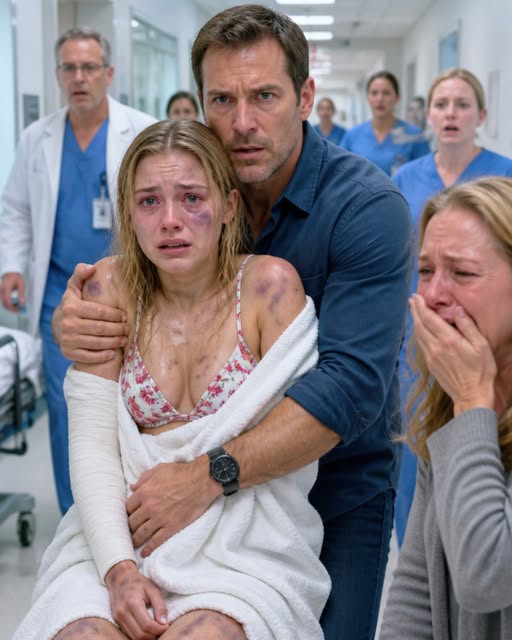
I was seventeen, small enough for them to call me weak, old enough to know the difference between a house and a cage. My stepfather, Thomas Vance, liked to beat me after dinner. Not because I talked back. Not because I failed school. He did it because he enjoyed watching fear change my face.
“Dance, little orphan,” he would say, circling me with a beer in his hand while my mother sat on the couch, scrolling through her phone like I was a loud commercial.
My real father had died when I was nine. He left me two things: his last name and a locked cloud account full of old family videos. At least, that was what everyone thought. Thomas thought Dad had left me nothing useful. Mom thought I was too broken to remember passwords.
They were both wrong.
For years, I learned silence the way other girls learned makeup. I learned which floorboards creaked. I learned where Thomas hid his cash, where Mom kept her forged signatures, and how their voices changed when they were lying. I learned to record without looking like I was recording.
An old phone, cracked at the corner, stayed hidden behind a loose vent in the living room. Another one lived inside a cereal box on top of the fridge. Every slap, every threat, every laugh after pain—saved, uploaded, backed up.
I didn’t use it yet. I was waiting for someone outside that house to look at me and believe what they saw.
That night, Thomas twisted my arm until something snapped. Mom’s face went white for one second, then hard again.
“Bathroom,” she said sharply. “You slipped.”
At the hospital, she smiled at the nurse. “She’s clumsy. Always has been.”
The doctor came in ten minutes later. Dr. Alexander Reed. Calm eyes. Careful hands. He looked at my arm, then at the yellowing bruises near my jaw, the finger marks fading on my neck.
He didn’t ask my mother anything. He looked straight at me and said softly, “Did you fall?”
My mother squeezed my wrist.
I raised my eyes. “No,” I said. “I survived.”
Dr. Reed stepped out. Thirty seconds later, he called 911.
PART 2
My mother’s smile cracked when two police officers entered the room. Thomas had gone outside to smoke, convinced the hospital visit was already under control. He always believed fear was a leash, and he had spent years tightening mine.
“Is this necessary?” Mom snapped. “My daughter is emotional. She makes things up when she wants attention.”
Dr. Reed stood between us. “She has injuries in different stages of healing.”
Mom laughed too quickly. “Teenagers are dramatic.”
I looked at her and said nothing. That scared her more than crying.
An officer named Brooks asked if I wanted to speak privately. Mom lunged forward. “She’s a minor. I’m her mother.”
Brooks didn’t blink. “And right now, you’re part of the investigation.”
They moved me to another room. For the first time in years, a door closed and Thomas was on the other side of it.
Brooks sat beside my bed. “Can you tell me what happened?”
I could have spilled everything like blood. Instead, I gave her the beginning, not the ending. “My stepfather hurts me,” I said. “My mother helps him hide it.”
Brooks’s expression hardened. “Do you have proof?”
I looked down at my broken arm. “More than he thinks.”
When Thomas stormed in twenty minutes later, he was smiling. That was his performance face—the one he used for neighbors, teachers, church volunteers, anyone with a clean shirt and easy trust.
“Sweetheart,” he said, spreading his arms. “You scared us.”
I stared at him. His eyes warned me to obey.
Mom stepped beside him, regaining confidence. “See? She’s confused. She hit puberty and became impossible. We’ve tried everything.”
Thomas sighed at the police like a tired saint. “Kids today. You discipline them, they call it abuse.”
Dr. Reed’s jaw tightened.
Then my phone rang. Not the cheap phone Mom allowed me to have. The old emergency phone hidden in my backpack. Mom’s eyes widened when she saw it.