Part 1: The Funeral Salute
The first thing my father said to me at my grandfather’s funeral was, “Still pretending the Army needs another doctor?”
He did not whisper it.
Arthur Vance never whispered when humiliation could be useful. He said it in the reception room of the Army Navy Country Club, loud enough for retired generals, lobbyists, and defense contractors to hear. My grandfather, General Marcus Vance, had been buried less than an hour earlier.
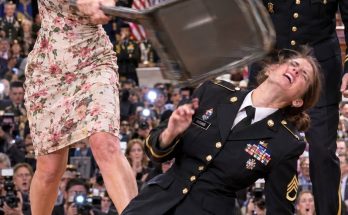
I stood before him in my dress uniform, gloves tucked under one arm, rain drying on my shoulders.
“Hello, Dad,” I said.
He looked over my ribbons and medical corps insignia with the same smile I remembered from childhood.
“The family doctor finally came home,” he said. “Should we all line up for aspirin?”
One contractor chuckled. My younger brother, Julian, laughed openly, as he always did when Dad gave him permission.
Julian lifted his whiskey. “Clari, I didn’t know they let Army doctors leave base for family events.”
“They do for funerals,” I said.
His smile twitched.
Small victories are small, but I had learned not to waste them.
The room looked like every Vance family performance: expensive grief, polished glass, defense money, and people networking beneath chandeliers. My stepmother, Victoria, floated past with appetizers and refused to look at me.
I told myself to leave.
I had come for my grandfather, not for Arthur, Julian, Victoria, or the family machine that turned grief into influence.
Then the room changed.
Conversations softened. Men adjusted jackets. A senator near the bar straightened. Power had entered the room, and everyone who chased it felt the charge.
I turned.
Harrison Reed, Deputy Assistant Secretary of Defense, stood at the entrance with three federal security agents behind him.
My father saw him too.
For the first time all afternoon, Arthur Vance stopped stopped smiling.
Reed scanned the room, passed over my father, my brother, and the contractors, then stopped on me.
He walked straight toward me.
Not toward my father.
Toward me.
When he reached me, he gave a formal salute.
My body returned it before my mind caught up.
“Colonel Vance,” he said. “It’s an honor to see you again.”
Behind me, Julian’s glass froze halfway to his mouth.
Reed lowered his voice, but not enough.
“The men from Kandahar still ask about you.”
The room forgot how to breathe.
My father looked at my uniform again, differently this time, as if the fabric had changed while he was not watching.
Reed shook my hand.
“I came to pay respects to your grandfather,” he said. “He spoke of you near the end.”
That hurt more than any insult, because my grandfather and I had barely spoken in years.
Two minutes later, my father found me near the hallway.
“How do you know Harrison Reed?”
I looked at him, and for once, I did not feel sixteen.
“You meet certain people,” I said, “on the worst day of somebody’s life.”
Then I walked outside into the cold.
I had barely reached the wet stone steps when Reed appeared behind me carrying two paper cups of coffee. He handed me one, then opened his other hand.
In his palm lay my grandfather’s old silver lighter.
“He wanted you to have this,” Reed said.
My fingers went cold before I touched it.
Taped to the bottom was a folded strip of paper with my name on it.
And I understood the funeral had not ended.
It had just begun.
Part 2: The Lighter and the Warning
The lighter was heavier than I remembered.
My grandfather used to flip it open and shut when thinking. Click, pause, click. That sound lived deep in my childhood, beside leather chairs, old books, black coffee, and my father’s voice telling me to stop asking questions at dinner.
“Did he give this to you personally?” I asked.
Reed watched the parking lot.
“Two weeks before he died. He made me promise to put it in your hand, not your father’s.”
My name was written on the folded paper in my grandfather’s handwriting.
Clarissa.