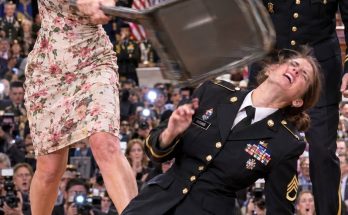
“She wants you dismissed, your benefits reviewed, and your access to federal property revoked.”
“I see.”
“She also threatened to withdraw her forty-million-dollar bid unless I acted immediately.”
“What did you tell her?”
“I told her that threatening a federal command to influence the senior adjudicator auditing her contract was an efficient way to trigger an ethics investigation.”
For months, Celeste had searched for a weapon big enough to destroy me.
At last, she found one.
Then pointed it at herself.
Part 7: The Empire Falls
Whitaker Global Transport’s proposal was suspended that afternoon.
By the next morning, federal auditors opened an inquiry into procurement interference, suspicious payments, and possible misuse of company funds.
I did not make the final decision.
I submitted my evidence, disclosed every family connection, and removed myself from the recommendation panel. Three independent officials reviewed the file.
They reached the same conclusion.
Celeste’s company was an unacceptable security and ethics risk.
The forty-million-dollar proposal was rejected, and the company was blocked from bidding on sensitive contracts while the investigation continued.
Celeste called me seventeen times.
I answered the eighteenth.
“You did this,” she said.
“You contacted a federal general and tried to use a contract as leverage in a personal dispute.”
“You set me up.”
“I asked you repeatedly to leave us alone.”
“You hid who you were.”
“I protected information you had no right to possess.”
“I am your family.”
“No. You are my husband’s mother. You used money to threaten my home and my daughter.”
Her voice broke.
“I will lose everything.”
“You were willing to take everything from Lily and me.”
“That was different.”
“It always is when the suffering belongs to someone else.”
I ended the call.
The collapse was fast. Investors withdrew. Lenders reviewed debts. Warehouse partners demanded advance payment. Insurance costs rose.
Then the Labor Day video reached local news.
Hundreds of thousands of people watched Grant threaten his wife, attack first, and tap three times on the grass.
His gym expelled him.
Bianca disappeared three days later.
Natalie lasted longer, but when the mansion began collapsing around Celeste, she came to my porch with two suitcases.
“I need somewhere to stay.”
“No.”
“You haven’t even heard me.”
“I heard you at my kitchen table. I heard you at my door. I heard you lie to the police.”
“I was under pressure.”
“You were wearing the pressure on three fingers.”
Her diamond rings were gone.
“Celeste took them back,” she whispered.
“That does not change why you accepted them.”
“We’re sisters.”
“We were sisters when you told me to give my frightened daughter to the man threatening her.”
“I made a mistake.”
“A mistake is forgetting a birthday. You helped an abusive man build a custody case.”
She cried in the driveway.
I felt grief.
Not guilt.
Forgiveness was not a key she could demand after helping someone burn down the house.
Part 8: The Gate Stays Closed
Two weeks later, the custody hearing began.
Grant entered the courtroom in a dark suit. Celeste sat behind him, no longer shining in diamonds. Their attorney argued that the Labor Day fight proved I was dangerous.
My attorney played the full video.
Then the police footage.
Then recordings of Grant threatening to break me, take Lily, and destroy my job.
Finally, Lily’s court-appointed advocate read her statement.
“I feel safe with my mother,” Lily had written. “I feel scared when my father gets angry. I do not want money. I want quiet.”
The judge removed his glasses.
The courtroom went still.
For the first time in Grant’s life, someone with more authority than his mother explained that fear was not fatherhood.
I received sole physical custody.
Grant was granted only supervised visitation, counseling requirements, anger-management treatment, and strict limits on contact. Celeste was denied independent visitation.
Outside the courthouse, Grant called after me.
“We were married for seven years.”
“I know.”
“You can’t erase that.”
“I’m not erasing it.”
“Then what are you doing?”
“Learning from it.”
He said he had no one left.
I looked at him calmly.
“You have supervised time with your daughter. Use it to become someone she does not fear.”
“What about us?”
“There is no us.”
“I can change.”
“Then change.”
“You don’t believe me?”
“My belief is no longer required.”
When he said he still loved me, I finally understood.
He had not missed me when I cooked his meals, managed his life, absorbed his insults, and protected Lily from his moods.
He missed me when no one was left to carry the weight of his choices.
“That is not love,” I said. “That is loneliness.”
By November, the Whitaker mansion was in foreclosure.
An unmarked moving truck came on a cold gray morning. Celeste drove away without looking at my house. Grant sat beside her with his hood pulled over his head. Natalie appeared briefly, carrying a garbage bag of clothes, but did not approach.
Nobody celebrated.
There was satisfaction in seeing a threat removed, but no joy in watching people destroy themselves.
Later, Lily sat at the kitchen table beneath the warm yellow lamp.
“Are they gone?” she asked.
“Yes.”
“For good?”
“They cannot come onto our property.”
She thought about that.
“Can we fix the purple tree in spring?”
The wisteria outside had been damaged but not killed. New buds had formed along the old vines.
“We can help it grow back,” I said.
“Will it look the same?”
“No.”
“Is that bad?”
“No. Different does not mean broken.”
Over the next year, our life grew beyond survival.
Henry helped repair the fence. Calvin taught Lily to prune roses. Ruth came to every school performance and clapped louder than anyone.
I did not teach Lily to hate her father.
I taught her that love without safety was not an obligation.
People called my boundaries cold.
Those people had never watched Lily freeze at the sound of an engine. They had never seen her measure rooms by the exits. They did not know how many nights she slept with shoes beside her bed because she thought we might need to run.
Peace was not cruelty.
Peace was something I built with my own hands.
One spring afternoon, Lily and I stood beside the blooming wisteria.
“It’s stronger now,” she said.
“Yes.”
“Because we fixed it?”
“Because the roots survived.”
Our house was still small.
My SUV was still old.
My coffee mug was still chipped.
But no one screamed in our kitchen.
No one punched walls.
No one confused money with authority or fear with love.
Grant had threatened me in front of our daughter because he believed strength belonged to the person who could create the most terror.
Ninety seconds later, he tapped the ground three times.
The months that followed taught him the truth.
Real strength was not forcing someone to their knees.
It was standing up, closing the gate, and never apologizing for protecting the life you rebuilt.