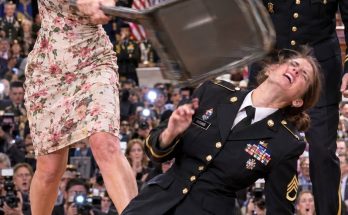
At first, they were awkward. We talked about weather, groceries, Army schedules, and football. We avoided Celeste, the hearing, and the distance between us.
Trust returned slowly.
One dinner.
One phone call.
One ordinary conversation at a time.
As for the forty million dollars, I did not change my personal life. I kept my rental house, my old vehicle, and the simple routine I preferred.
The money was not something I had earned.
It was something I had been entrusted to carry.
Within a year, I created three charitable funds.
The first provided scholarships for children of active-duty service members.
The second supported surviving military spouses with emergency assistance, counseling referrals, transportation, and help navigating paperwork after loss.
The third helped aging veterans with medical transportation, mobility support, home visits, and companionship during long hospital days.
My father attended the first fundraising gala.
He sat in the front row and listened as I spoke about families who had served quietly and needed someone to stand beside them.
Afterward, he found me near the exit.
“Your grandfather would be proud,” he said.
Later, I opened one of my grandfather’s final letters.
If a day ever comes when you must choose between money and character, keep the character. Money eventually finds its way toward the person prepared to carry it properly.
Only then did I fully understand.
The forty million dollars was not my greatest inheritance.
The real inheritance was patience.
Discipline.
Responsibility.
The ability to stay calm when someone tried to rewrite the truth.
And the wisdom to know when silence protects you—and when love requires you to speak.
Part 5: The Inheritance That Lasted
Years later, my father and I drove past the old Miller Street house. Dogwoods were blooming, and children’s bikes rested in the driveway.
“I thought selling it would feel like losing your mother again,” Dad said. “But it didn’t. She wasn’t in the furniture or walls.”
“No,” I said. “She was in what we carried away.”
We did not stop.
By then, the charitable programs had expanded beyond North Carolina. Scholarships helped students finish school. Veterans received rides to medical appointments. Surviving spouses found people who understood that grief did not follow administrative deadlines.
At one event, a young woman told me the scholarship had allowed her to finish nursing school without burying her mother in debt.
“I don’t know who gave the original money,” she said, “but I hope they understood what it became.”
I thought of my grandfather.
“I believe he would understand,” I said.
I never spoke to Celeste again.
For a while, I imagined what I might say if we crossed paths. Over time, I stopped rehearsing. Some people do not need a final speech. The truth was already in the court record. My father knew it. The people who mattered knew it.
Walter Crane retired several years later and gave me the original leather folder containing the trust documents.
“You should keep this,” he said. “I’ve carried it long enough.”
I placed it back in the same kitchen drawer where I had hidden it years before, beside utility bills and spare keys.
The ordinariness made me smile.
Forty million dollars had exposed greed, motive, loneliness, pride, and love. But the money itself had never made a decision.
People had done that.
Celeste saw access.
Preston saw opportunity.
My father saw the damage too late.
My grandfather saw responsibility.
Eventually, so did I.
An inheritance is not only a house, an account, or land passed down after someone dies. Sometimes the greatest inheritance is a habit, a warning, a standard, or a chance to make a better choice than the generation before you.
My grandfather left me forty million dollars.
More importantly, he taught me not to become the kind of person who believed forty million dollars made me more valuable than I had been without it.
My father and I rebuilt our relationship the only way trust can truly return.
Dinner by dinner.
Phone call by phone call.
Year by year.
And when I now stand at those annual events in my dress blues, with families gathered beneath the American flag, I do not think first about the lawsuit or the woman who arrived on my porch with an attorney.
I think about my grandfather on his porch, holding iced tea while cicadas hummed in the trees.
I think about the trust he placed in me long before the documents became necessary.
Then I look at what his gift has become, and I understand the real measure of an inheritance.
It is not how much money enters your name.
It is what remains of your character after the money arrives.